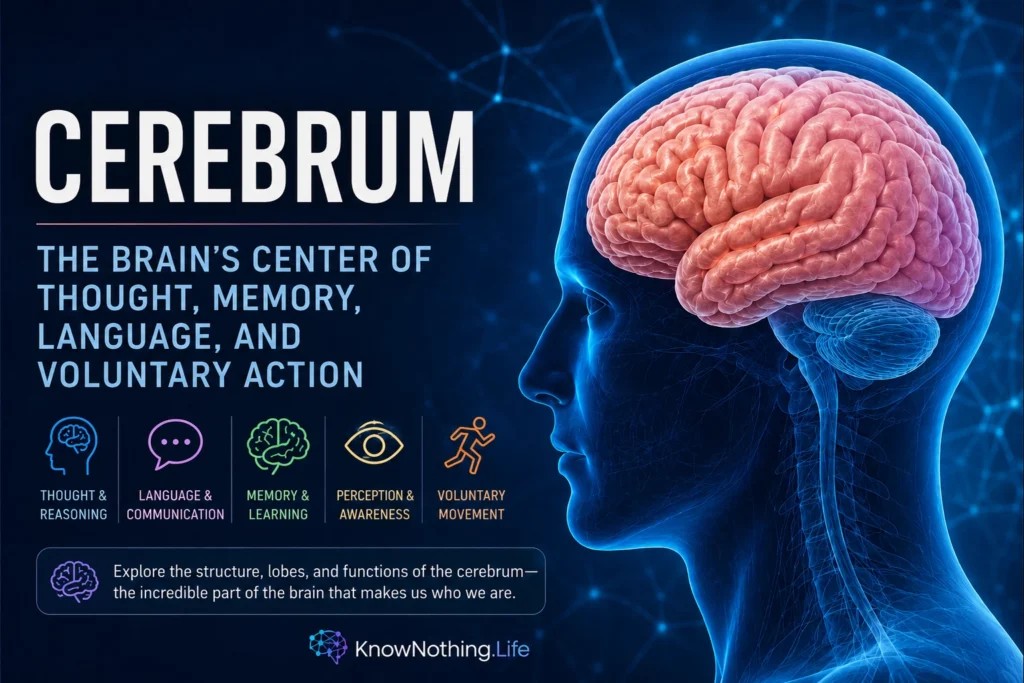
The cerebrum is the largest and most visibly distinctive part of the human brain, forming the two great hemispheres that sit above the brainstem and cerebellum. When people casually refer to “the brain,” they are often picturing the cerebrum: the folded, walnut-like surface of the cerebral cortex, divided into left and right halves by the longitudinal fissure. Yet the cerebrum is more than its outer surface. It includes the cerebral cortex, underlying white matter, deep gray-matter structures, and limbic regions that help support perception, voluntary movement, language, emotion, memory, planning, and conscious experience. The cerebral hemispheres are commonly described through major lobes, including the frontal, parietal, temporal, occipital, and limbic lobes, each associated with distinct but overlapping functions.
The cerebrum is not a single “thinking organ” in the simple sense. It is a layered, networked system in which specialized regions cooperate constantly. A person reading a sentence, for example, is not using only a “reading center.” Vision, attention, memory, eye movement, language comprehension, emotional tone, prediction, and meaning all interact across cerebral networks. This is one reason modern neuroscience has moved beyond rigid localization, even while preserving the insight that certain areas are especially important for certain functions. The cerebrum is best understood as both local and global: local enough that damage to one region can produce a specific deficit, but global enough that complex mental life depends on communication among many regions.
Structure of the Cerebral Cortex
The most famous part of the cerebrum is the cerebral cortex, a thin sheet of gray matter folded into gyri and sulci. These folds increase surface area, allowing more cortical tissue to fit inside the skull. The cortex is often called the seat of higher cognition, but it also handles basic sensory and motor functions. The frontal lobe is strongly involved in voluntary movement, planning, attention, personality, and executive control; the parietal lobe integrates bodily sensation and spatial awareness; the temporal lobe supports hearing, language, object recognition, and memory; and the occipital lobe is central to visual processing.
The cortex is also organized microscopically. In 1909, German neuroanatomist Korbinian Brodmann published his landmark work on the cytoarchitecture of the cerebral cortex, dividing it into numbered areas based on differences in cellular organization. Later neuroscience has revised, expanded, and complicated Brodmann’s map, but it remains one of the most influential frameworks in brain science. Research by Katrin Amunts and colleagues has emphasized that Brodmann’s original map was a foundation rather than a final answer: cortical architecture is more heterogeneous than early maps suggested, and modern mapping uses multiple scales of analysis, from cellular structure to functional connectivity.
The Lobes of the Cerebrum
The frontal lobes are often associated with what feels most personal about the mind: decision-making, impulse control, planning, speech production, moral judgment, and personality. The famous case of Phineas Gage, reported by physician John Martyn Harlow in the nineteenth century, helped make frontal-lobe injury central to the history of neuroscience. Gage survived a severe injury in which an iron rod passed through his skull, damaging frontal regions. Later accounts of his personality change were sometimes exaggerated, but the case remains important because it helped show that frontal damage could alter emotion, behavior, and social judgment. A modern review describes Gage’s case as early scientific evidence that frontal-lobe damage may affect personality, emotions, and social behavior.
The parietal, temporal, and occipital lobes reveal the cerebrum’s role as an interpreter of the world. The parietal lobe helps build a map of the body and its location in space. The temporal lobe contributes to hearing, memory, language, and recognition. The occipital lobe receives and processes visual information, but vision is not a passive recording of the outside world. The classic 1962 work of David Hubel and Torsten Wiesel on the visual cortex showed that neurons respond to specific visual features, helping establish the idea that the cortex analyzes patterns through organized functional architecture. Their research at Harvard became one of the most influential bodies of work in neuroscience, and Hubel shared the 1981 Nobel Prize in Physiology or Medicine for discoveries concerning information processing in the visual system.
Language, Memory, and Meaning
Language is one of the clearest examples of cerebral specialization. In 1861, French physician Paul Broca studied Louis Victor Leborgne, a patient who could understand language but had lost most of his ability to speak. After Leborgne’s death, Broca connected the patient’s speech impairment with damage in the left frontal region, helping establish the principle that some mental functions depend heavily on particular brain areas. Later, Carl Wernicke identified a different language disorder involving impaired comprehension, associated historically with posterior temporal regions. Modern neuroscience has shown that language is not confined to two isolated “centers,” but Broca’s and Wernicke’s work remain foundational in the study of aphasia and cerebral localization.
Memory also depends on cerebral networks rather than a single storage site. One of the most important studies in memory science was the 1957 report by William Scoville and Brenda Milner on patient H.M., who developed profound difficulty forming new long-term memories after bilateral medial temporal-lobe surgery involving the hippocampal region. This case changed neuroscience by showing that memory is not one unified faculty. Short-term memory, long-term declarative memory, procedural learning, and emotional memory can be partly dissociated. The cerebrum therefore does not store memory like files in a cabinet. It reconstructs memory through systems involving the hippocampus, temporal cortex, prefrontal cortex, and wider association networks.
Hemispheres and Communication
The cerebrum is divided into left and right hemispheres, connected mainly by the corpus callosum. Popular culture often exaggerates this division into simplistic claims about “left-brained” logical people and “right-brained” creative people. The real science is more interesting. Many language functions are left-lateralized in most right-handed people, while some spatial and attentional functions rely more heavily on right-hemisphere systems. Yet both hemispheres participate in most complex tasks. Speaking, drawing, solving problems, reading emotions, and making decisions all require coordination across many regions.
Roger Sperry’s split-brain research helped reveal what happens when communication between the hemispheres is surgically disrupted. Studying patients whose corpus callosum had been severed to treat severe epilepsy, Sperry found that the hemispheres could process information with surprising independence. In his Nobel lecture, he described each disconnected hemisphere as having its own “cognitive domain” with separate perceptual, learning, and memory experiences. The lesson is not that humans have two unrelated minds, but that unified consciousness depends on integration. The cerebrum’s power comes not only from specialization, but from communication among specialized systems.
Why the Cerebrum Matters
The cerebrum matters because it is where biology becomes biography. It allows a person to recognize a face, remember a childhood home, speak a sentence, imagine the future, restrain an impulse, feel embarrassed, learn a skill, grieve a loss, and revise a belief. It is the organ of voluntary action and reflective life, but it is not separate from the body. Sensation, movement, emotion, hormones, sleep, pain, and social experience constantly shape cerebral activity. This is why brain science has become central not only to medicine, but also to psychology, education, philosophy, artificial intelligence, and ethics.
At the same time, the cerebrum should not be treated as a mystical command center floating above the rest of the nervous system. It works with the brainstem, cerebellum, spinal cord, endocrine system, immune system, and body. Its achievements emerge from billions of neurons and trillions of synaptic connections, but also from development, culture, language, learning, and environment. The cerebrum is where the physical structure of the brain meets the lived structure of human experience. To study it is to study the machinery of perception and action, but also the biological foundation of memory, imagination, personality, and selfhood.