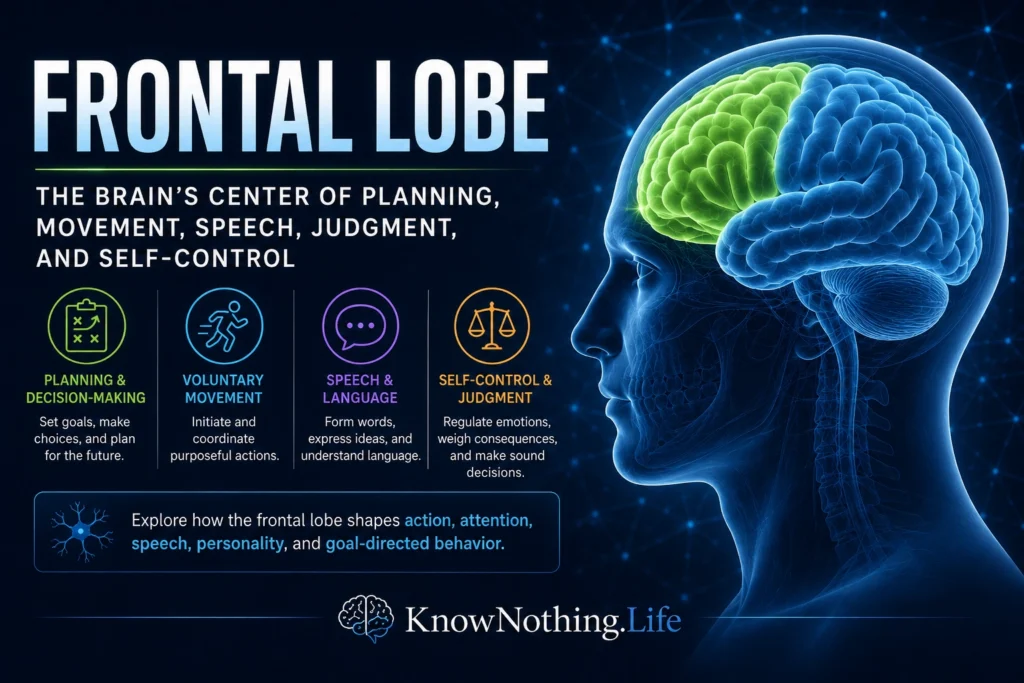
The frontal lobe is the large forward region of the cerebral cortex, located behind the forehead and in front of the parietal lobe. It is one of the most important areas of the brain for voluntary movement, attention, planning, language production, decision-making, impulse control, motivation, personality, and social behavior. Anatomically, the frontal lobe includes the primary motor cortex, premotor cortex, supplementary motor area, frontal eye fields, Broca’s area in the dominant hemisphere, and the broad prefrontal cortex. StatPearls describes the prefrontal cortex as a higher-order association center involved in decision-making, reasoning, personality expression, social appropriateness, and complex cognitive behavior.
The frontal lobe is often associated with what people casually call “executive function,” but this phrase can make it sound like a single mental control room. In reality, frontal-lobe functions are distributed across many specialized but connected systems. Some regions help initiate body movement, while others support speech, working memory, inhibition, emotional regulation, and goal-directed behavior. The frontal lobe does not act alone; it works with the parietal lobe, temporal lobe, limbic system, basal ganglia, thalamus, cerebellum, and brainstem. Its importance comes from its role in organizing action across time: turning perception, memory, emotion, and intention into behavior.
Anatomy and Major Regions
The rear portion of the frontal lobe contains the precentral gyrus, which houses the primary motor cortex, also known as Brodmann area 4. This region helps control voluntary movements of specific body parts, with different areas of the motor cortex corresponding to different regions of the body. Just in front of it are premotor and supplementary motor areas that help prepare, sequence, and coordinate movement. These motor regions show that the frontal lobe is not only about abstract thought. It is also the part of the cortex that helps translate intention into physical action.
The front portion of the frontal lobe is the prefrontal cortex, a large and complex area especially associated with planning, decision-making, working memory, emotional regulation, and behavioral control. The prefrontal cortex is commonly divided into regions such as the dorsolateral prefrontal cortex, orbitofrontal cortex, ventromedial prefrontal cortex, and anterior cingulate-related medial regions. These areas contribute to different dimensions of self-regulation. For example, the dorsolateral prefrontal cortex is often linked with working memory and problem-solving, while orbitofrontal and ventromedial regions are important for evaluating reward, punishment, emotion, and social consequences.
Movement, Action, and Motor Control
The frontal lobe is essential for voluntary movement. When a person reaches for a cup, writes a sentence, kicks a ball, smiles on purpose, or raises a hand, frontal motor regions help initiate and guide the action. The primary motor cortex sends signals through descending motor pathways, including the corticospinal tract for limb and trunk movement and the corticobulbar tract for many face and head movements. The premotor cortex and supplementary motor area help organize actions before they happen, especially learned sequences, coordinated gestures, and movements guided by external cues or internal plans.
This motor role connects the frontal lobe directly to daily life. Movement is not simply a muscular event; it is a planned, timed, goal-directed act. Picking up a glass requires the brain to select an object, estimate distance, shape the hand, control force, and adjust movement based on feedback. The frontal lobe helps organize this process in cooperation with the parietal lobe, cerebellum, basal ganglia, and sensory systems. Damage to frontal motor regions may cause weakness, impaired voluntary control, difficulty initiating movement, or problems sequencing skilled action even when the muscles themselves are intact.
Executive Function and Goal-Directed Behavior
The prefrontal cortex is especially important for executive function, the set of mental abilities that allow people to plan, focus attention, remember goals, resist impulses, shift strategies, and organize behavior over time. In a famous 2001 paper, Earl Miller and Jonathan Cohen proposed that cognitive control depends on the active maintenance of goal-relevant patterns of activity in the prefrontal cortex, allowing thought and action to be guided by internal goals rather than immediate stimuli alone. This is one reason the frontal lobe matters so much for human flexibility: it helps people act according to plans, rules, values, and future consequences.
Joaquín Fuster also emphasized the frontal lobe’s role in the temporal organization of behavior. His work argued that the lateral prefrontal cortex helps organize goal-directed actions across time in behavior, cognition, and language. This means the frontal lobe is not merely a place for “thinking”; it is a system for connecting past experience, present context, and future intention. A person studying for an exam, saving money, apologizing after an argument, or resisting a bad habit is relying on frontal-lobe networks that help hold future outcomes in mind long enough to shape present behavior.
Working Memory, Attention, and Mental Control
Working memory is one of the frontal lobe’s best-studied cognitive functions. It allows the mind to hold and manipulate information temporarily, such as remembering a phone number long enough to type it, following a multi-step instruction, comparing two options, or keeping track of what one is saying during conversation. Patricia Goldman-Rakic’s research helped establish the importance of the dorsolateral prefrontal cortex in working memory, especially the ability to represent information that is no longer present in the environment. Later reviews describe prefrontal working memory as a distributed process involving sustained activity in cortical networks rather than a simple storage box.
Attention also depends heavily on frontal systems. The frontal lobe helps choose what matters, suppress distractions, switch tasks, and maintain focus when a goal is difficult. This is why frontal-lobe dysfunction can produce problems that look like poor discipline but are actually failures of regulation: impulsive decisions, distractibility, poor planning, emotional outbursts, or difficulty completing tasks. The frontal lobe gives the mind a form of internal steering. It does not eliminate emotion or instinct, but it helps organize them into behavior that fits the situation.
Language and Speech Production
The frontal lobe is central to speech production, especially in the dominant hemisphere, which is usually the left hemisphere for most right-handed people. Broca’s area, traditionally associated with the left inferior frontal gyrus, became famous after the nineteenth-century work of French physician Paul Broca. Broca studied patients who had severe difficulty producing speech despite relatively preserved comprehension, and his work helped establish that language functions could be linked to specific brain regions. Modern research has complicated the older picture, showing that speech production depends on broader frontal, temporal, parietal, and subcortical networks.
Even so, Broca’s work remains one of the landmarks in neuroscience because it showed that the frontal lobe participates in turning thought into spoken language. Speech is not merely the selection of words; it requires planning sequences of sounds, coordinating the mouth and tongue, controlling grammar, monitoring errors, and adjusting expression to social context. The frontal lobe helps organize these expressive aspects of language. When frontal language networks are damaged, a person may know what they want to say but struggle to produce fluent, grammatical, effort-free speech.
Personality, Emotion, and Social Judgment
The frontal lobe is also deeply involved in personality and social behavior. The famous case of Phineas Gage remains one of the most discussed examples. In 1848, Gage survived an accident in which an iron tamping rod passed through his skull, damaging frontal regions. Later reports of his personality change have sometimes been exaggerated, but the case remains historically important because it helped show that frontal-lobe damage could alter emotion, judgment, and social behavior. A modern review describes Gage’s case as early scientific evidence that frontal-lobe damage may affect personality, emotions, and social interaction.
The reason frontal damage can change behavior so dramatically is that the frontal lobe helps regulate impulse, reward, punishment, empathy, and future consequence. Orbitofrontal damage, for example, is associated with poor impulse control, excessive risk-taking, unstable mood, and socially inappropriate behavior. These symptoms reveal what the frontal lobe normally contributes: not just intelligence, but judgment. A person may still perceive the world and remember facts, yet lose the ability to use that knowledge wisely in real situations. In this sense, the frontal lobe helps transform knowledge into conduct.
Why the Frontal Lobe Matters
The frontal lobe matters because it helps make human behavior flexible, deliberate, and socially meaningful. It allows people to pause before acting, imagine outcomes, follow rules, change strategies, express thoughts in language, and coordinate movement with intention. It is central to school, work, relationships, morality, creativity, and self-control. When the frontal lobe works well, it often works quietly. People simply feel capable of planning, speaking, focusing, choosing, and acting. When it is injured or impaired, the loss can affect nearly every part of daily life.
At the same time, the frontal lobe should not be treated as the “personality center” in a simplistic way. Human identity emerges from the whole brain and body, including memory, emotion, sensation, language, culture, and experience. The frontal lobe is powerful because it integrates many of these systems into organized behavior. It helps the brain ask not only “What is happening?” but “What should I do next?” To understand the frontal lobe is to understand one of the brain’s most important bridges between thought and action, impulse and restraint, personality and responsibility.