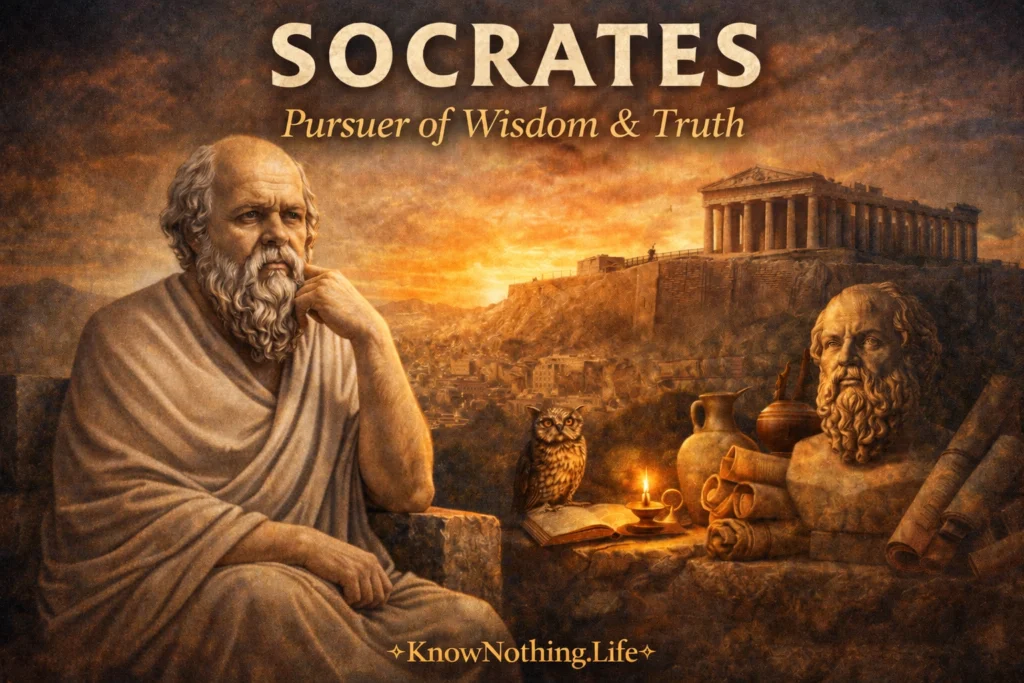
The life of Socrates stands at the foundation of Western philosophy, yet it is marked by a paradox: one of history’s most influential thinkers left behind no written works of his own. What we know about him comes primarily through the accounts of his students and contemporaries—most notably Plato and Xenophon—as well as the satirical portrayal by Aristophanes. Through these fragmented yet powerful sources, Socrates emerges not as a distant academic figure, but as a relentless questioner who transformed philosophy from abstract speculation into a living, breathing inquiry into human existence.
Born in Athens around 470 BCE, Socrates lived during a time of political upheaval, intellectual flourishing, and cultural transformation. Rather than aligning himself with the natural philosophers who sought to explain the cosmos, he turned his attention inward—toward ethics, knowledge, and the examined life. His method of inquiry, grounded in dialogue and questioning, reshaped how truth itself could be approached. To understand Socrates is not simply to learn about a man, but to encounter a way of thinking that continues to challenge assumptions thousands of years later.
Early Life and Historical Context
Socrates was born to Sophroniscus, a stonemason, and Phaenarete, a midwife—professions that later became symbolic in his philosophical identity. He often compared his method to midwifery, claiming that he helped others “give birth” to their own understanding. Unlike many intellectuals of his time, he did not establish a formal school or charge fees for instruction, setting him apart from the Sophists who dominated the intellectual marketplace of Athens.
The Athens of Socrates’ lifetime was both vibrant and volatile. The city had reached remarkable cultural heights during the age of Pericles, yet it was also embroiled in the Peloponnesian War, which brought political instability and social unrest. These conditions shaped Socrates’ philosophical mission. He became deeply concerned with the moral character of individuals and the integrity of public life, believing that the health of the state depended on the virtue of its citizens.
Despite his reputation for wisdom, Socrates claimed ignorance as his defining trait. This stance, often summarized in the phrase “I know that I know nothing,” reflects a deeper epistemological humility. It was not a rejection of knowledge, but a recognition of its limits—a starting point for genuine inquiry.
The Socratic Method and Philosophy
At the heart of Socrates’ legacy lies the Socratic Method, a form of cooperative dialogue that exposes contradictions in a person’s beliefs through systematic questioning. Rather than lecturing, Socrates engaged others in conversations that forced them to examine their assumptions. This approach often left his interlocutors intellectually unsettled, yet it also opened the door to clearer, more refined understanding.
His philosophical concerns centered on ethical questions: What is justice? What is virtue? Can these qualities be taught? In dialogues such as those recorded in Apology and Euthyphro, Socrates dismantles confident definitions offered by others, revealing how little they truly understand about concepts they claim to know. This process was not merely argumentative; it was transformative. Socrates believed that self-knowledge was essential for living a good life.
One of his most enduring ideas is captured in the statement: “The unexamined life is not worth living.” This declaration, recorded in Plato’s Apology, encapsulates his commitment to introspection and moral responsibility. For Socrates, philosophy was not an abstract discipline—it was a way of life grounded in continuous questioning and ethical awareness.
Works and Sources
Socrates wrote nothing himself, which makes his “works” unique in the history of philosophy. Instead, his ideas are preserved through secondary sources, each offering a different perspective on his character and teachings. The most influential accounts come from Plato, whose dialogues serve as the primary vehicle for Socratic philosophy.
In Plato’s Apology, Socrates defends himself against charges of impiety and corrupting the youth of Athens. The text presents a powerful portrait of intellectual courage, as Socrates refuses to abandon his philosophical mission even in the face of death. In Crito, he debates whether it is just to escape from prison, ultimately choosing to respect the laws of Athens. Finally, in Phaedo, Socrates discusses the immortality of the soul on the day of his execution, offering a serene and profound meditation on death.
Xenophon’s writings, including Memorabilia and Apology, portray Socrates in a more practical and less abstract light, emphasizing his moral teachings and everyday wisdom. Meanwhile, Aristophanes’ play The Clouds presents a comedic and critical caricature, depicting Socrates as a sophist and eccentric thinker suspended in a “thinkery.” Together, these sources form a composite image—one that is complex, sometimes contradictory, but undeniably influential.
Trial and Death
The final chapter of Socrates’ life is as significant as his philosophy. In 399 BCE, he was brought to trial in Athens, accused of impiety and corrupting the youth. These charges reflected deeper tensions within Athenian society, particularly in the aftermath of political turmoil and the restoration of democracy following oligarchic rule.
During the trial, as recorded in Plato’s Apology, Socrates delivers a defense that is both defiant and principled. He challenges his accusers, questions the nature of wisdom, and ultimately refuses to conform to expectations of submission. Rather than pleading for mercy, he asserts that his actions have benefited Athens by encouraging critical thought and moral reflection.
His refusal to compromise led to a guilty verdict and a death sentence. In a final act of philosophical consistency, Socrates declined opportunities to escape, choosing instead to accept the judgment of the court. He was executed by drinking hemlock, a method reserved for condemned citizens. His death became a symbol of intellectual integrity and the cost of truth.
One of his attributed reflections on death captures this perspective: “Death may be the greatest of all human blessings.” This statement reflects not resignation, but a philosophical acceptance rooted in the belief that the soul transcends the body.
Philosophy and Legacy
The influence of Socrates extends far beyond his lifetime, shaping the course of Western thought through his students and their intellectual descendants. Plato developed his teacher’s ideas into a comprehensive philosophical system, while Aristotle—Plato’s student—further expanded and systematized philosophical inquiry. Through this lineage, Socratic thought became embedded in disciplines ranging from ethics and politics to logic and metaphysics.
Socrates’ emphasis on questioning laid the groundwork for critical thinking as a cornerstone of intellectual life. His method is still used in modern education, particularly in law and philosophy, where dialogue and debate are essential tools for uncovering truth. Beyond academia, his ideas resonate in everyday life, encouraging individuals to reflect on their beliefs and values.
Perhaps most importantly, Socrates redefined wisdom not as the accumulation of knowledge, but as the recognition of one’s own ignorance. This perspective fosters humility, curiosity, and openness—qualities that remain vital in an increasingly complex world. His life demonstrates that philosophy is not confined to books or institutions; it is an active pursuit of understanding that requires courage and honesty.
Quotes and Key Ideas
Socrates’ words, preserved through the writings of others, continue to inspire and provoke thought. Among his most famous quotes:
- “The unexamined life is not worth living.”
- “I know that I know nothing.”
- “To find yourself, think for yourself.”
- “Wisdom begins in wonder.”
Each of these statements reflects a core aspect of his philosophy: self-examination, intellectual humility, independence of thought, and curiosity. They are not merely aphorisms, but guiding principles for a life of inquiry.
These ideas challenge individuals to move beyond passive acceptance and engage actively with the world. In doing so, they carry forward the spirit of Socratic philosophy—a spirit that refuses easy answers and embraces the complexity of truth.
Conclusion
Socrates remains one of the most enigmatic and influential figures in intellectual history. Without writing a single book, he transformed philosophy into a dynamic process of questioning and dialogue. His life, marked by humility, courage, and unwavering commitment to truth, continues to serve as a model for thinkers across generations.
In a world often driven by certainty and quick conclusions, the legacy of Socrates offers a powerful counterpoint. To “know nothing” is not to be ignorant, but to remain open—to question, to explore, and to seek understanding without arrogance. It is this mindset that defines not only Socratic philosophy, but the very essence of intellectual growth.