To “know nothing” is often dismissed as a confession of ignorance, a failure of intellect, or a lack of education. Yet across centuries of philosophical thought and modern psychological research, this phrase reveals something far more profound. It can signify not the absence of knowledge, but a deeper awareness of the limits of certainty. In this sense, “knowing nothing” becomes an intellectual stance—one that challenges assumptions, dismantles ego, and opens the mind to continuous discovery.
Rather than treating knowledge as a static possession, this perspective reframes it as a dynamic process. What we call “knowing” is often provisional, shaped by perception, bias, and incomplete information. To recognize that one “knows nothing” is not to deny reality, but to approach it with humility. It is a deliberate rejection of false certainty in favor of curiosity and openness. This paradox has captivated thinkers from ancient Greece to modern cognitive science, making it one of the most enduring and transformative ideas in human thought.
The Socratic Foundation: Wisdom Through Ignorance
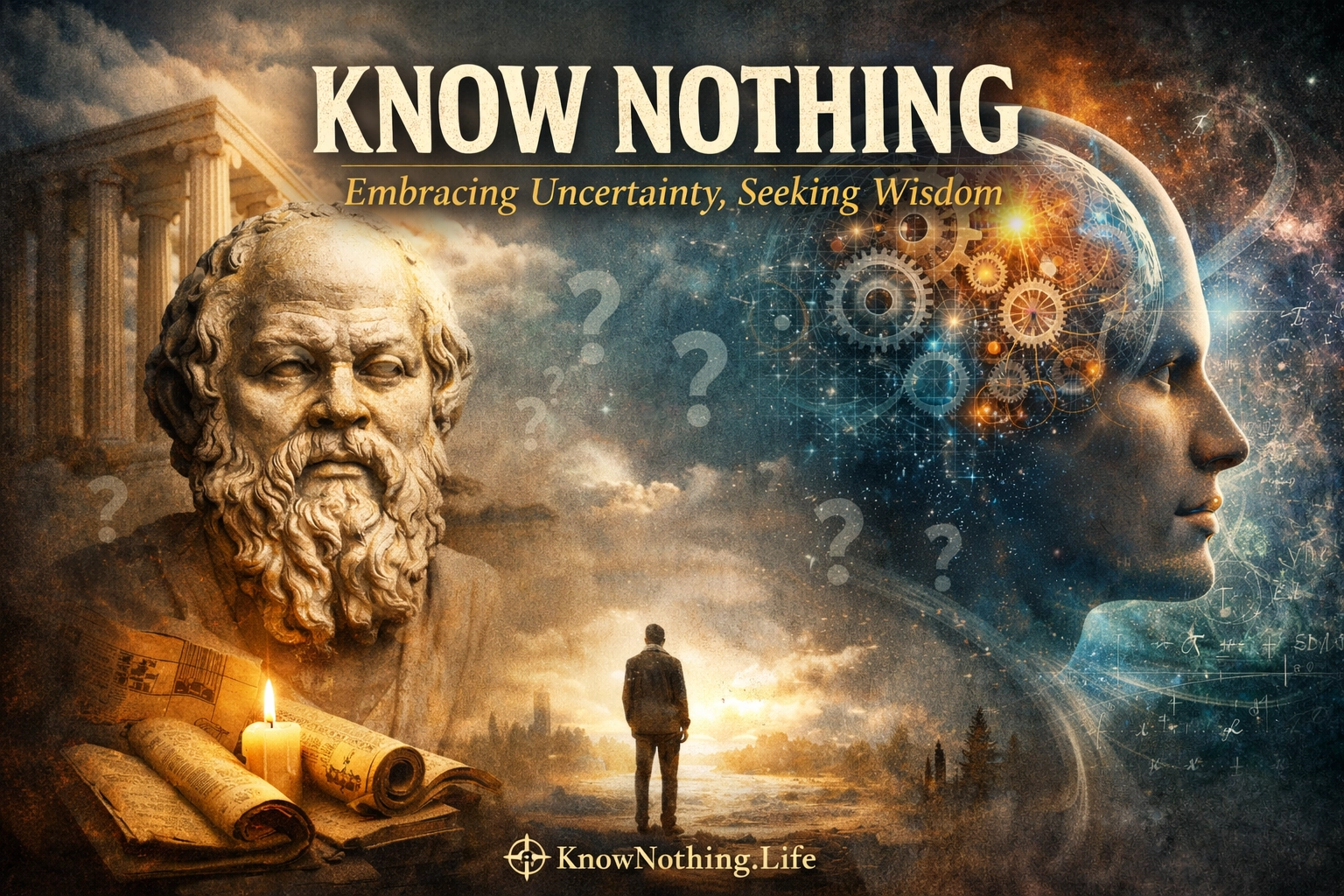
The philosophical roots of “knowing nothing” are most famously associated with Socrates, who is often credited with the statement: “I know that I know nothing.” While the exact phrasing is debated, the idea appears in the dialogues of Plato, where Socrates demonstrates that true wisdom lies in recognizing one’s ignorance. Unlike those who claimed certainty, Socrates questioned everything—beliefs, definitions, and even the nature of knowledge itself.
This approach, now known as the Socratic method, involves asking probing questions to expose contradictions and assumptions. By doing so, Socrates revealed that many people who believed they possessed knowledge were merely operating on unexamined beliefs. His form of “knowing nothing” was not passive ignorance, but active inquiry. It required intellectual courage—the willingness to admit uncertainty in a culture that often rewards confidence over truth.
Philosophically, this idea dismantles the illusion of absolute knowledge. If every claim can be questioned, then certainty becomes fragile. Yet rather than leading to nihilism, Socratic ignorance creates a foundation for genuine learning. It invites individuals to remain in a state of inquiry, where understanding is always evolving rather than fixed.
Eastern Philosophy: Emptiness and Beginner’s Mind
While Western philosophy often frames “knowing nothing” as a logical or epistemological stance, Eastern traditions approach it as a state of being. In Zen Buddhism, the concept of shoshin, or “beginner’s mind,” emphasizes openness, eagerness, and lack of preconceptions. The idea is simple yet radical: the more one believes they know, the less they are able to truly see.
Zen teachings encourage practitioners to empty the mind of rigid frameworks. This is not about erasing knowledge, but about loosening attachment to it. When the mind is cluttered with assumptions, it filters reality through expectation. By contrast, a mind that “knows nothing” perceives things as they are, not as they are believed to be.
A famous Zen saying captures this idea: “In the beginner’s mind there are many possibilities, but in the expert’s there are few.” This perspective aligns closely with the Socratic tradition, yet it places greater emphasis on experience over analysis. Rather than questioning through dialogue, Zen encourages direct awareness—seeing without conceptual interference. In both traditions, however, the underlying principle remains the same: certainty can be a barrier to understanding.
Modern Philosophy: Uncertainty and the Limits of Knowledge
The theme of “knowing nothing” continues in modern philosophy, particularly in the works of thinkers who challenged the reliability of perception and reason. René Descartes famously doubted everything he could, including the evidence of his own senses. His method of radical doubt sought to strip away false beliefs in order to find something unquestionably true. While he ultimately arrived at “I think, therefore I am,” the process itself reflects the importance of questioning assumed knowledge.
Later philosophers expanded on this uncertainty. Immanuel Kant argued that humans do not perceive reality directly, but through mental structures that shape experience. This means that what we “know” is always filtered, never purely objective. Similarly, Friedrich Nietzsche challenged the idea of absolute truth altogether, suggesting that knowledge is often a construct shaped by perspective and power.
These ideas reinforce the notion that “knowing nothing” is not a deficiency, but a recognition of epistemic limits. If perception is subjective and truth is complex, then certainty becomes suspect. The most intellectually honest position may be one of informed uncertainty—acknowledging that knowledge is always partial, provisional, and open to revision.
Psychological Perspective: The Illusion of Knowledge
Modern psychology provides empirical support for the philosophical claim that humans often overestimate what they know. One well-documented phenomenon is the illusion of explanatory depth, where individuals believe they understand complex systems—such as how a zipper works or how policies function—until they are asked to explain them in detail. This gap between perceived and actual understanding highlights how fragile “knowledge” can be.
Another relevant concept is the Dunning-Kruger effect, where individuals with low expertise tend to overestimate their competence, while those with higher expertise are more aware of their limitations. This creates a paradox: the more one truly knows, the more one recognizes how much remains unknown. In this sense, “knowing nothing” becomes a marker of intellectual maturity rather than ignorance.
Cognitive biases further complicate the picture. Confirmation bias, for instance, leads individuals to favor information that supports existing beliefs, reinforcing a false sense of certainty. By contrast, adopting a “know nothing” mindset can counteract these biases. It encourages skepticism, curiosity, and a willingness to revise beliefs in light of new evidence. Psychologically, this mindset is associated with greater cognitive flexibility and openness to experience—traits linked to both intelligence and emotional resilience.
Existential Implications: Identity and Meaning
Beyond knowledge itself, the idea of “knowing nothing” has profound implications for identity and meaning. If one relinquishes certainty, what remains as a foundation for understanding the self? Existential philosophers grappled with this question, often concluding that meaning is not discovered but created.
Jean-Paul Sartre argued that humans are “condemned to be free,” meaning that in the absence of inherent meaning, individuals must define themselves through choices. This perspective aligns with the idea of “knowing nothing” as a starting point rather than an endpoint. Without predetermined truths, the individual becomes responsible for constructing meaning.
Similarly, Albert Camus explored the tension between the human desire for certainty and the indifferent nature of the universe. In confronting this “absurdity,” Camus did not advocate despair, but defiance. To accept that one “knows nothing” about ultimate meaning is to gain the freedom to live authentically, without illusion.
This existential dimension transforms the concept from an intellectual stance into a way of life. It invites individuals to embrace uncertainty not as a threat, but as an opportunity—an open field in which meaning can be continuously redefined.
Practical Application: Living with a “Know Nothing” Mindset
Adopting a “know nothing” mindset has practical implications that extend beyond philosophy and psychology. In everyday life, it encourages active listening, critical thinking, and intellectual humility. Instead of approaching conversations with the goal of being right, one approaches them with the goal of understanding. This shift can lead to deeper relationships and more productive dialogue.
In learning environments, this mindset fosters curiosity. When individuals believe they already know, they are less likely to explore. By contrast, recognizing gaps in knowledge creates motivation to learn. This is particularly relevant in rapidly changing fields, where adaptability is more valuable than static expertise. The willingness to question and update beliefs becomes a key advantage.
Professionally, embracing uncertainty can improve decision-making. Overconfidence often leads to errors, while humility encourages the consideration of alternative perspectives. Leaders who acknowledge what they do not know are more likely to seek input, adapt to new information, and make informed choices. In this way, “knowing nothing” becomes not a weakness, but a strategic strength.
Conclusion: The Power of Not Knowing
To “know nothing” is not to exist in ignorance, but to exist in awareness—an awareness of limits, biases, and the ever-changing nature of understanding. From Socrates’s relentless questioning to modern psychology’s insights into cognitive bias, the message is consistent: certainty can be deceptive, and humility is a gateway to deeper knowledge.
This perspective challenges conventional notions of intelligence. Rather than equating knowledge with accumulation, it reframes it as a process of continual refinement. The individual who “knows nothing” is not empty, but open—ready to question, to learn, and to grow. In a world saturated with information and opinion, this mindset offers clarity.
Ultimately, the power of “knowing nothing” lies in its paradox. By relinquishing the illusion of certainty, one gains access to a richer, more nuanced understanding of reality. It is not the end of knowledge, but its beginning—a foundation upon which genuine insight can be built.