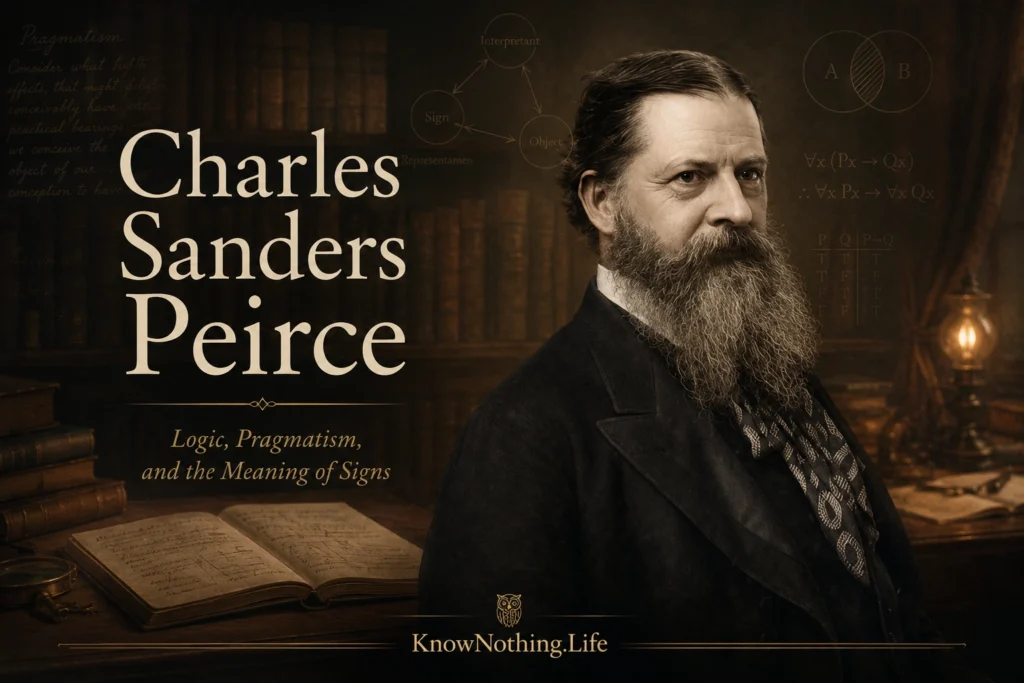
Charles Sanders Peirce was born on September 10, 1839, in Cambridge, Massachusetts, into one of the most intellectually distinguished families in nineteenth-century America. His father, Benjamin Peirce, was a celebrated Harvard mathematician and astronomer, and the young Peirce grew up surrounded by mathematics, science, experiment, and argument. Unlike many philosophers whose thought began in literary or theological education, Peirce was formed by laboratory habits, measurement, exact reasoning, and the discipline of scientific error correction.
Peirce studied at Harvard, receiving his undergraduate degree in 1859 and later training in chemistry at the Lawrence Scientific School. This scientific background shaped everything he wrote. He did not treat logic as an abstract game or philosophy as a private meditation. For Peirce, thinking was a form of inquiry, and inquiry was a public, fallible, self-correcting process directed toward truth. His later philosophy of pragmatism, signs, and scientific method grew from the conviction that ideas must be tested by their consequences and clarified through disciplined investigation.
The Coast Survey and a Life of Work
For much of his adult life, Peirce worked for the United States Coast Survey, one of the leading scientific institutions in America. His work involved geodesy, astronomy, pendulum experiments, gravitation, measurement, and mathematical calculation. He traveled, observed, compared instruments, and published technical scientific reports. This was not a side episode in his life. It was the practical foundation of his philosophy. Peirce knew science not as a romantic ideal, but as a demanding collective labor of error, correction, inference, and approximation.
Yet his professional life was troubled. Peirce never secured the stable academic position his genius seemed to merit. He lectured at Johns Hopkins University from 1879 to 1884, where he influenced students and helped advance logic, but the appointment did not become permanent. Personal controversy, institutional politics, difficult temperament, and social scandal damaged his career. The result was one of the great ironies in American intellectual history: one of the most original philosophers America ever produced spent much of his later life underemployed, isolated, and financially insecure.
Pragmatism and the Meaning of Ideas
Peirce is best known as the founder of pragmatism, though he later renamed his own version “pragmaticism” to distinguish it from what he saw as looser uses of the term. The origins of pragmatism lie in the Cambridge Metaphysical Club of the early 1870s, a circle that included figures such as William James, Chauncey Wright, and Oliver Wendell Holmes Jr. Peirce’s key essays “The Fixation of Belief” and “How to Make Our Ideas Clear” appeared in the late 1870s and became foundational texts of American philosophy.
His pragmatic maxim is one of the most famous statements in modern philosophy: “Consider what effects, which might conceivably have practical bearings, we conceive the object of our conception to have.” Then, he says, our conception of those effects is the whole of our conception of the object. Peirce did not mean that truth is whatever feels useful in the moment. He meant that the meaning of an idea is clarified by the conceivable practical differences it would make in experience and inquiry. A concept with no possible consequences is empty verbal machinery.
Truth, Doubt, and Inquiry
Peirce’s theory of truth is closely connected to his theory of inquiry. He rejected both private certainty and casual skepticism. Human beings begin in belief, encounter doubt, and seek a settled belief through inquiry. Doubt, for Peirce, is not a fashionable attitude but an actual irritation that demands resolution. Different methods can fix belief: tenacity, authority, a priori reasoning, or science. Peirce argued that only the scientific method genuinely submits belief to a reality independent of what any individual happens to prefer.
His famous definition of truth expresses this communal and long-range vision: “The opinion which is fated to be ultimately agreed to by all who investigate, is what we mean by the truth.” This does not mean truth is decided by present majority vote. It means that truth is what inquiry would converge upon if pursued indefinitely under proper conditions. Reality is what resists our wishes and corrects our errors. Peirce’s philosophy is therefore both fallibilist and realist. We may always be mistaken, but inquiry is not aimless. It is answerable to the real.
Logic, Abduction, and Scientific Reasoning
Peirce considered himself first and foremost a logician. His work in logic was vast, original, and often ahead of its time. He contributed to the logic of relations, quantification, probability, mathematical logic, and the development of diagrammatic systems such as existential graphs. While Gottlob Frege is often treated as the central founder of modern logic, Peirce’s work belongs near the same transformation. He helped move logic beyond traditional syllogisms toward relations, symbols, and formal systems capable of expressing complex reasoning.
One of Peirce’s most important contributions is his account of abduction, or hypothesis formation. Deduction draws necessary consequences from premises; induction tests and generalizes from cases; abduction proposes an explanatory hypothesis. For Peirce, science depends on all three. Abduction is the creative leap by which inquiry begins, but it must be disciplined by testing. This made Peirce unusually sensitive to the full life of reasoning: guessing, experimenting, correcting, and revising. Logic was not merely proof; it was the method of responsible discovery.
Semiotics and the Theory of Signs
Peirce also created one of the most influential theories of signs in modern thought. His semiotic is triadic: a sign involves a sign-vehicle, an object, and an interpretant. A sign does not simply stand for something in a two-part relation. It generates an interpretation, and that interpretation can itself become another sign. Meaning is therefore dynamic, relational, and ongoing. Human thought, language, science, mathematics, and communication all depend on sign processes.
His famous classification of signs into icons, indexes, and symbols remains widely used. An icon represents by resemblance, as a portrait resembles a face. An index represents by actual connection, as smoke points to fire or a footprint to a passerby. A symbol represents by rule, habit, or convention, as words do in language. This theory made Peirce central not only to philosophy, but to linguistics, literary theory, communication studies, cognitive science, and media theory. He saw signs everywhere because he saw thinking itself as a sign process.
Categories, Metaphysics, and the Architecture of Thought
Peirce’s philosophy is often difficult because it is architectonic. He wanted a connected system of logic, metaphysics, phenomenology, science, mathematics, semiotics, and ethics. One of his central structures was his doctrine of categories: Firstness, Secondness, and Thirdness. Firstness concerns possibility, quality, immediacy, and feeling. Secondness concerns actuality, resistance, fact, and reaction. Thirdness concerns law, mediation, habit, meaning, and generality. These categories appear throughout his writings and give his philosophy its deep structure.
This metaphysical side of Peirce is sometimes neglected by readers who know only the pragmatic maxim. But Peirce was not a narrow practical thinker. He developed views on chance, continuity, habit-taking, evolutionary cosmology, and the growth of reason in the universe. He called some of these ideas tychism, synechism, and agapism. Whether or not one accepts his speculative metaphysics, it reveals the ambition of his mind. Peirce wanted to explain not only how humans reason, but how order, law, novelty, and meaning emerge in reality itself.
Poverty, Arisbe, and Late Work
In 1887, Peirce and his second wife, Juliette, moved to a house near Milford, Pennsylvania, which they named Arisbe. There he spent many of his later years writing, revising, corresponding, and struggling financially. His manuscripts multiplied, but little appeared in book form during his lifetime. He depended at times on help from friends, especially William James, who admired Peirce’s genius and tried to secure support for him. The contrast between Peirce’s intellectual wealth and material poverty is painful.
Despite hardship, his late work was extraordinarily fertile. He continued refining pragmatism, semiotics, logic, metaphysics, and the theory of inquiry. In one of his memorable rules for philosophy, Peirce wrote, “Do not block the way of inquiry.” The line captures both his intellectual generosity and his severity. Any doctrine that forbids questioning, experimentation, or correction commits the deepest philosophical error. For Peirce, inquiry must remain open because truth is approached through fallible, communal, ongoing investigation.
Death and Lasting Legacy
Charles Sanders Peirce died on April 19, 1914, in Milford, Pennsylvania. At the time of his death, he was admired by a small number of serious thinkers but far from widely recognized. Much of his work remained in manuscripts. Over the twentieth century, as his papers were edited and studied, his reputation grew enormously. He came to be seen as the founder of pragmatism, a pioneer of modern logic, a creator of semiotics, a philosopher of science, and one of the most original minds in American philosophy.
Peirce’s lasting importance lies in the unity of his vision. He taught that meaning depends on consequences, truth depends on inquiry, thought depends on signs, and knowledge depends on a community willing to correct itself. He resisted both dogmatism and relativism. We do not possess absolute certainty, but neither are we trapped in private opinion. We can inquire, test, interpret, revise, and move closer to reality. Peirce remains essential because he gave philosophy a model of intelligence as an unfinished communal adventure: humble before error, loyal to truth, and always open to the next question.