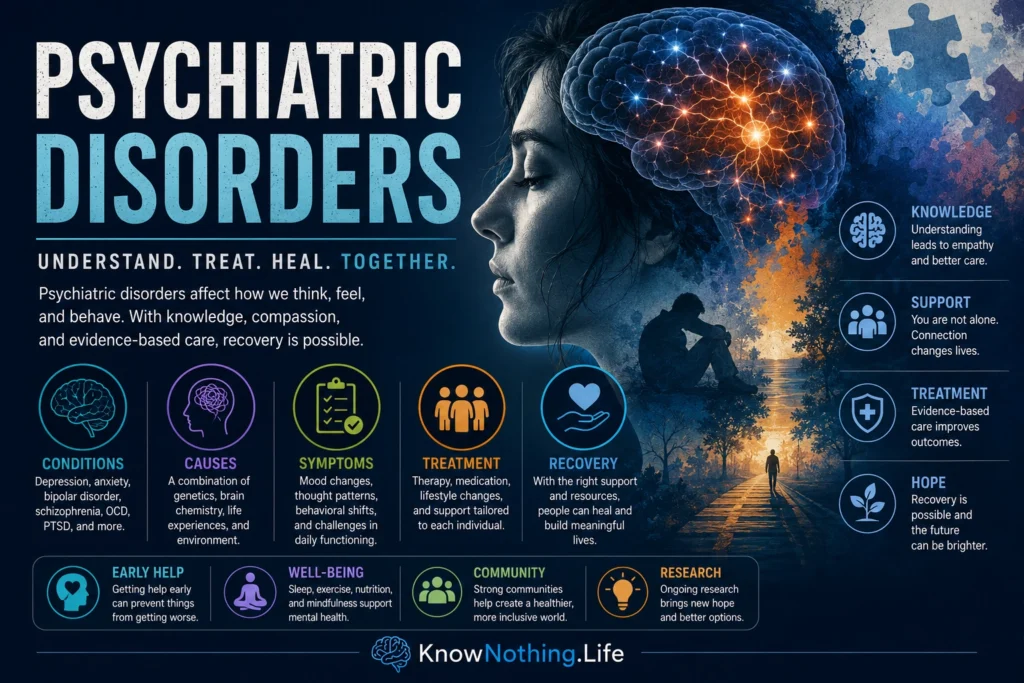
Psychiatric disorders are health conditions involving significant disturbances in cognition, emotional regulation, perception, motivation, or behavior. They include depressive disorders, anxiety disorders, bipolar disorder, schizophrenia and other psychotic disorders, obsessive-compulsive disorder, trauma-related conditions, eating disorders, personality disorders, and several other diagnostic groups. Their effects range from relatively brief episodes to persistent conditions requiring long-term care. Symptoms become clinically important when they produce substantial distress, interfere with relationships or responsibilities, increase safety risks, or limit a person’s ability to function in daily life.
These conditions are among the world’s largest causes of disability. The World Health Organization reported in 2025 that more than one billion people were living with mental health conditions, with anxiety and depressive disorders among the most common. Mental disorders account for approximately one in every six years lived with disability worldwide, while people with severe conditions may experience substantially shorter life expectancy because of suicide, medical illness, inadequate health care, social disadvantage, and other interacting factors. The burden cannot be understood through symptoms alone; it also includes disrupted education, unemployment, caregiver strain, homelessness, discrimination, and reduced access to ordinary community life.
Diagnosis and Classification
Psychiatric diagnosis is based mainly on patterns of symptoms, their duration and severity, the circumstances in which they occur, and their effects on functioning. Unlike many infectious or metabolic diseases, most psychiatric disorders cannot currently be confirmed through a single blood test, scan, or genetic result. Clinicians instead conduct detailed interviews, review medical and developmental histories, assess mental status, and gather information about sleep, substance use, medications, trauma, physical health, family history, and changes in behavior. Information from relatives or other trusted observers may be helpful when insight, memory, or communication is impaired.
The two leading classification systems are the American Psychiatric Association’s Diagnostic and Statistical Manual of Mental Disorders, Fifth Edition, Text Revision and the World Health Organization’s International Classification of Diseases, Eleventh Revision. These systems provide common terminology and diagnostic requirements, improving communication among clinicians and researchers. They are not complete theories of what causes mental illness, however, and a diagnosis does not explain every individual experience. Cultural expectations, developmental stage, physical illness, grief, discrimination, and social circumstances must be considered so that understandable responses to adversity are not automatically treated as disease.
Genes, Brain Systems, and Environment
Psychiatric disorders rarely arise from one isolated cause. Genetic susceptibility can influence brain development, temperament, stress sensitivity, learning, sleep, and neurotransmitter function, but genes operate within environmental and developmental contexts. Prenatal conditions, childhood adversity, chronic stress, social isolation, substance exposure, physical illness, discrimination, and economic insecurity may change risk without determining a fixed outcome. Protective relationships, education, community support, stable housing, and access to timely care can influence whether vulnerabilities develop into severe or persistent impairment.
Large genetic studies have challenged the idea that every diagnosis has an entirely separate biological foundation. A Psychiatric Genomics Consortium analysis of eight disorders identified 109 genetic loci associated with at least two conditions, including variants shared across schizophrenia, bipolar disorder, depression, attention-deficit/hyperactivity disorder, autism, obsessive-compulsive disorder, anorexia nervosa, and Tourette syndrome. Earlier work also found shared genetic effects across five major disorders. These findings do not make the diagnoses interchangeable, but they help explain why symptoms and conditions frequently overlap within individuals and families.
Diagnostic Boundaries and Comorbidity
Psychiatric categories are useful because they organize recognizable patterns and guide evidence-based treatment. Depression commonly involves persistent low mood or loss of interest, while anxiety disorders center on excessive fear, worry, avoidance, or physiological arousal. Mania includes unusually elevated or irritable mood accompanied by changes in energy, activity, sleep, judgment, and behavior. Psychotic disorders may involve hallucinations, delusions, disorganized thought, or diminished motivation and emotional expression. Trauma-related disorders, obsessive-compulsive conditions, eating disorders, and personality disorders involve different combinations of intrusive experiences, avoidance, repetitive behavior, disturbed self-perception, and interpersonal difficulty.
In practice, many people meet criteria for more than one disorder over their lifetime. Depression may occur with anxiety, substance misuse, eating disorders, or personality difficulties, while attention problems can appear in mood, trauma, sleep, and neurodevelopmental conditions. Research from the Dunedin longitudinal study proposed a general “p factor” representing broad vulnerability to persistent and overlapping psychopathology. This model does not replace specific diagnoses, but it emphasizes that severity, chronicity, and comorbidity may sometimes predict a person’s needs better than a single label considered in isolation.
Clinical Assessment and Treatment Planning
A psychiatric evaluation must distinguish primary mental disorders from conditions that can imitate or intensify them. Thyroid disease, seizures, dementia, autoimmune illness, medication effects, hormonal changes, sleep disorders, infections, nutritional deficiencies, intoxication, and withdrawal can produce changes in mood, cognition, perception, or behavior. Assessment may therefore include physical examination, laboratory testing, toxicology screening, neurological evaluation, or brain imaging when clinically indicated. Immediate attention is required when symptoms involve suicidal intent, severe self-neglect, violent risk, delirium, catatonia, mania with dangerous behavior, or psychosis that prevents safe decision-making.
Effective treatment planning is collaborative and should consider diagnosis, symptom severity, previous responses, medical health, cultural background, practical resources, personal goals, and patient preferences. Treatment may focus on symptom remission, but it should also address relationships, education, employment, housing, physical health, and meaningful participation in life. Progress is often nonlinear. A medication or psychotherapy that works well for one person may provide limited benefit or unacceptable side effects for another, making regular measurement and thoughtful adjustment essential.
Psychotherapy and Medication
Psychotherapy helps people examine patterns of emotion, thought, behavior, relationships, and coping. Cognitive behavioral therapy has been studied across depression, anxiety disorders, obsessive-compulsive disorder, post-traumatic stress disorder, eating disorders, insomnia, and several other conditions. A broad review led by Stefan Hofmann examined 106 meta-analyses selected from 269 published studies and found particularly strong support for cognitive behavioral approaches in several anxiety-related conditions, stress, and bulimia. Other evidence-based therapies include exposure therapy, interpersonal psychotherapy, dialectical behavior therapy, family-focused treatment, and specialized trauma therapies.
Medication can reduce symptoms by influencing neurotransmitter receptors, intracellular signaling, neural excitability, sleep, and other biological processes. Antidepressants, antipsychotics, mood stabilizers, stimulants, and anti-anxiety medications have different uses and risk profiles. The STAR*D depression study showed that many patients did not reach remission with the first antidepressant and that remission became less likely across successive treatment steps. In schizophrenia, the CATIE trial found high treatment-discontinuation rates and important tradeoffs among antipsychotics involving effectiveness, tolerability, weight gain, and metabolic effects. These studies reinforced the need for individualized care rather than assuming one medication is universally superior.
Combined Care and Long-Term Recovery
Many psychiatric conditions respond best to combinations of interventions. Medication may reduce severe depression, mania, psychosis, panic, or attention difficulties enough for a person to participate more effectively in psychotherapy and rehabilitation. Psychological treatment can improve coping, relapse recognition, communication, adherence, and problem-solving. In the STEP-BD program, intensive psychosocial treatment added to pharmacotherapy improved functioning among patients experiencing bipolar depression, while adjunctive antidepressants did not consistently produce greater recovery than mood-stabilizing treatment alone. The findings demonstrate why treatments must be matched to the disorder and clinical phase rather than applied through a single general formula.
Recovery does not always mean the permanent disappearance of every symptom. For some people, it means preventing recurrence; for others, it involves maintaining relationships, returning to work, living independently, or rebuilding a sense of purpose while managing ongoing vulnerability. Peer support, supported employment, family education, substance-use treatment, physical health care, and stable housing can be central parts of recovery. Stigma remains a major obstacle because fear of judgment can delay help-seeking and reduce social opportunity even after symptoms improve.
The Future of Psychiatric Research
Researchers are increasingly investigating dimensions that cross traditional diagnostic categories. The National Institute of Mental Health’s Research Domain Criteria framework studies functions such as threat response, reward learning, cognition, arousal, and social processes across the full range from typical to impaired functioning. By connecting behavior with brain circuits, physiology, genetics, and development, this approach seeks to discover mechanisms that may eventually improve assessment and treatment. It is a research framework rather than a replacement for clinical diagnosis.
Future care may combine clinical interviews with digital measures, sleep and activity data, cognitive testing, genetics, neuroimaging, and biological markers. Yet technical precision will have limited value unless treatment is affordable, voluntary, culturally responsive, and available before a crisis develops. Psychiatric disorders emerge from interactions among biology, experience, relationships, and society. Understanding them requires scientific rigor without reducing a person to a brain scan, genetic risk score, or diagnostic label. The central purpose of psychiatric care remains helping individuals reduce suffering, regain agency, and build lives that they consider meaningful.