Democritus was born around 460 BCE in Abdera, a Greek colony on the coast of Thrace. Unlike many of his philosophical predecessors, Democritus lived in a region often regarded by Athenians as peripheral and culturally unsophisticated. Yet Abdera produced one of the most influential thinkers of antiquity, a philosopher whose ideas would echo through the centuries and shape the foundations of modern science. Little is known with certainty about his early life, but ancient sources describe him as coming from a wealthy family, which allowed him the freedom to travel and study extensively.
Democritus is often associated with his teacher Leucippus, the figure traditionally credited with originating the theory of atomism. While the historical existence of Leucippus has been debated, the intellectual partnership between the two is widely acknowledged. Democritus expanded and systematized the ideas attributed to his predecessor, transforming atomism into a comprehensive philosophical system. His education likely included exposure to earlier Greek thinkers such as Heraclitus and Parmenides, whose contrasting views on change and permanence informed his own attempts to reconcile motion with stability.
According to tradition, Democritus traveled widely, visiting Egypt, Persia, and possibly India. These journeys exposed him to diverse intellectual traditions and contributed to his reputation as a polymath. Unlike philosophers who confined themselves to a single discipline, Democritus pursued knowledge across a broad range of fields, including mathematics, astronomy, ethics, and natural philosophy. This expansive curiosity would become a defining feature of his work, reflecting a commitment to understanding the world in its entirety rather than in isolated parts.
The Theory of Atomism
Democritus’ most enduring contribution to philosophy is his development of atomism, a theory that posits that all matter is composed of indivisible, eternal particles called atoms. These atoms move through empty space, or the void, combining and separating to form the observable world. This idea represented a radical departure from earlier philosophies that sought to explain reality in terms of continuous substances or elemental forces. By introducing the concept of discrete particles, Democritus provided a framework that anticipated key aspects of modern physics.
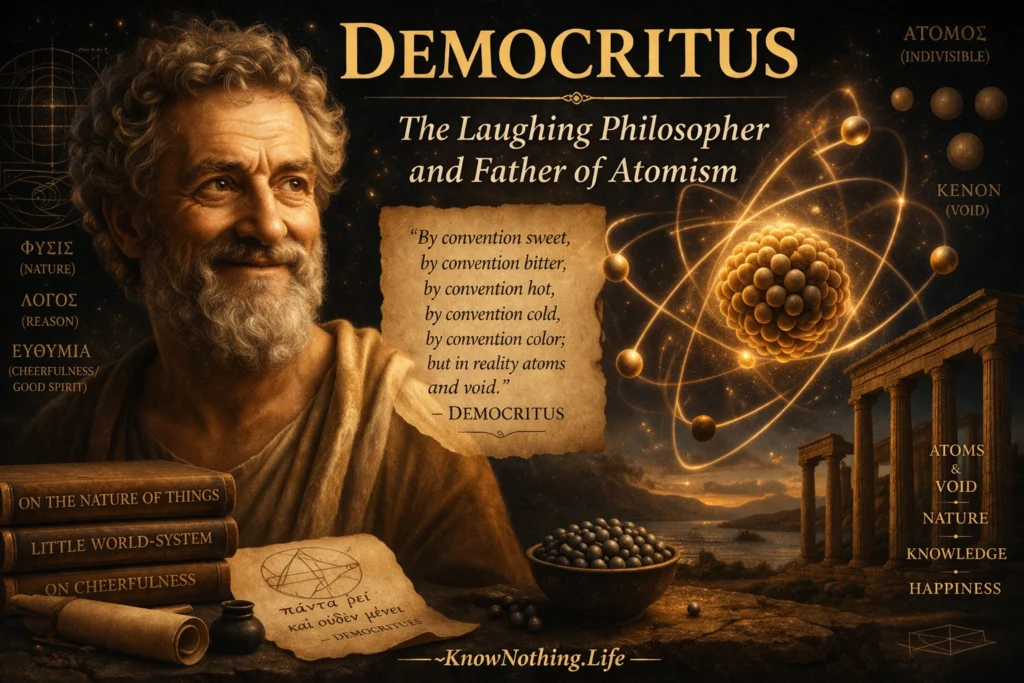
In Democritus’ system, atoms differ in shape, size, and arrangement, but not in quality. The properties we perceive—such as color, taste, and texture—are not inherent in the atoms themselves but arise from their interactions with our senses. As he famously stated, “By convention sweet, by convention bitter, by convention hot, by convention cold, by convention color; but in reality atoms and void.” This distinction between appearance and reality reflects a sophisticated understanding of perception, suggesting that sensory experience is not a direct representation of the underlying structure of the world.
Atomism also offered a solution to the philosophical problem of change. While Parmenides had argued that change is impossible because being cannot arise from non-being, Democritus introduced the void as a form of “non-being” that allows for motion and transformation. In this way, he reconciled the existence of change with the permanence of fundamental particles. His theory provided a coherent explanation for both stability and variation, laying the groundwork for later scientific developments.
Epistemology and the Nature of Knowledge
Democritus’ philosophical inquiries extended beyond the physical structure of the universe to the nature of knowledge itself. He distinguished between two kinds of knowledge: “bastard” knowledge, derived from the senses, and “legitimate” knowledge, obtained through reasoning. While sensory experience provides the raw data of perception, it is often misleading or incomplete. True understanding, according to Democritus, requires the application of intellect to uncover the hidden reality beneath appearances.
This epistemological framework reflects a deep skepticism about the reliability of the senses, a theme that would later be developed by philosophers such as Plato. Yet Democritus did not reject sensory experience entirely; rather, he viewed it as a necessary but insufficient component of knowledge. The senses provide clues about the world, but these clues must be interpreted through rational analysis. This balanced approach anticipates the integration of empirical observation and theoretical reasoning that characterizes modern science.
Democritus’ emphasis on reason also underscores his commitment to intellectual independence. He rejected appeals to tradition and authority, advocating instead for a method of inquiry grounded in evidence and logic. His approach reflects a broader shift in Greek philosophy toward systematic investigation and critical thinking, marking an important step in the evolution of epistemology.
Ethics and the Philosophy of Happiness
In addition to his work on natural philosophy, Democritus developed a rich ethical theory centered on the concept of happiness, or “euthymia.” This term, often translated as “good spirit” or “cheerfulness,” describes a state of inner tranquility and balance. For Democritus, happiness is not derived from external wealth or power, but from the cultivation of a harmonious and disciplined mind. He is often remembered as the “laughing philosopher,” a title that reflects his emphasis on joy and moderation.
Democritus’ ethical teachings stress the importance of self-control, moderation, and the pursuit of knowledge. He believed that excessive desires lead to dissatisfaction and turmoil, while a measured approach to life fosters stability and contentment. As he wrote, “Happiness resides not in possessions, and not in gold, happiness dwells in the soul.” This perspective aligns with later philosophical traditions, including Stoicism and Epicureanism, which similarly emphasize the importance of inner well-being over external circumstances.
His ethical philosophy is closely connected to his atomistic worldview. Just as the physical world is composed of orderly arrangements of atoms, so too should the human soul be organized in a balanced and harmonious way. This analogy reflects a broader theme in Democritus’ thought: the idea that the principles governing the cosmos also apply to human life. By understanding these principles, individuals can achieve a state of equilibrium that mirrors the order of the universe.
Major Works and Intellectual Legacy
Democritus was a prolific writer, producing works on a wide range of subjects, including mathematics, astronomy, medicine, and ethics. Titles attributed to him include Little World-System, On the Nature of Things, and On Cheerfulness. Unfortunately, none of his works survive in complete form; what we know of his philosophy comes primarily from fragments and later accounts. Despite this loss, his influence has endured, shaping the development of both philosophy and science.
His atomistic theory was later adopted and expanded by Epicurus, whose work preserved and transmitted many of Democritus’ ideas. Through Epicurus, atomism influenced Roman thinkers such as Lucretius, whose poem De Rerum Natura presents a detailed exposition of the theory. These later interpretations ensured that Democritus’ ideas remained part of the intellectual tradition, even as other philosophical schools gained prominence.
In the modern era, Democritus is often regarded as a precursor to scientific materialism. His insistence that the universe can be explained in terms of physical processes, without recourse to supernatural causes, anticipates the methodological naturalism of modern science. Although his conception of atoms differs from contemporary scientific models, the underlying principle—that complex phenomena arise from the interactions of simpler components—remains central to scientific inquiry.
Final Years and Enduring Influence
The final years of Democritus’ life are largely undocumented, but he is believed to have lived to an advanced age, possibly into his nineties. Ancient accounts describe him as a solitary figure, devoted to study and contemplation. Despite his intellectual achievements, he was sometimes regarded with suspicion or ridicule by his contemporaries, who may have found his ideas unconventional or unsettling. Yet his reputation grew over time, earning him a place among the most important thinkers of antiquity.
Democritus’ legacy is defined not only by his specific theories but by his approach to understanding the world. He sought to explain natural phenomena through rational principles, emphasizing the importance of inquiry and evidence. This commitment to intellectual rigor has made him a central figure in the history of philosophy, bridging the gap between early Greek speculation and the systematic science of later periods.
Today, Democritus is remembered as both a visionary and a pioneer. His conception of a universe composed of atoms and void anticipated discoveries that would not be fully realized until millennia later. At the same time, his ethical teachings continue to resonate, offering insights into the nature of happiness and the pursuit of a balanced life. As he is often quoted, “Nothing exists except atoms and empty space; everything else is opinion,” a statement that captures both the boldness and the enduring relevance of his thought.