Zeno of Citium stands as one of the most influential philosophical figures of the Hellenistic world, not because he left behind a complete body of surviving texts, but because he established a system of thought that would shape ethical philosophy for centuries: Stoicism. Living in the aftermath of the conquests of Alexander the Great, Zeno confronted a world in which traditional civic identities were dissolving into expansive empires, and individuals were increasingly detached from the stable political structures that had once defined Greek life. In this context, his philosophy addressed a deeply human concern—how to live well amid uncertainty, instability, and loss of control.
What distinguishes Zeno’s contribution is his insistence that philosophy must function as a way of life rather than a purely theoretical exercise. He shifted attention away from speculative metaphysics toward practical ethics rooted in rational self-mastery. Happiness, in his view, was not contingent upon external circumstances such as wealth or status, but upon the cultivation of virtue and the alignment of one’s mind with reason. This orientation toward inner stability would become the defining characteristic of Stoicism and would later influence thinkers such as Epictetus and Marcus Aurelius.
Although much of what is known about Zeno’s life and teachings comes from later writers like Diogenes Laertius, the philosophical structure he created remains clear. By placing virtue at the center of human flourishing and emphasizing rational discipline over emotional reaction, Zeno established a framework that continues to resonate in both philosophical discourse and modern psychological practice.
Early Life and Intellectual Formation
Zeno was born around 334 BCE in Citium, a city on the island of Cyprus that functioned as a cultural crossroads between Greek and Phoenician traditions. This environment likely exposed him early to a diversity of ideas, shaping a mindset receptive to synthesis rather than rigid adherence to a single tradition. His father, a merchant, is said to have brought philosophical texts back from Athens, which sparked Zeno’s early interest in philosophy, though his initial path followed the more practical route of commerce.
A pivotal turning point came when a shipwreck left him stranded in Athens. According to later accounts, he entered a bookseller’s shop and encountered writings about Socrates. Struck by the image of a man who lived according to principle rather than circumstance, Zeno asked where such individuals might be found. He was directed to Crates of Thebes, a prominent figure in the Cynic tradition. Under Crates, Zeno absorbed the Cynic emphasis on simplicity, self-sufficiency, and indifference to social convention.
However, Zeno did not remain confined to Cynicism. He studied under Stilpo and engaged with ideas from both Platonic and Aristotelian traditions. This broad intellectual exposure allowed him to refine and expand beyond the more extreme aspects of Cynicism, creating a balanced system that combined ethical rigor with logical structure. His philosophical development illustrates a commitment not only to discipline but to synthesis—integrating multiple traditions into a coherent vision centered on rational living.
Founding of Stoicism
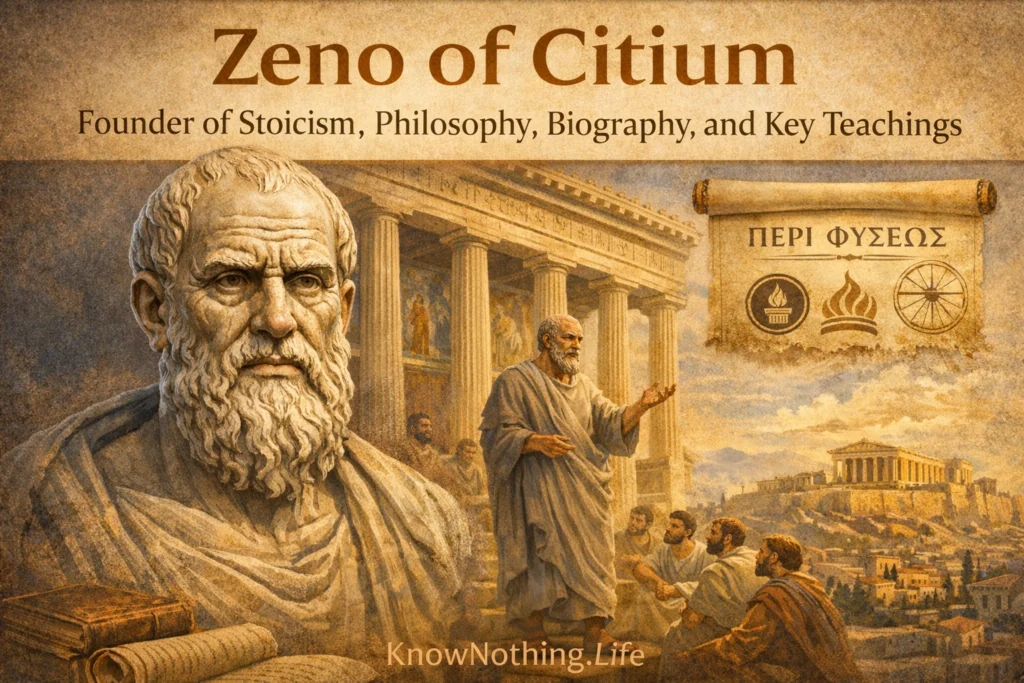
Around 300 BCE, Zeno began teaching in Athens at the Stoa Poikile, or “Painted Porch,” from which his philosophical school derived its name. Unlike the more formal institutions established by Plato or Aristotle, Zeno’s teaching environment was public and accessible. This setting reflected his belief that philosophy should be integrated into everyday life rather than confined to elite academic circles.
Stoicism, as Zeno developed it, was organized into three interrelated domains: logic, physics, and ethics. Logic provided the tools for reasoning and understanding, physics explained the nature of the universe as an ordered and rational whole, and ethics guided human conduct in alignment with that order. Of these, ethics held primacy, as it directly addressed the question of how to live. Zeno taught that the universe operates according to a rational principle, often referred to as logos, and that human beings achieve fulfillment by aligning their thoughts and actions with this universal reason.
This alignment required a radical rethinking of value. Zeno argued that only virtue—wisdom, courage, justice, and temperance—is inherently good. External factors such as health, wealth, and social standing are “indifferents,” meaning they have no bearing on moral worth. This distinction formed the basis of Stoic resilience: by detaching one’s sense of well-being from uncontrollable external conditions, one can achieve a stable and enduring form of happiness grounded in inner discipline.
Philosophical Teachings and Core Ideas
Zeno’s philosophy centers on the idea that human suffering arises not from events themselves but from judgments about those events. By misidentifying external conditions as essential to happiness, individuals become vulnerable to anxiety, fear, and disappointment. Zeno’s solution was to cultivate correct judgments through reason, recognizing that virtue alone is sufficient for a good life. This insight laid the foundation for the Stoic pursuit of apatheia, a state of freedom from irrational passions.
Importantly, apatheia does not imply emotional suppression or indifference to life. Rather, it represents a condition in which emotions are guided by reason rather than distorted by false beliefs. A Stoic does not eliminate feeling but refines it, responding to circumstances with clarity and proportion. This disciplined emotional life allows for tranquility even in the face of adversity, as one’s sense of well-being is no longer tied to external outcomes.
Several sayings attributed to Zeno encapsulate these ideas. One of the most widely cited is: “Man conquers the world by conquering himself.” This reflects the Stoic emphasis on internal mastery as the foundation of all achievement. Another, “We have two ears and one mouth, so we should listen more than we say,” highlights the importance of reflection, restraint, and thoughtful engagement with others. These concise expressions reveal a philosophy deeply concerned with self-regulation, awareness, and ethical consistency.
Works and Writings
Zeno authored numerous works, though none survive in complete form. Our knowledge of them comes through fragments and references preserved by later writers. Among his most important texts were The Republic, On Nature, On Life According to Nature, and On Passions. These works collectively articulated his vision of a rational universe and the ethical life aligned with it.
In The Republic, Zeno presented a model of an ideal society that diverged significantly from that of Plato. Rather than emphasizing structured hierarchies or rigid political systems, Zeno envisioned a community governed by reason and equality, where individuals live in harmony without reliance on formal institutions such as courts or temples. This concept reflects the Stoic idea of cosmopolitanism—the belief that all human beings belong to a single universal community defined by shared rationality.
His work On Nature explored the Stoic understanding of the cosmos as an interconnected and rational whole. Zeno rejected the notion of randomness, instead proposing that the universe operates according to a coherent and purposeful order. Human beings, as rational participants in this system, are capable of understanding and aligning with it. Though the details of these writings are largely lost, their influence is evident in the later development of Stoic philosophy, which maintained a strong emphasis on the unity of logic, physics, and ethics.
Influence and Legacy
The philosophical system established by Zeno became one of the most enduring traditions of the ancient world. Stoicism spread throughout the Hellenistic and Roman periods, influencing a wide range of thinkers and leaders. Figures such as Seneca, Epictetus, and Marcus Aurelius expanded upon his teachings, adapting them to new cultural and political contexts while preserving their essential principles.
In Rome, Stoicism evolved into a philosophy of practical governance and personal conduct. Marcus Aurelius, for example, applied Stoic principles to his role as emperor, using them to navigate the responsibilities and pressures of leadership. This adaptability contributed to the longevity of Stoicism, allowing it to remain relevant across different historical periods and social conditions.
Zeno’s influence extends into modern thought as well. The Stoic emphasis on the role of beliefs in shaping emotional experience has clear parallels in contemporary psychological approaches such as cognitive-behavioral therapy. By focusing on the examination and correction of judgments, Stoicism provides tools for managing stress, anxiety, and emotional disturbance. In this way, Zeno’s insights continue to inform both philosophical inquiry and practical methods for improving mental well-being.
Final Years and Death
Zeno lived in accordance with the principles he taught, maintaining a lifestyle marked by simplicity, discipline, and independence. Ancient sources describe him as reserved yet approachable, committed to his students and consistent in his philosophical practice. His personal conduct reinforced the credibility of his teachings, demonstrating that Stoicism was not merely theoretical but fully livable.
Accounts of his death, which occurred around 262 BCE, vary in detail but share a common theme of acceptance. One widely circulated story suggests that after a fall, Zeno interpreted the incident as a sign that his time had come and chose to end his life. While the historical accuracy of this account is uncertain, it aligns with the Stoic view that death is a natural event to be accepted rationally rather than feared.
Zeno’s passing did not diminish his influence. Instead, it marked the continuation of a philosophical tradition that would shape ethical thought for generations. His students and successors carried forward his ideas, ensuring that Stoicism remained a central force in ancient philosophy.
Final Thoughts
Zeno of Citium redefined the purpose of philosophy, transforming it into a disciplined approach to living with clarity, resilience, and moral integrity. By placing virtue at the center of human flourishing and emphasizing the importance of rational judgment, he provided a framework for navigating a world characterized by uncertainty and change. His teachings continue to resonate because they address a timeless question: how can one maintain inner stability in the face of external unpredictability?
The enduring power of Zeno’s philosophy lies in its practicality. It does not depend on external success or favorable circumstances but on the cultivation of inner discipline and ethical consistency. Through Stoicism, Zeno offered not just a set of ideas but a method for living—one that remains as relevant today as it was in the ancient world.