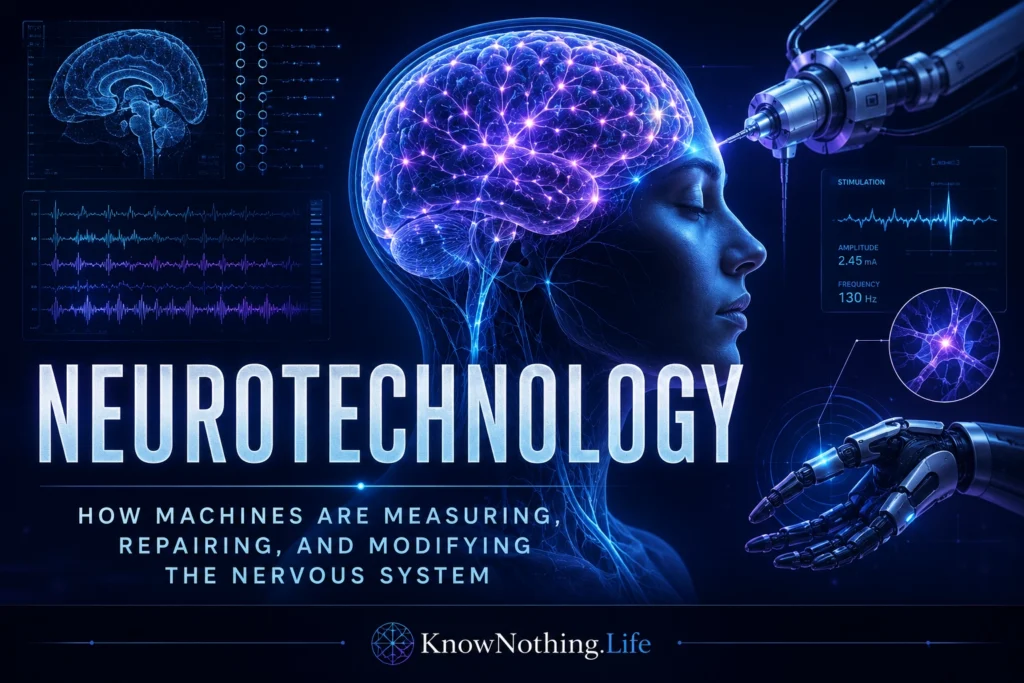
Neurotechnology refers to devices and computational systems designed to record, interpret, stimulate, or otherwise interact with the nervous system. The category includes familiar clinical tools such as cochlear implants and deep brain stimulators, along with experimental brain–computer interfaces, spinal stimulators, retinal prostheses, wearable electroencephalography systems, neurofeedback platforms, and noninvasive brain-stimulation devices. Some technologies primarily measure neural activity, while others attempt to alter it. Increasingly, the most advanced systems do both, creating a continuous exchange between the brain, software, and an external or implanted device.
The field is often associated with futuristic ideas about merging people with computers, but its most established applications are medical. Neurotechnology can provide sensory information to people with hearing loss, reduce symptoms of movement disorders, detect abnormal neural activity, restore communication after paralysis, and support rehabilitation after nervous-system injury. Its central challenge is translating complex biological signals into reliable information or stimulation patterns. Neural activity changes from moment to moment, differs among individuals, and is influenced by movement, medication, fatigue, learning, and disease. A successful system must therefore work with a living and adaptive nervous system rather than treating the brain like a fixed electrical circuit.
Cochlear Implants and the Restoration of Hearing
Cochlear implants are among the clearest examples of successful neurotechnology. A microphone and speech processor convert sound into coded electrical signals, which are transmitted to an implanted electrode array in the cochlea. Those electrodes stimulate surviving auditory nerve fibers, partially replacing the function of damaged sensory hair cells. The implant does not recreate natural hearing or repair the inner ear. Instead, it provides the nervous system with a simplified electrical representation that users learn to interpret through experience and rehabilitation.
A prospective randomized study led by Noel Cohen compared multichannel and single-channel cochlear implants in adults with profound postlingual deafness. All participants receiving functioning devices detected sound, but multichannel systems were substantially more effective for recognizing words and sentences. The study also found that improvements to the external speech processor could significantly improve performance without replacing the implanted electrode. This result illustrates a defining feature of modern neurotechnology: capability depends not only on the biological interface but also on the algorithms that transform sensory information into stimulation.
Deep Brain Stimulation and Neuromodulation
Deep brain stimulation uses surgically implanted electrodes to deliver electrical pulses to selected brain regions. It is widely used for certain movement disorders, particularly Parkinson’s disease, essential tremor, and dystonia, and it has also been investigated for epilepsy, obsessive-compulsive disorder, depression, and other conditions. The stimulation does not simply activate or silence one location. It changes activity across connected neural networks, with the clinical result depending on electrode placement, pulse settings, disease characteristics, and the pathways reached by the electrical field.
A major randomized trial found that stimulation of the subthalamic nucleus produced greater improvements in motor function and quality of life than medical management alone among selected patients with advanced Parkinson’s disease, although surgery and stimulation also introduced significant risks. Traditional systems deliver continuous stimulation, but newer adaptive devices record neural activity and adjust output in response to biomarkers associated with symptoms. A blinded randomized feasibility trial published in 2024 found that chronic adaptive stimulation improved troublesome motor symptoms compared with conventional continuous stimulation in a small group of participants. This closed-loop approach aims to provide stimulation when needed while reducing unnecessary energy use and side effects.
Brain–Computer Interfaces and Communication
A brain–computer interface, or BCI, translates neural activity into commands for an external device. Noninvasive systems may use scalp-recorded EEG, while invasive interfaces obtain higher-resolution signals from electrodes placed on or within the brain. Researchers have used these signals to control computer cursors, robotic limbs, spelling systems, and speech decoders. For people with paralysis, the goal is not to strengthen damaged muscles but to create a new route through which movement intentions can reach the outside world.
Speech neuroprostheses have advanced particularly rapidly. In 2023, Francis Willett and colleagues reported an intracortical system that decoded attempted speech into text at an average rate of 62 words per minute using a vocabulary of approximately 125,000 words. Sean Metzger and colleagues separately developed a cortical-surface interface that translated attempted speech into text, synthesized sound, and movements of a digital facial avatar. A 2024 study involving a man with amyotrophic lateral sclerosis achieved more than 90 percent accuracy with a large vocabulary after limited calibration and later maintained approximately 97.5 percent accuracy during structured testing. These results are remarkable, but each system was trained for a particular consenting participant and does not constitute general-purpose thought reading.
Movement and Sensory Neuroprostheses
Controlling a robotic arm through brain activity solves only part of the problem of restoring movement. Natural movement also depends on touch, pressure, limb position, and rapid sensory feedback. Without these signals, a person must rely heavily on vision and may apply too much or too little force. Bidirectional neuroprostheses therefore record motor intentions while stimulating sensory pathways to provide information about contact with an object. The nervous system must learn to interpret these artificial sensations just as it learns to control the prosthetic device.
In a landmark human study, Sharlene Flesher and colleagues used intracortical microstimulation of the somatosensory cortex to evoke sensations perceived in specific parts of the hand of a participant with spinal cord injury. Researchers have since combined motor decoding with artificial touch to improve prosthetic control. Neurotechnology has also targeted the spinal cord. Grégoire Courtine and colleagues used precisely timed epidural electrical stimulation with intensive rehabilitation to enable participants with chronic spinal cord injury to regain voluntary control of stepping and walking under selected conditions. These systems do not universally reverse paralysis, but they demonstrate that appropriately timed stimulation can engage surviving pathways below an injury.
Vision, Rehabilitation, and Neural Plasticity
Visual neuroprostheses attempt to replace lost input at the retina, optic nerve, or visual cortex. Retinal devices transform images captured by a camera into electrical or light-based stimulation delivered to surviving retinal cells. The resulting perception is far less detailed than ordinary vision, but it may help users detect patterns, letters, objects, or movement. A photovoltaic subretinal implant studied in people with geographic atrophy from age-related macular degeneration used special glasses to project near-infrared images onto an implanted chip, producing central visual perception within areas where photoreceptors had been lost.
Neurotechnology can also support rehabilitation by pairing stimulation with meaningful movement. The goal is to strengthen useful neural connections during periods when the patient is actively practicing a skill. Vagus nerve stimulation paired with upper-limb therapy has shown promise after stroke, while closed-loop stimulation is being investigated for spinal cord injury and other conditions. These approaches depend on neural plasticity: stimulation is timed to reinforce activity associated with successful movement rather than delivered as an isolated treatment. Technology may therefore act as a catalyst for learning, but repeated practice and an intact rehabilitation program remain essential.
Noninvasive Neurotechnology
Not every neurotechnology requires an implant. Transcranial magnetic stimulation uses a magnetic field to induce electrical currents in cortical tissue, while transcranial direct current stimulation delivers weak current through scalp electrodes. Focused ultrasound can influence deeper tissue by sending concentrated acoustic energy through the skull. EEG devices record electrical activity from the scalp, and functional near-infrared spectroscopy estimates changes in cortical blood oxygenation. These methods are used in research, clinical treatment, rehabilitation, and a growing consumer market.
Noninvasive technologies are generally easier to apply than implanted devices, but they sacrifice precision and are not automatically harmless. The amount of neural tissue affected can be broad, and responses vary with anatomy, age, medication, brain state, electrode position, and stimulation parameters. Findings from small laboratory studies have often failed to replicate consistently, especially when devices are promoted as simple tools for increasing intelligence, creativity, or concentration. Medical neurotechnology should therefore be distinguished from consumer products whose marketing may exceed the evidence supporting their benefits.
Artificial Intelligence and Closed-Loop Systems
Artificial intelligence has become central to neurotechnology because neural signals are noisy, high-dimensional, and constantly changing. Machine-learning models can detect patterns associated with attempted speech, hand movement, seizure activity, sleep stages, or Parkinsonian symptoms. The software may also adapt as a user gains experience or as the signal changes over time. In this sense, many modern neurotechnologies are not static machines but learning systems connected to learning nervous systems.
Closed-loop devices represent the next major stage of development. Instead of delivering the same stimulation continuously, they measure the user’s neural or behavioral state, estimate what is happening, and adjust treatment in real time. A seizure-responsive implant may stimulate only when it detects an abnormal pattern, while adaptive deep brain stimulation can increase or reduce output according to disease-related signals. The promise is greater precision and fewer side effects, but the system’s decisions depend on the validity of its biomarkers and algorithms. An incorrect or biased model could deliver ineffective treatment, miss an important event, or make a change the user cannot easily understand.
Privacy, Identity, and Long-Term Responsibility
Neurotechnology produces exceptionally sensitive information. Neural recordings may reveal patterns associated with movement, attention, health, emotional responses, or attempted communication. Data collected for one purpose may later be analyzed with more powerful algorithms or combined with medical, behavioral, and commercial records. Implanted systems also raise questions about cybersecurity, ownership, software updates, and continued access when a research trial ends or a manufacturer stops supporting a device.
The ethical issue is not simply whether technology changes the brain, because medication, education, rehabilitation, and ordinary experience also produce neural change. More important questions concern informed consent, user control, reversibility, fairness, and responsibility for long-term care. UNESCO adopted its Recommendation on the Ethics of Neurotechnology on November 11, 2025, establishing a global framework focused on human dignity, mental privacy, autonomy, discrimination, workplace and educational use, and protection of neural data. Its adoption reflects growing recognition that devices capable of interacting with the nervous system require safeguards extending beyond ordinary consumer-data policies.
The Future of Neurotechnology
The future will likely bring smaller implants, wireless interfaces, more accurate decoders, personalized stimulation, artificial sensory feedback, and devices that operate for longer periods outside laboratories. Neurotechnology may restore communication, movement, hearing, and vision more effectively while allowing treatment to adapt continuously to symptoms. Its most transformative achievements may not involve creating superhuman abilities but helping people recover capacities that injury or disease has taken away.
Progress should nevertheless be judged by more than a demonstration that a device works briefly under controlled conditions. Successful neurotechnology must remain safe, reliable, repairable, affordable, and useful in everyday life. Users need control over their data and meaningful influence over how systems are designed. Long-term support must continue after experiments and corporate product cycles end. The nervous system is not merely another platform for computation; it is inseparable from a person’s communication, agency, experience, and identity. The field will fulfill its promise only when technical innovation is matched by equally serious commitments to clinical evidence, accessibility, privacy, and human autonomy.