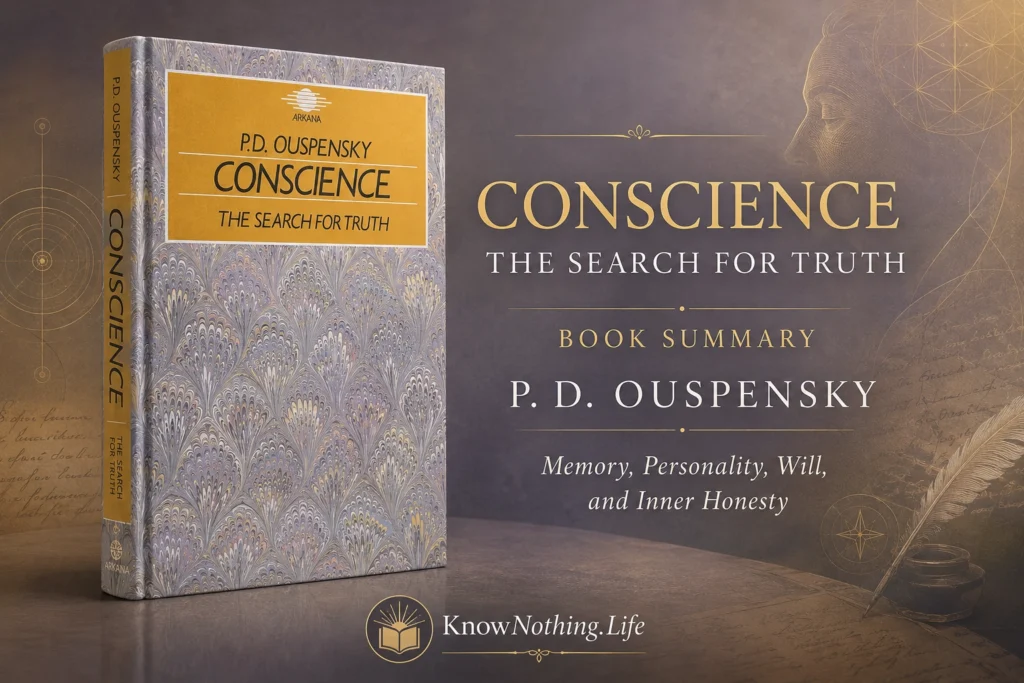
P. D. Ouspensky’s Conscience: The Search for Truth is not a continuous manuscript prepared as a single book. Published in 1979 with an introduction by Merrily E. Taylor, it gathers five shorter works—“Memory,” “Surface Personality,” “Self-Will,” “Negative Emotions,” and “Notes on Work”—originally issued in limited Stourton Press editions between 1952 and 1955. Much of the material was reconstructed from records of Ouspensky’s meetings in London and New York. The result is one of his most concentrated accounts of why people misunderstand themselves and what genuine inner change would demand.
The title unifies subjects that initially appear separate. For Ouspensky, conscience is not conventional respectability or guilt after breaking a rule. It is an emotional recognition of truth: the capacity to experience one’s motives and contradictions together rather than one convenient fragment at a time. Consciousness would mean knowing oneself more completely; conscience is the ability to feel that knowledge. The five works describe forces that keep this faculty dormant—forgetfulness, fragmented personality, self-assertion, reactive emotion, and resistance to disciplined work.
Conscience as the Experience of Inner Truth
Ouspensky’s definition places conscience between philosophy and psychology. Adam Smith, in The Theory of Moral Sentiments, described conscience through the imagined “impartial spectator,” an internal standpoint from which people evaluate their conduct at a distance from immediate self-interest. Kant treated conscience as an inner tribunal associated with moral duty. Ouspensky shares the idea that conscience reveals what self-interest conceals, but he does not primarily present it as reasoning about universal rules. Conscience emerges when contradictory feelings are experienced simultaneously and can no longer be separated by excuses.
This explains why intelligence alone cannot guarantee truthfulness. A clever person can create more elaborate justifications, while an emotionally awakened recognition may expose the personal cost of a lie immediately. Yet Ouspensky’s conscience should not be treated as infallible intuition. Feelings can reflect prejudice, fear, and conditioning, and philosophical accounts allow that conscience may err. His stronger insight is that moral knowledge becomes effective only when felt as relevant to one’s own conduct rather than stored as an abstract principle applied mainly to others.
“Memory” and the Disappearing Life
The opening work argues that people remember far less of their lives than they suppose. Routine days collapse into vague summaries, while unusually vivid moments remain because greater attention was present. Ouspensky connects memory with self-remembering, the effort to remain aware of oneself while perceiving and acting. He also claims that imagination, habitual lying, and “false personality” distort recollection by replacing events with stories that protect a preferred self-image. Poor memory is therefore not merely failed storage; it reflects weak presence during experience and later revision for psychological comfort.
Modern research supports part of this portrait. Martin Conway and Christopher Pleydell-Pearce describe autobiographical memories as constructions produced within a self-memory system, where current goals and self-images influence retrieval. Memory is neither a complete recording nor a neutral archive. Ouspensky’s warning about self-serving reconstruction is plausible, although his claim that self-remembering can create a fundamentally different order of memory remains an esoteric hypothesis rather than an established finding.
“Surface Personality” and the Many Selves
“Surface Personality” develops one of Ouspensky’s best-known claims: the ordinary person is “many, not one.” Different desires, roles, emotions, and opinions become active in different situations, and each temporary state speaks as “I.” One self promises restraint, another pursues gratification, and a third later invents an explanation. Because these states are rarely observed together, people imagine a unity they have not achieved. Surface personality is the collection of acquired reactions, defenses, and social performances that obscures a more coherent center of gravity.
Contemporary psychology uses different language but recognizes a context-dependent self. Allen McConnell’s multiple self-aspects framework describes the self-concept as a collection of selves activated by different roles and environments. The parallel is limited: psychology generally regards multiplicity as normal and sometimes adaptive, whereas Ouspensky treats it as incomplete development. His valuable challenge is not that people must become uniform, but that identity should become integrated enough for important commitments to survive changes in mood and circumstance.
“Self-Will” and the Difference Between Desire and Will
Ouspensky distinguishes will from self-will and wilfulness. Self-will is the insistence on acting in one’s own way because it is one’s own; wilfulness is resistance awakened simply by prohibition. Neither represents freedom because both arise from temporary “I’s” and reactive self-assertion. True will would belong to a permanent, conscious self capable of organizing competing impulses around a stable aim. What people ordinarily call will is often only the strongest desire at a particular moment.
This differs sharply from Kantian autonomy, in which moral freedom requires a rational agent to give law to itself rather than submit blindly to another will. Ouspensky instead emphasizes school discipline and temporary external direction as ways to expose mechanical resistance. That can create accountability, but it can also justify dependence when a teacher’s authority is placed beyond criticism. Modern goal research offers a less hierarchical lesson: intentions become more effective when translated into specific plans connecting foreseeable situations with goal-directed responses. Wanting change is not yet an organized ability to act.
“Negative Emotions” and Emotional Responsibility
The fourth work examines anger, suspicion, jealousy, fear, boredom, and self-pity. Ouspensky argues that people treat their expression as sincerity and justify them through external causes. He asks readers to notice how the same event produces a powerful reaction on one day and little reaction on another, showing that the person’s condition helps shape the response. His first instruction is to separate emotion from automatic expression, then study the imagination, identification, and interpretations that sustain it. He also distinguishes unavoidable suffering from the narratives that magnify it.
This teaching requires qualification. Suppressing expression is not the same as understanding emotion. James Gross’s experiments found that suppression could reduce outward display while increasing sympathetic activation, whereas reappraisal reduced reported emotional experience. Ouspensky is most persuasive when read as advocating observation and reconsideration, not denial of grief, fear, injustice, or legitimate anger. His statement that negative emotions are entirely useless is too sweeping; emotions can signal danger, violated boundaries, or loss. The constructive question is whether emotion informs action or becomes a rehearsed identity.
“Notes on Work” and the Cost of Transformation
“Notes on Work” shifts from diagnosis to commitment. Its essays concern deciding to work, working on oneself, and the purpose of a school. Ouspensky warns that change requires sustained self-observation, self-remembering, sincerity, discipline, and willingness to follow practices that conflict with habitual preferences. The intellect can prepare and guide the student, he says, but further development requires emotion and will. Inner work is not another collection of ideas; it is a reorganization of attention and conduct tested under ordinary pressure.
The insistence on commitment is one of the collection’s strengths. People often use spiritual language to decorate an unchanged life. Ouspensky asks what someone is prepared to sacrifice—not necessarily possessions, but cherished grievances, flattering explanations, compulsive speech, and the right to remain inconsistent without seeing it. Yet the school model is also the book’s greatest ethical risk. Systems demanding obedience or surrender of judgment must be evaluated by transparent standards, freedom to leave, and respect for autonomy. Discipline can support development; it does not make authority automatically wise.
Meaning and Limits of Conscience
The five works form a single argument. Memory is weak because attention is weak and recollection serves self-image. Personality is fragmented because contradictory parts rarely meet. Self-will imitates freedom while obeying reactive preference. Negative emotions gain power through identification and justification. Work begins when these mechanisms are observed without turning observation into another flattering theory. Conscience appears when the person can bear a more complete truth about what is happening within.
Conscience: The Search for Truth is not scientific psychology, and its permanent “I,” higher consciousness, essence, and school-guided evolution have not been empirically demonstrated. Its enduring value lies in the severity of its questions. How much of a life is actually remembered? Which self made yesterday’s promise, and which is breaking it now? Is emotional expression revealing truth or protecting a familiar story? Ouspensky’s answer is that truth requires more than correct ideas. It requires a quality of attention in which the divided person begins to see—and feel—the whole contradiction at once.