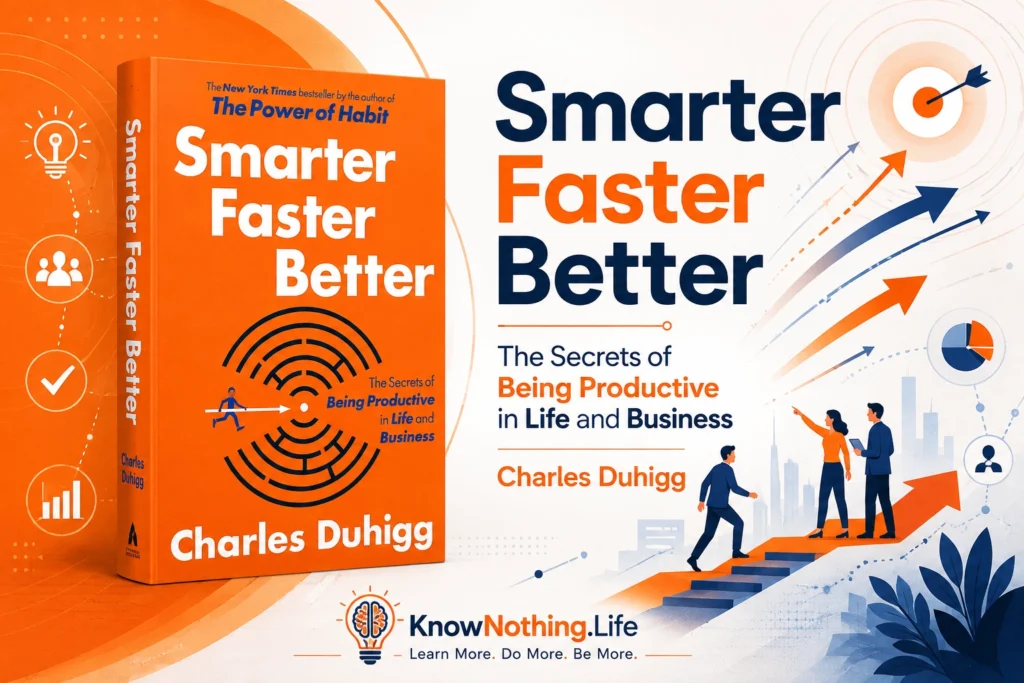
In Smarter Faster Better: The Secrets of Being Productive in Life and Business, Charles Duhigg examines why some people and organizations consistently accomplish more without simply working longer hours. Published in 2016, the book moves beyond conventional productivity advice about schedules, checklists, and efficiency hacks. Instead, Duhigg argues that exceptional productivity depends largely on how people make choices: how they motivate themselves, set goals, direct attention, work with others, interpret information, and respond to uncertainty. The book is organized around eight broad ideas—motivation, teams, focus, goal setting, managing others, decision making, innovation, and absorbing data—which Duhigg presents through stories drawn from psychology, business, aviation, education, entertainment, and organizational research.
The underlying philosophy is older than modern productivity science. Aristotle’s Nicomachean Ethics treats practical wisdom not simply as knowing what is good but as developing the judgment necessary to act appropriately in changing circumstances. John Dewey similarly argued in How We Think that intelligent behavior depends on reflective inquiry rather than mechanical repetition. Duhigg’s account belongs to this tradition. Productivity, in his view, is not synonymous with frantic activity. It is the capacity to recognize what deserves attention and then organize thought and action around it. The most productive person is therefore not necessarily the person completing the most tasks, but the person making better decisions about which tasks matter.
Motivation Begins With a Sense of Control
Duhigg begins with motivation because productivity collapses when people feel that their actions have little influence over what happens to them. He draws on the psychological concept of locus of control, associated especially with Julian Rotter’s influential 1966 work on internal and external control of reinforcement. People with a stronger internal orientation tend to perceive outcomes as more connected to their own choices and behavior, whereas an external orientation places greater emphasis on luck, circumstances, powerful others, or forces outside personal control. Rotter’s original theory was more nuanced than the popular slogan that people should simply “take control,” but the connection Duhigg emphasizes is important: experiencing oneself as an active participant in events can change willingness to exert effort.
This argument closely resembles Edward Deci and Richard Ryan’s self-determination theory. Their research distinguishes autonomous motivation—acting with a sense of volition and personal endorsement—from behavior experienced primarily as externally controlled. Self-determination theory identifies autonomy, competence, and relatedness as fundamental psychological needs associated with healthier forms of motivation. Duhigg’s practical lesson is therefore not that every unpleasant task must become enjoyable. Rather, people can often increase motivation by finding a meaningful choice inside an obligation: choosing how to begin, what method to use, what objective to emphasize, or how the task connects to something they value. The principle resembles Epictetus’ distinction in the Enchiridion between what depends upon us and what does not. Productivity often improves when attention returns to the portion of a situation over which meaningful agency remains possible.
Why Great Teams Need Psychological Safety
Individual talent does not automatically produce an effective team. Duhigg examines research into group performance and emphasizes psychological safety—the shared expectation that members can speak candidly, raise concerns, admit uncertainty, and make interpersonal mistakes without being humiliated or punished. Amy Edmondson’s landmark research on work teams found psychological safety associated with learning behaviors such as seeking feedback, discussing errors, and experimenting with new approaches. The important point is not that productive teams eliminate disagreement. Effective groups can debate intensely. What matters is whether disagreement occurs within an environment where participation is socially safe.
This changes how leadership should be understood. A leader does not maximize performance simply by having superior ideas or dominating discussion. Productive leadership frequently involves creating conditions under which information held by other people can emerge. Listening, inviting dissent, acknowledging uncertainty, and ensuring that participation is distributed can therefore become performance tools rather than merely expressions of courtesy. The principle has philosophical echoes in John Stuart Mill’s On Liberty, where exposure to opposing viewpoints is treated as essential to testing and refining beliefs. Suppressing dissent may make a group appear harmonious while simultaneously depriving it of information. Duhigg’s broader conclusion is that healthy norms often matter more than assembling an impressive collection of individuals.
Focus Requires Building Mental Models
Modern productivity culture often treats focus as the ability to ignore distraction, but Duhigg presents it as something more sophisticated. Under stress or information overload, people can experience forms of attentional tunneling in which consciousness becomes narrowly concentrated on a limited set of cues while important information outside that tunnel is neglected. Research across cognitive psychology and human-factors science has documented how high workload and stress can constrict attention and reduce sensitivity to relevant information elsewhere in an environment.
One defense is to construct mental models—to continually tell ourselves a plausible story about what is happening, what should happen next, and what deviations would mean. Mental simulation gives attention somewhere purposeful to go. Instead of passively reacting to whatever stimulus appears most urgent, a person compares reality with an anticipated sequence. William James recognized in The Principles of Psychology that attention is fundamentally selective: consciousness cannot process everything equally, so some objects must be elevated while others recede. Duhigg turns this insight into a productivity strategy. Before a difficult meeting, imagine the conversation. Before beginning a complicated project, picture the stages. Before entering a demanding environment, anticipate likely obstacles. Focus improves when the mind possesses a model against which incoming information can be interpreted rather than merely reacting to whatever happens next.
Stretch Goals and SMART Goals Work Together
Duhigg’s treatment of goal setting distinguishes ambition from execution. Stretch goals force people to imagine achievements substantially beyond current routines, while specific short-term objectives convert those ambitions into manageable actions. Goal-setting research associated with Edwin Locke and Gary Latham has repeatedly found that, under appropriate conditions, specific and challenging goals can produce stronger performance than vague instructions to simply “do your best.” Goal effects, however, depend on factors including commitment, feedback, task complexity, and whether the goal directs attention toward useful strategies.
The difficulty is that either style can become dysfunctional by itself. A distant stretch goal may inspire without telling anyone what to do tomorrow. A collection of highly specific SMART goals—specific, measurable, achievable, realistic, and time-bound—can produce the opposite problem: people may become extremely efficient at completing incremental tasks while losing sight of whether those tasks serve an important purpose. Duhigg recommends maintaining both levels simultaneously. Ambitious goals establish direction; concrete plans create traction. Philosophically, the distinction resembles Aristotle’s separation between ends and means. Technical efficiency answers the question of how something can be accomplished, but practical judgment must still determine whether the objective deserves pursuit.
Managing Others Through Trust and Commitment
Another major theme is that organizations perform better when employees possess genuine decision-making responsibility. Duhigg contrasts rigid command-and-control systems with cultures that distribute authority, encourage problem solving, and treat workers as sources of knowledge rather than interchangeable components. This does not mean removing structure. The more important distinction is between organizations in which information travels upward and those in which employees learn that initiative is dangerous.
The psychological principle again involves agency. When workers believe their judgments matter, they have stronger reasons to notice problems and improve processes. Environments that deny meaningful discretion can unintentionally teach passivity. Duhigg therefore treats trust as an operational resource. A strong organization creates enough structure to coordinate action while leaving enough autonomy for people closest to a problem to respond intelligently. This parallels Deci and Ryan’s work on autonomy-supportive environments, which shows why motivation cannot always be maximized through surveillance and external control alone. Productivity becomes partly a property of organizational design: systems can either invite people to think or train them merely to comply.
Better Decisions Come From Thinking in Probabilities
Duhigg also challenges the desire for certainty. Productive decision makers learn to imagine multiple possible futures rather than assuming that one prediction will inevitably occur. Instead of asking only, “What will happen?” they ask, “What could happen, how likely is each possibility, and what would I do under each scenario?” This resembles probabilistic and Bayesian approaches to reasoning, in which beliefs are treated as provisional and adjusted as new evidence arrives.
The philosophical implication is substantial. Human beings naturally prefer coherent stories, yet reality frequently contains ambiguity. Good judgment therefore requires becoming comfortable with uncertainty without surrendering to indecision. The approach resembles the fallibilism associated with philosophers such as Charles Sanders Peirce: beliefs can guide action while remaining open to revision. Duhigg’s productive thinker does not wait for perfect knowledge. Instead, that person estimates possibilities, gathers information, updates assumptions, and chooses while recognizing that the chosen forecast may prove wrong. Productivity under uncertainty depends less on always predicting correctly than on constructing decisions that can survive imperfect predictions.
Innovation Comes From Recombining Existing Ideas
Creativity is often romanticized as a mysterious flash of inspiration, but Smarter Faster Better presents innovation as heavily dependent on recombination. New ideas frequently emerge when concepts, experiences, or techniques from different domains are brought together in unfamiliar ways. Sociologist Ronald Burt’s research on “structural holes” provides an important parallel: people who bridge otherwise disconnected social groups gain exposure to diverse information and can encounter possibilities unavailable within more homogeneous networks. In his study of managers, brokerage across such gaps was associated with access to ideas judged more valuable.
Creative productivity therefore benefits from intellectual variety. Expertise remains important, but innovation may stall when everyone shares identical assumptions. Someone exposed to different disciplines, communities, technologies, or artistic traditions has more material available for recombination. This echoes Arthur Koestler’s idea in The Act of Creation that creativity often involves bringing previously separate “matrices” of thought into contact. Duhigg adds a practical dimension: organizations can encourage innovation by exposing people to diverse ideas while giving them enough familiarity with a problem to recognize which combinations are valuable.
Turning Information Into Knowledge
The final theme concerns data. Modern life provides an extraordinary abundance of information, yet possessing information is not equivalent to understanding it. Duhigg argues that people learn more effectively when they actively manipulate information—rewriting it, categorizing it, explaining it, converting it into another format, or forcing themselves to make decisions with it. Simply receiving a polished report can create the illusion of knowledge without requiring much cognitive engagement.
Experimental psychology provides support for this broader principle. Norman Slamecka and Peter Graf’s classic research on the “generation effect” found that people remembered information they had generated themselves better than comparable information they merely read. The lesson extends beyond memorization. Creating a graph by hand, summarizing a study, explaining an idea to someone else, or reorganizing a dataset forces the mind to decide what relationships matter. Dewey’s philosophy of education similarly emphasized learning through active inquiry rather than passive reception. Duhigg’s message is that data becomes useful when the user does something intellectually demanding with it.
What Smarter Faster Better Ultimately Teaches
The central insight of Smarter Faster Better is that productivity is not fundamentally a matter of squeezing more activity into every hour. Duhigg’s eight themes repeatedly return to the quality of thought preceding action: choose something to create agency, establish norms that allow truth to surface, construct mental models before crises occur, combine ambitious goals with concrete plans, distribute meaningful responsibility, think probabilistically, expose yourself to diverse ideas, and actively transform information into understanding. That is why the book is less a manual for time management than a study of cognitive and organizational behavior.
The deeper philosophical lesson is that efficiency and wisdom are not identical. A person can become extraordinarily efficient while pursuing the wrong objective, responding to the wrong signal, or processing information without understanding it. Duhigg therefore places judgment at the center of productivity. The smartest systems do not eliminate thinking in favor of routines; they create conditions under which better thinking becomes more likely. In that sense, Smarter Faster Better offers a useful corrective to productivity culture itself. The goal is not merely to become faster. It is to become better at deciding where effort belongs, what information matters, which goals deserve commitment, and how to adapt when reality refuses to follow the plan.