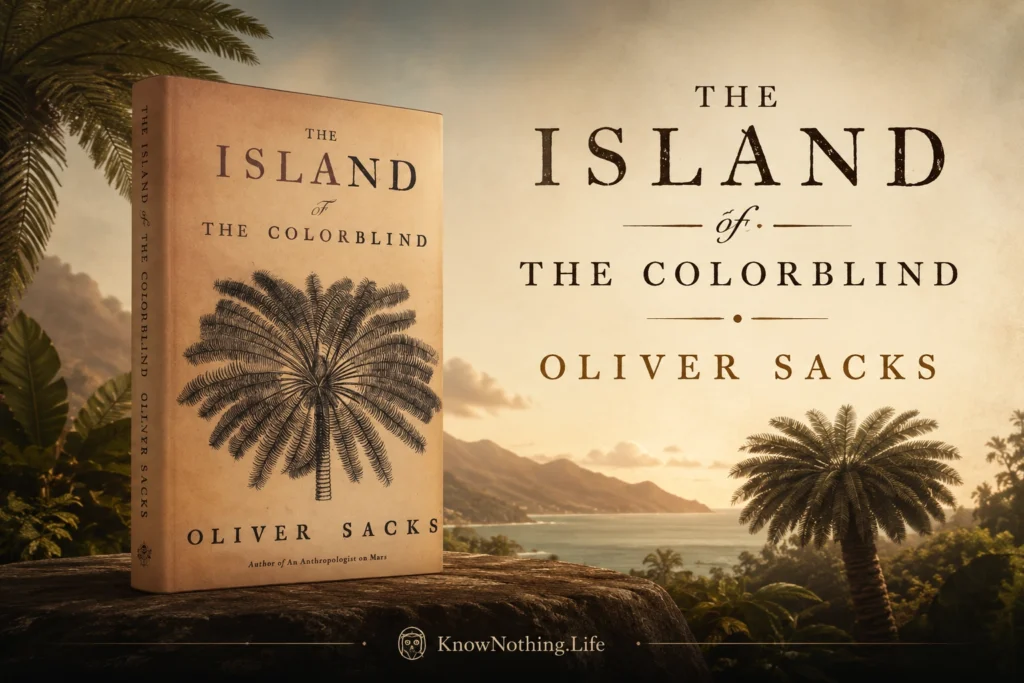
Oliver Sacks’ The Island of the Colorblind, published in 1997, is unlike most of his better-known neurological books. Instead of constructing the narrative around individual patients in hospitals or clinics, Sacks travels through Micronesia to investigate unusual conditions affecting entire populations. The book consists essentially of two connected journeys. The first takes him to Pingelap and nearby Pohnpei, where an extraordinarily high proportion of people inherit complete achromatopsia, a rare retinal disorder that eliminates normal cone-mediated color vision and makes bright daylight profoundly uncomfortable. The second, often called “Cycad Island,” brings him to Guam and Rota, where he investigates the historically devastating neurological syndrome known locally as lytico-bodig, now generally discussed as Guam amyotrophic lateral sclerosis–parkinsonism-dementia complex, or ALS-PDC. Sacks described himself during these travels as something like a “neuroanthropologist,” interested not only in disease but in the ways whole communities adapt to unusual neurological circumstances.
That expansion from clinical neurology into anthropology, genetics, botany, ecology, and history is the book’s defining feature. The Island of the Colorblind is part medical investigation and part travel writing, but it is also a meditation on islands themselves. Sacks shares the fascination of Charles Darwin and Alfred Russel Wallace with isolated environments in which geography can magnify biological processes that might remain almost invisible elsewhere. A rare recessive mutation can become common after a population bottleneck; an environmental exposure can potentially leave a neurological signature across generations; unusual plants can preserve evolutionary histories stretching into deep geological time. Sacks therefore treats the Pacific island not merely as scenery but as an intellectual laboratory. His central question is broader than “What causes this disease?” He wants to know how biology, history, environment, culture, and individual experience combine to produce a particular human world.
Pingelap and the Island of Complete Colorblindness
Sacks is drawn first to Pingelap, a remote coral atoll in Micronesia famous for an extraordinary concentration of complete achromatopsia. In the general population, the condition is rare—roughly one case in tens of thousands—but studies of the Pingelapese have estimated that approximately 4 to 10 percent of the population is affected, while a much larger proportion carries the recessive mutation. The disorder is locally associated with the term maskun. For Sacks, the numbers immediately transform an uncommon medical condition into a communal reality. Instead of an isolated child growing up in a world designed almost entirely for normal color vision, Pingelap contains extended families in which achromatopsia is familiar and culturally understood.
The concentration of the condition is a classic illustration of the founder effect. Historical accounts describe a catastrophic eighteenth-century typhoon that reduced Pingelap’s population to only a small number of survivors. As the population recovered, a recessive allele carried by the surviving group became unusually common. Modern genetic work subsequently identified the specific Pingelapese form of achromatopsia with a mutation in CNGB3, which encodes an essential component of the cyclic nucleotide-gated channel used in cone phototransduction. Researchers demonstrated that the Pingelapese disorder segregates with a CNGB3 mutation, helping establish that normal cone function requires the beta subunit encoded by this gene. Sacks was writing at precisely the moment when an old island legend about inheritance was becoming a molecular genetic story.
What a Colorless World Is Actually Like
Calling achromatopsia “colorblindness” can be misleading because it sounds like the relatively common inability to distinguish particular colors. Complete achromatopsia is far more consequential. People with the disorder have severely impaired or absent cone function while relying largely on rod-mediated vision. Clinical characteristics typically include very poor color discrimination, reduced visual acuity, congenital nystagmus, and intense photophobia. Because rods function most effectively under low illumination, bright tropical daylight can transform vision into an overwhelming glare rather than improving it. Sacks becomes fascinated by the reversal this creates on Pingelap: conditions most sighted visitors experience as visually magnificent—the blazing equatorial sun and brilliant colors—may be the least comfortable conditions for an achromatope.
The psychologically interesting question is what replaces color. Sacks listens as Pingelapese achromatopes describe an environment organized through brightness, contrast, texture, contour, movement, and subtle differences in luminance. This does not mean that losing color automatically gives someone superhuman sensitivity in other domains. Rather, a person who has always depended upon nonchromatic information learns to attend to features that trichromatic observers may routinely ignore. Modern research on color constancy reinforces the more general lesson: perception is not a simple copy of external physical properties. The visual system continuously computes relationships among illumination, surface reflectance, context, and sensory signals in order to construct relatively stable perceptual objects. Sacks’s islanders therefore challenge the intuition that everyone inhabits exactly the same perceptual world.
Color, Consciousness, and the Construction of Reality
This aspect of the book places The Island of the Colorblind beside Sacks’s earlier essay “The Case of the Colorblind Painter” in An Anthropologist on Mars, but the two conditions are importantly different. Mr. I lost color perception through cortical damage after a lifetime of seeing color; the Pingelapese achromatopes described by Sacks were generally born without normal cone-mediated color vision. Mr. I experienced colorlessness as catastrophic absence because his memories, art, expectations, and identity had formed in a chromatic world. Someone born with complete achromatopsia has no equivalent remembered world to lose. The comparison shows why identical descriptions such as “cannot see color” can conceal radically different psychological realities.
The philosophical implications recall both Johann Wolfgang von Goethe’s Theory of Colours and Maurice Merleau-Ponty’s Phenomenology of Perception. Whatever their scientific limitations, both traditions insist that color has to be understood partly as experienced color, not merely as wavelength. Modern vision science makes the same point more technically: physical light entering the eye must be interpreted by neural systems before it becomes the stable colors and surfaces of conscious experience. Sacks uses achromatopsia to make this abstract issue tangible. Color feels like an unquestionable property of the world—leaves simply are green and blood simply is red—yet the existence of a functioning color-vision system is one of the biological conditions that allows those properties to appear that way to us. Neurological variation reveals how much of what we call reality is a collaboration between world and nervous system.
Islands as Natural Experiments in Genetics and Adaptation
Pingelap also allows Sacks to explore one of the most important ideas in population biology: chance can have enormous biological consequences when populations are small. A destructive storm is a climatic event, yet because it radically reduced the number of people who contributed genes to future generations, its effects became visible biologically centuries later. Later health research on Pingelap has continued to describe the population bottleneck produced by the eighteenth-century disaster and the resulting unusual prevalence of achromatopsia. The story is therefore an unusually vivid demonstration that genes do not operate outside history. Natural disasters, migration, marriage patterns, isolation, and population growth all influence which genetic variants become common.
At the same time, Sacks resists treating the Pingelapese merely as specimens demonstrating Mendelian genetics. His interest lies in adaptation. Families organize schedules around daylight. People use dark glasses or seek shade. Some activities become easier in twilight or at night. Cultural knowledge about maskun allows experiences that might seem mysterious elsewhere to be recognized immediately. This is where his medical approach moves toward anthropology: a biological difference acquires its practical meaning inside a social environment. The disorder remains a genuine visual disability, especially under intense illumination, but the consequences are partly shaped by how a community accommodates it. Sacks’s perspective anticipates modern discussions of disability that examine not only what a body cannot do but also how environments either intensify or reduce limitations.
Guam, Lytico-Bodig, and a Much Darker Mystery
The second major journey takes Sacks into a very different neurological landscape. Among the Chamorro population of Guam, physicians had documented extraordinarily high historical rates of a progressive neurodegenerative syndrome locally called lytico-bodig. “Lytico” referred broadly to an ALS-like paralytic disease, while “bodig” was associated with parkinsonism and dementia. At its historical peak, Guam ALS-PDC occurred at rates many times higher than ordinary ALS elsewhere. Over subsequent decades, however, incidence declined dramatically and the typical age of onset increased—patterns that encouraged researchers to suspect that a changing environmental exposure might be involved.
Sacks travels with neurologist John Steele, visits Chamorro families, observes people with the disease, and listens to histories extending across generations. Once again, the community rather than the isolated clinical case becomes the unit of inquiry. Yet unlike Pingelapese achromatopsia, whose molecular cause would become comparatively clear, lytico-bodig remains a scientific mystery. Genetic surveys failed to identify a simple causative mutation, while epidemiological changes suggested that genes alone could not explain the syndrome. For Sacks, this uncertainty is intellectually irresistible. The disease becomes a detective story in which geography, diet, plants, war, migration, culture, and delayed neurodegeneration all become possible clues.
Cycads, BMAA, and the Problem of Scientific Uncertainty
The plant at the center of the most famous hypothesis is the cycad, an ancient seed plant for which Sacks had possessed a lifelong botanical fascination. Chamorro people traditionally processed cycad seeds into flour after extensive washing to remove toxins. Researchers proposed that chronic exposure to cycad compounds might help explain Guam’s neurological epidemic. Particular attention eventually focused on the amino acid BMAA, associated with cyanobacteria living symbiotically in cycad roots. Later researchers proposed that BMAA could become concentrated through the food web, including in flying foxes that consumed cycad material and were themselves traditionally eaten. Sacks and ethnobotanist Paul Alan Cox later became closely associated with this biomagnification hypothesis.
The scientific situation, however, remains contested, and this uncertainty is important when reading the book today. Some experimental and epidemiological work has supported environmental cycad-related hypotheses, including research focusing on BMAA, cycasin, and other cycad toxins. Other investigators have argued that evidence specifically identifying BMAA as the cause of ALS-PDC is insufficient, pointing to analytical inconsistencies, exposure uncertainties, and competing explanations. A major critical review concluded that existing evidence did not establish a causal BMAA-neurodegeneration relationship, while proponents subsequently published responses disputing that conclusion. The responsible modern summary is therefore that the cause of Guam ALS-PDC has not been conclusively established. Sacks’s story is valuable partly because it shows science before the mystery has been neatly solved.
Neurology Meets Botany and Deep Time
Cycads lead Sacks away from medicine into natural history. These ancient plants have evolutionary origins stretching deep into the geological past, and the sight of them flourishing on Pacific islands reawakens the botanical passion of his childhood. His journey to Rota becomes as much an encounter with ferns, cycads, forests, and island ecology as an investigation of disease. Contemporary reviewers noticed this unusual transformation: the book begins as neurological travel writing and gradually becomes a celebration of botany and island natural history. What might seem like a digression is actually central to Sacks’s worldview. Human nervous systems are biological structures embedded within evolutionary and ecological history.
Here The Island of the Colorblind recalls Darwin’s On the Origin of Species and Wallace’s writings on island biogeography. Islands compress processes that operate everywhere: species become isolated, populations diverge, unusual traits become common, and fragile ecosystems develop under particular combinations of geography and history. Sacks extends this logic to human disease. Pingelap demonstrates how demographic isolation can amplify a recessive mutation; Guam raises the possibility that a distinctive ecological and cultural exposure can influence neurological disease. In both cases, medicine becomes impossible to separate completely from ecology. Human beings are not merely brains inside bodies—they are organisms living among plants, foods, climates, pathogens, customs, and historical events.
The Psychology of Adaptation
Running beneath both halves of the book is Sacks’ longstanding fascination with adaptation. The Pingelapese achromatopes have not simply spent their lives wishing to possess normal trichromatic vision. They have learned ways of navigating a world in which illumination, contrast, shadow, and timing matter differently. This theme parallels many of Sacks’ other works. In A Leg to Stand On, he must reconstruct his own sense of bodily ownership after injury. In Seeing Voices, Deaf communities demonstrate how language can flourish visually rather than acoustically. In An Anthropologist on Mars, people reorganize their lives around radically altered neurological conditions. Sacks repeatedly returns to the idea that the nervous system is not merely a collection of capacities but a system capable of reorganizing itself around what remains possible.
Yet The Island of the Colorblind expands adaptation from the level of the individual to the level of the community. A culture can accumulate practical knowledge about a hereditary condition just as a person can develop compensatory strategies. This distinction matters psychologically because disability is never experienced in a vacuum. The same retinal physiology may produce different practical consequences in an environment filled with intense glare than in one designed around filtered lighting and accessible technologies. Sacks therefore anticipates an increasingly important idea in psychology and disability studies: functioning emerges from the relationship among individual capacities, learned strategies, social expectations, and environmental design.
Why The Island of the Colorblind Still Matters
Some aspects of the scientific landscape have changed substantially since Sacks traveled through Micronesia. The molecular basis of Pingelapese achromatopsia is now much clearer: genetic studies identified the CNGB3 mutation underlying the island’s distinctive founder population, and research on inherited achromatopsia now extends to retinal imaging, molecular mechanisms, and experimental gene therapies. The Guam story remains less settled. Environmental involvement appears plausible given the historical epidemiology, but no single cycad compound, toxin, gene, nutritional factor, or exposure has achieved universal acceptance as the definitive cause of lytico-bodig. That contrast itself makes the book scientifically instructive. Some mysteries yield to molecular genetics; others remain complicated after decades of investigation.
What survives most strongly is Sacks’ method. He begins with unusual neurological conditions but refuses to stop at the level of diagnosis. On Pingelap he asks what a world without color is like. On Guam he asks how a mysterious disease becomes woven into family and community history. Among cycads he asks how plants, diets, and evolutionary time might intersect with nervous systems. Across the islands he asks how isolation magnifies biological processes while simultaneously producing distinctive cultures of adaptation. The Island of the Colorblind ultimately becomes a book about the many scales at which a human life can be understood—from genes and photoreceptors to perception, family, culture, ecology, and geological history.
That is what makes the book more than an account of two exotic medical curiosities. Sacks uses the apparent strangeness of Pingelap and Guam to challenge the idea that ordinary human experience is biologically inevitable. Color vision depends upon particular retinal machinery. Population genetics depends partly upon accidents of history. Neurological disease may emerge from interactions extending across decades. Perception changes how environments appear, while environments influence how biological differences are lived. By the end of The Island of the Colorblind, the islands no longer seem like exceptions to normal human existence. They instead reveal, with unusual clarity, a truth that applies everywhere: every human mind exists at the intersection of biology, history, environment, and experience.