
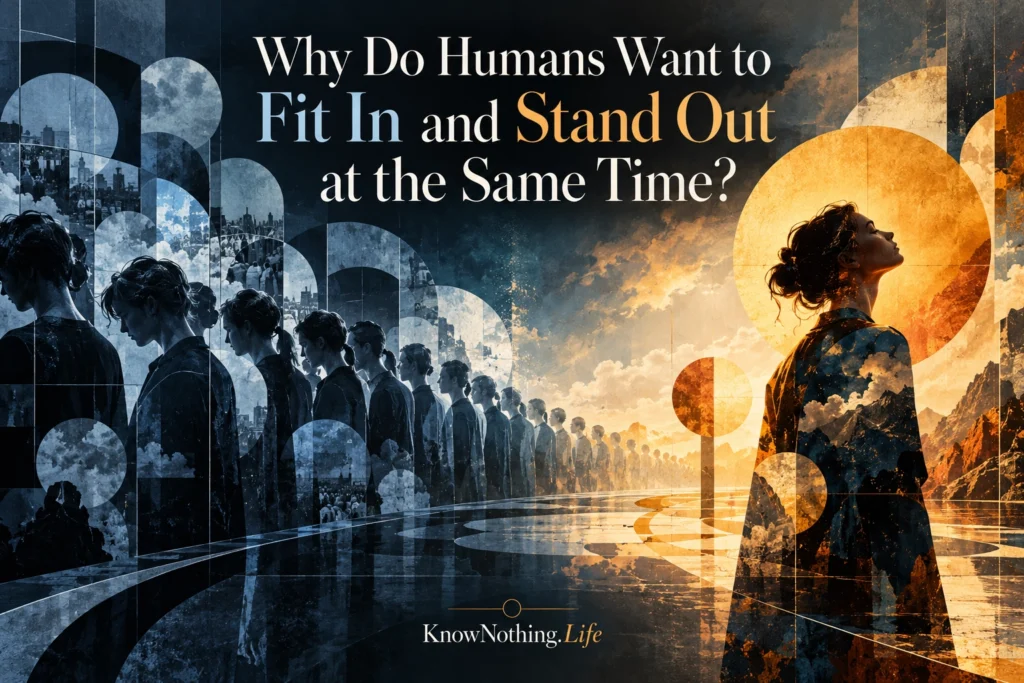
Human beings appear to want two contradictory things. We want acceptance, belonging, recognition, and the security of knowing that other people see us as members of the group. Yet we also want individuality. We want our tastes to feel personal, our achievements to be noticed, our personalities to seem distinctive, and our lives to possess something that cannot be reduced to everybody else’s. A person may buy clothes to fit the expectations of a social group while carefully choosing details that make the outfit unique. Teenagers may reject their parents’ culture only to dress almost identically to their friends. Professionals try to demonstrate that they understand the norms of their field while simultaneously attempting to distinguish themselves from their colleagues. Even people who proudly identify as nonconformists often belong to communities built around shared forms of nonconformity.
Psychology suggests that this tension is not a contradiction we need to eliminate. It may be a fundamental feature of human social life. We need enough similarity to others to belong, cooperate, communicate, and maintain social identity, but we also need enough difference to experience ourselves as distinct individuals. Social psychologist Marilynn Brewer captured this tension in her 1991 theory of optimal distinctiveness, arguing that identity reflects competing needs for inclusion and differentiation. Too little belonging creates isolation; too much similarity threatens individuality. Much of human behavior occurs in the narrow psychological space between these extremes.
Humans Are Social Creatures Before They Are Individualists
The desire to fit in begins with a basic fact about our species: humans survive through other humans. Aristotle famously wrote in the Politics that human beings are “by nature a political animal.” His point was not merely that people enjoy politics. Human flourishing occurs within communities because individuals depend on shared language, cooperation, traditions, institutions, and relationships. Long before modern civilization, exclusion from a social group could have carried severe consequences. Food, protection, information, child-rearing, and defense were often collective activities. Being accepted by others was therefore not simply emotionally pleasant; it could influence survival.
Modern psychology strongly supports the importance of belonging. In their influential 1995 paper “The Need to Belong,” Roy Baumeister and Mark Leary reviewed extensive evidence and argued that humans possess a fundamental motivation to form and maintain stable interpersonal relationships. People seek frequent positive interaction, suffer when important relationships dissolve, and respond strongly to exclusion. Later research on ostracism by Kipling Williams found that even relatively minor experiences of being ignored can threaten belonging, self-esteem, control, and a sense of meaningful existence. We may therefore care about fitting in because acceptance is deeply connected to how human social systems have always worked.
Belonging also tells us something about ourselves. Membership in a family, profession, nationality, friendship group, hobby community, or cultural movement provides categories through which identity becomes intelligible. Without social reference points, even individuality would be difficult to describe. Saying “I am different” immediately raises the question: different from whom?
Conformity Is Not Always Mindless
Few psychological studies are more famous than Solomon Asch‘s conformity experiments during the 1950s. Participants were asked to judge which of several lines matched a target line while surrounded by other people who had secretly been instructed to give incorrect answers. Although the correct answer was visually obvious, many participants conformed at least some of the time. Asch’s work demonstrated something uncomfortable: individuals can publicly adopt a group’s judgment even when the group appears clearly wrong.
Conformity is often portrayed as weakness, but that interpretation is too simple. Social psychologists distinguish between normative influence and informational influence. Normative influence occurs when people adapt their behavior because they want acceptance or want to avoid rejection. Informational influence occurs because other people can genuinely provide useful information. If everyone around you suddenly begins running from a building, following them before understanding why may be highly rational. Groups contain accumulated knowledge, and humans evolved in environments where ignoring the behavior of everyone else could sometimes be dangerous.
Muzafer Sherif’s earlier experiments using the autokinetic effect showed how groups can create shared judgments under ambiguous circumstances. When participants were uncertain about how much a stationary point of light appeared to move, their estimates gradually converged. Social influence therefore does more than pressure individuals to obey. It also helps humans construct common understandings when reality is uncertain. The problem arises when belonging becomes more important than accuracy. Human beings need groups, but groups can preserve bad beliefs just as easily as useful ones.
Yet Humans Also Have a Need to Feel Unique
If belonging were our only social motivation, human societies would probably be far more uniform than they are. Instead, people decorate their bodies, create distinctive styles, pursue unusual careers, develop personal tastes, collect rare objects, customize possessions, and search for ways to differentiate themselves. Psychologists C. R. Snyder and Howard Fromkin developed a theory of uniqueness during the 1970s arguing that people become motivated to restore a sense of individuality when they perceive themselves as excessively similar to others.
Their experiments demonstrated that people whose sense of uniqueness had been threatened could become more interested in unusual or scarce choices. Distinctiveness therefore has psychological value. We do not merely want to exist inside a group; we want to believe there is something recognizable about us within it.
This may explain why compliments concerning uniqueness can be unusually satisfying. Being told “you are exactly like everyone else” rarely feels flattering even when the comparison involves admirable people. We generally want both social approval and some evidence that the approval belongs specifically to us. The ideal message is often not “you fit perfectly” or “you are completely different,” but “you belong here, and you bring something no one else does.”
Optimal Distinctiveness Theory Explains the Paradox
Marilynn Brewer’s optimal distinctiveness theory provides one of the clearest explanations for why belonging and individuality coexist. Brewer proposed that humans balance two opposing needs: assimilation and differentiation. Assimilation draws us toward groups and similarity. Differentiation pushes us away from excessive sameness. When one need becomes overfulfilled, the other becomes psychologically more important.
Imagine arriving alone in a foreign country where almost nobody speaks your language. Encountering someone from your hometown may immediately feel comforting because the need for belonging has become strong. Now imagine attending a gathering where hundreds of people share your hometown, profession, clothing style, interests, and opinions. Suddenly the urge to distinguish yourself may become stronger. The same person can therefore seek similarity in one context and uniqueness in another without contradiction.
Brewer argued that social identities are especially satisfying when they provide both simultaneously. A group makes us similar to its members while making us different from outsiders. This is one reason relatively distinctive communities can become psychologically powerful. Being a member of a specialized profession, uncommon hobby, musical subculture, fandom, or minority intellectual movement can satisfy inclusion and uniqueness at once: “I belong to these people, but we are not everybody.”
Groups Let Us Stand Out Together
Henri Tajfel and John Turner’s social identity theory helps explain another strange feature of individuality: people frequently express uniqueness collectively. Instead of simply saying “I am different,” we say “we are different.” Football supporters, political movements, musical scenes, professions, universities, national cultures, and even consumer communities develop distinctive symbols, vocabulary, clothing, rituals, and values.
Once people identify strongly with a group, differences between “us” and “them” can become psychologically important. Tajfel’s famous minimal-group experiments demonstrated how surprisingly little is required for group distinctions to influence judgments. Participants assigned to essentially arbitrary categories could begin favoring members of their own group. Social identity does not merely describe existing differences; classification itself can create psychological significance.
This explains a familiar social paradox. A subculture may begin as rebellion against mainstream conformity and eventually develop strict rules of its own. Punk rejects conventional appearance but develops recognizable punk appearance. Alternative communities criticize mainstream tastes while establishing expectations about what authentic members should value. Countercultures become cultures. Humans therefore do not escape conformity by joining unconventional groups. We often trade one reference group for another.
Status Requires Similarity and Difference at the Same Time
Standing out also matters because social groups contain status hierarchies. To gain prestige, individuals typically need to demonstrate both competence within accepted standards and qualities exceeding those standards. A musician who ignores every convention may be incomprehensible, while one who perfectly imitates everyone else may be forgettable. Recognition often belongs to someone who understands the rules well enough to modify them successfully.
Research on status and conformity has repeatedly shown that high-status individuals can sometimes deviate from norms more safely than low-status individuals. Tom Hollander’s classic work on idiosyncrasy credits suggested that group members can earn freedom to deviate after demonstrating competence and commitment. Someone who has already proved loyalty to a group may be permitted greater individuality because their deviation is less likely to signal rejection of the group itself.
This produces an important social pattern: before people can safely stand out, they often first demonstrate that they fit in. The new employee learns organizational norms before challenging them. The artist masters established techniques before breaking them. The scientist learns a discipline’s methods before proposing a radical theory. Innovation often depends on a combination of conformity and departure rather than pure rebellion.
Fashion and Consumption Turn the Conflict Into a Marketplace
Few areas reveal the fit-in/stand-out dilemma as clearly as fashion. Clothing communicates membership while offering opportunities for distinction. Georg Simmel explored this paradox in his 1904 essay “Fashion.” He argued that fashion simultaneously satisfies the desire for social adaptation and the desire for differentiation. People imitate a group through fashion while using changing styles to distinguish themselves from other groups.
The pattern continues in modern consumer behavior. People buy recognizable brands because shared symbols communicate membership, but they also seek limited editions, personalization, unusual combinations, and products that signal individuality. Jonah Berger and Chip Heath’s research on identity signaling showed that people often select cultural preferences partly according to what those choices communicate about who they are. Consumers may abandon a product or style when an undesirable group adopts it because the symbolic meaning of the object has changed.
This is why mass-produced products can be marketed as expressions of individuality. Millions of consumers can purchase the same item because each believes it communicates something personal. What appears contradictory makes sense psychologically: individuality is often expressed through socially recognizable symbols. A completely private difference that nobody understands cannot function effectively as an identity signal.
Social Media Intensifies Both Desires
Digital culture has made the tension especially visible. Social platforms reward conformity through trends, algorithms, likes, follower counts, memes, shared formats, and rapidly spreading cultural norms. Users learn what kinds of posts receive attention and may adapt accordingly. At the same time, the platforms encourage everyone to construct a distinctive personal brand. We are asked to belong to the conversation while somehow remaining original within it.
This creates a difficult psychological environment because similarity and uniqueness become measurable. A person can see exactly how many people liked a post, how many followers someone else has, which trend is becoming popular, and whether their own attempt to stand out attracted attention. Social comparison that once occurred within relatively small communities can now happen against thousands or millions of people.
The result can produce an exhausting cycle. People imitate what succeeds, the imitation makes everything feel repetitive, and then everyone searches for a new way to appear authentic. Once the distinctive style becomes popular, it loses some of its distinctiveness and the cycle begins again. The modern demand to “be yourself” can therefore become another social command.
Philosophers Have Long Distrusted the Crowd
Western philosophy contains a long tradition warning that belonging can become intellectually dangerous. Ralph Waldo Emerson’s 1841 essay Self-Reliance declares, “Whoso would be a man must be a nonconformist.” Emerson was attacking the tendency to surrender individual judgment to social expectation. For him, mature individuality required trusting one’s own perception even when society disapproved.
Søren Kierkegaard was even more suspicious of mass opinion. In writings later collected under the theme “The Crowd Is Untruth,” he argued that responsibility belongs to individuals rather than anonymous crowds. Friedrich Nietzsche likewise attacked herd morality when he believed collective values prevented exceptional forms of individuality from emerging.
Yet total independence is probably impossible. Even Emerson wrote in a language inherited from others, addressed a community of readers, and drew upon intellectual traditions. The individual who rejects society still defines the rejection in relation to society. Philosophical independence therefore cannot mean having no social influences. It means becoming sufficiently aware of those influences that we can decide which ones deserve authority.
Psychological Health May Require Both Belonging and Individuality
The desire to fit in and the desire to stand out ultimately protect different human needs. Belonging provides security, companionship, shared meaning, and social recognition. Distinctiveness provides agency, individuality, self-definition, and the feeling that one’s existence is not interchangeable with everyone else’s.
Either need can become unhealthy when pursued without the other. Extreme conformity can produce self-silencing, groupthink, dependence on approval, and fear of difference. Extreme individualism can produce alienation, narcissism, loneliness, and the illusion that humans can flourish without social obligations.
A mature identity therefore does not require choosing between conformity and uniqueness. It requires knowing when each serves us. Sometimes the courageous act is refusing the crowd. Sometimes it is accepting that we need other people. Sometimes standing out expresses genuine individuality; sometimes it is merely another attempt to gain attention. Sometimes fitting in represents cowardice; sometimes it represents empathy, cooperation, or respect.
Humans want to fit in and stand out at the same time because neither complete sameness nor complete separation satisfies what it means to be a social individual. We want to be able to look around and say, “These are my people.” But we also want those people to look back and know exactly which one of us we are.