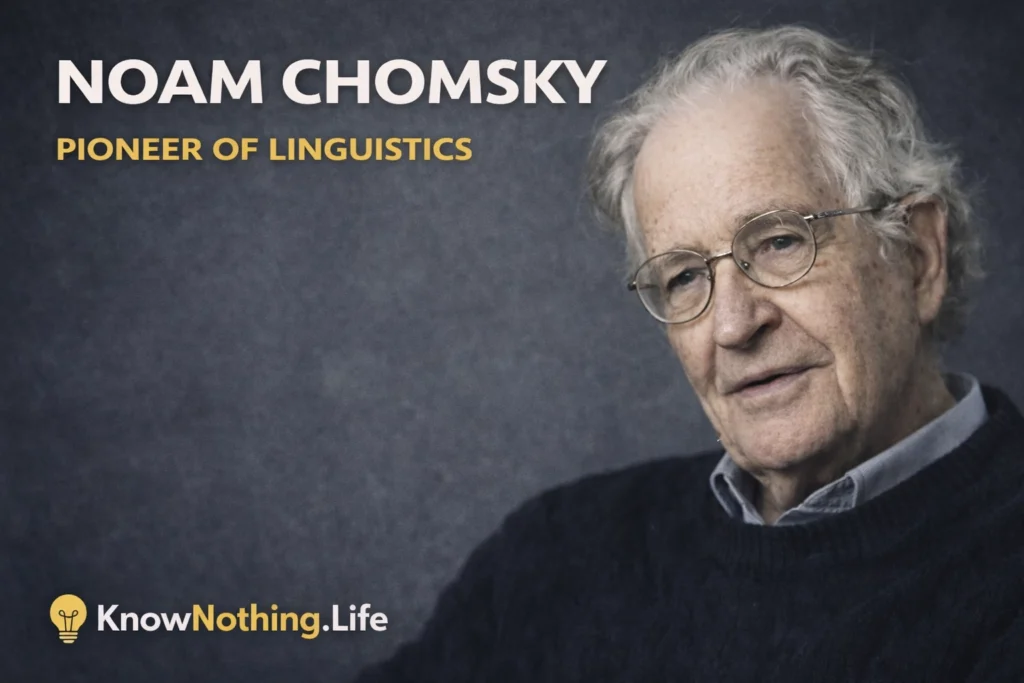
Noam Chomsky stands as one of the most influential intellectuals of the modern era, reshaping both the scientific study of language and the political critique of power. Few thinkers have achieved such dual prominence across disciplines that rarely intersect so forcefully. In linguistics, he revolutionized how scholars understand the human mind; in political thought, he became a relentless critic of state authority, corporate media, and imperial power. His work carries a rare combination of technical rigor and moral urgency, making him a central figure in both academic and public discourse.
Born on December 7, 1928, in Philadelphia, Chomsky emerged from a scholarly Jewish household steeped in linguistic and cultural traditions. His early exposure to Hebrew language studies and political debates surrounding fascism and war shaped his intellectual trajectory. Over the course of decades, he would develop theories that challenged foundational assumptions about human cognition while simultaneously speaking out against war, inequality, and propaganda. His legacy is not confined to a single discipline; rather, it lies in a broader project—understanding how human beings think, speak, and are governed.
Early Life and Intellectual Formation
Chomsky’s early years were marked by a profound curiosity about language and politics. His father, William Chomsky, was a respected scholar of Hebrew grammar, and his mother, Elsie, was politically engaged and socially conscious. These influences combined to create an environment where intellectual inquiry and ethical reflection were inseparable. As a child, Chomsky was already writing about the rise of fascism in Europe, demonstrating an early awareness of global political dynamics that would later define much of his work.
He attended the University of Pennsylvania, where he studied linguistics, philosophy, and mathematics. It was here that he encountered Zellig Harris, whose work in structural linguistics initially guided Chomsky’s thinking. However, Chomsky soon departed from the dominant behaviorist and structuralist paradigms of the time. Influenced by rationalist traditions associated with thinkers like René Descartes, he began to argue that language was not merely a product of environmental conditioning but rather an innate feature of the human mind.
This shift marked the beginning of what would become a profound intellectual revolution. Chomsky’s early work challenged the prevailing view that language learning could be explained solely through stimulus and response. Instead, he proposed that humans are born with an inherent capacity for language—a theory that would fundamentally alter the trajectory of cognitive science.
The Linguistic Revolution: Generative Grammar
Chomsky’s breakthrough came with the publication of Syntactic Structures in 1957, a work that transformed linguistics into a formal, scientific discipline concerned with the underlying structures of language. In this text, he introduced the concept of generative grammar—the idea that a finite set of rules can produce an infinite number of sentences. This approach shifted the focus from observable speech patterns to the mental systems that make language possible.
Central to his theory is the notion of a “universal grammar,” an innate set of principles shared by all human languages. According to Chomsky, children do not simply imitate speech; they actively construct grammatical systems based on limited input. This argument, often referred to as the “poverty of the stimulus,” suggests that the complexity of language cannot be explained without positing an inborn linguistic framework. As he famously stated, “Language is a mirror of mind in a deep and significant sense.”
Chomsky’s work directly challenged behaviorist theories, particularly those of B. F. Skinner, whose book Verbal Behavior attempted to explain language through conditioning. In a landmark review, Chomsky dismantled Skinner’s arguments, asserting that behaviorism failed to account for the creativity and generativity of human language. This critique played a pivotal role in what is now known as the cognitive revolution, which reoriented psychology toward the study of mental processes.
Language and Mind: Philosophical Foundations
Beyond its technical contributions, Chomsky’s linguistic theory carries profound philosophical implications. His work aligns with a rationalist tradition that views the human mind as structured and creative rather than passive and reactive. In this sense, Chomsky’s ideas echo those of Enlightenment thinkers who emphasized the inherent capacities of human reason. He argued that language is not merely a tool for communication but a fundamental component of human nature.
Chomsky’s conception of the mind emphasizes creativity as a defining feature of language use. Humans can produce and understand sentences they have never encountered before, demonstrating a capacity that cannot be reduced to learned behavior. This insight has implications not only for linguistics but also for fields such as philosophy, psychology, and artificial intelligence. It raises questions about the nature of knowledge, the limits of computation, and the uniqueness of human cognition.
He often framed his work in terms of a broader inquiry into what it means to be human. Language, in his view, provides a window into the structure of the mind and the biological foundations of thought. “The limits of my language,” he suggested in a spirit reminiscent of Ludwig Wittgenstein, “mean the limits of my world”—a sentiment that underscores the deep connection between linguistic capacity and human experience.
Political Thought and Activism
While Chomsky’s contributions to linguistics are monumental, his role as a political thinker is equally significant. Beginning in the 1960s, he emerged as a vocal critic of U.S. foreign policy, particularly during the Vietnam War. His essay “The Responsibility of Intellectuals” argued that scholars and citizens alike have a duty to expose government lies and challenge unjust power structures. This marked the beginning of a lifelong commitment to political activism.
Chomsky’s political philosophy is rooted in a form of libertarian socialism or anarcho-syndicalism. Drawing inspiration from figures like Mikhail Bakunin, he advocates for decentralized power, worker control, and democratic participation. He is deeply skeptical of both state authority and corporate power, viewing them as systems that often operate against the interests of ordinary people.
One of his most influential political works, Manufacturing Consent (1988), co-authored with Edward S. Herman, examines the role of mass media in shaping public opinion. The book introduces the “propaganda model,” which argues that media institutions serve elite interests by filtering information in ways that reinforce existing power structures. “The smart way to keep people passive and obedient,” Chomsky wrote, “is to strictly limit the spectrum of acceptable opinion, but allow very lively debate within that spectrum.”
Major Works and Intellectual Legacy
Chomsky’s body of work spans more than six decades and includes contributions to linguistics, philosophy, political theory, and media analysis. Among his most important linguistic works are Aspects of the Theory of Syntax (1965), which further developed the concept of deep and surface structures, and The Minimalist Program (1995), which sought to refine and simplify the principles of generative grammar.
In political thought, his writings are equally extensive and influential. Books such as Hegemony or Survival (2003) and Who Rules the World? (2016) analyze global power dynamics and critique U.S. foreign policy. Throughout these works, Chomsky maintains a consistent focus on exposing the mechanisms of power and advocating for greater democratic accountability.
His intellectual legacy is not limited to specific theories or texts but extends to an entire way of thinking. Chomsky encourages skepticism toward authority, rigorous analysis of evidence, and a commitment to truth. His influence can be seen across disciplines, from cognitive science to political activism, and his work continues to inspire new generations of scholars and thinkers.
Criticism and Controversy
Despite his immense influence, Chomsky’s ideas have not been without controversy. In linguistics, some critics argue that the concept of universal grammar is too abstract or biologically unsubstantiated. Alternative approaches, such as usage-based and emergentist theories, challenge the notion of innate linguistic structures. These debates reflect broader tensions within the field about the nature of language and cognition.
Chomsky’s political positions have also sparked significant debate. His critiques of U.S. policy and media institutions have earned him both admiration and criticism. Some view him as a principled defender of truth and justice, while others argue that his analyses can be overly critical or selective. Nevertheless, even his critics often acknowledge the depth and consistency of his arguments.
What remains undeniable is Chomsky’s willingness to engage with difficult and controversial issues. He has consistently used his platform to challenge dominant narratives and encourage critical thinking. This commitment to intellectual independence is a defining feature of his career.
Conclusion
Noam Chomsky’s life and work represent a remarkable synthesis of scientific innovation and moral engagement. In linguistics, he redefined the study of language as a window into the human mind, introducing concepts that continue to shape research today. In politics, he has served as a persistent voice of dissent, challenging systems of power and advocating for a more just and democratic world.
His legacy lies not only in the theories he developed but in the example he set as a public intellectual. Chomsky demonstrates that rigorous scholarship and ethical responsibility are not mutually exclusive but deeply interconnected. His work invites us to question what we are told, to seek deeper understanding, and to recognize the structures—both linguistic and political—that shape our lives.
As he once observed, “If we don’t believe in freedom of expression for people we despise, we don’t believe in it at all.” This statement captures the essence of his philosophy: a commitment to truth, freedom, and the enduring power of human reason.