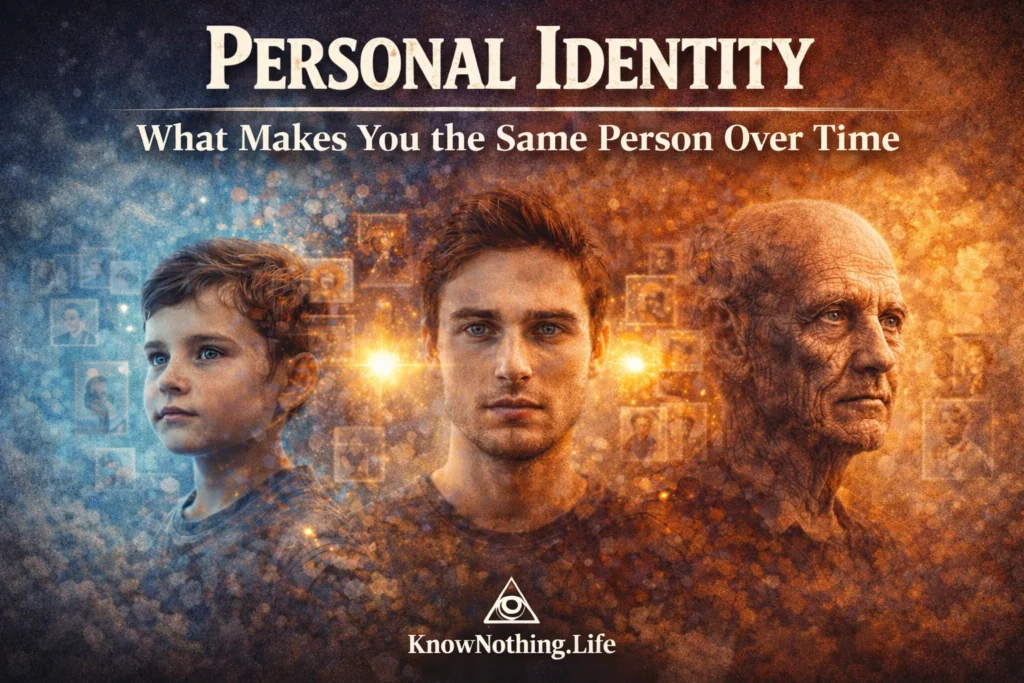
Personal identity is one of the most profound and persistent questions in philosophy: what makes you the same person across time? At first glance, the answer seems obvious—you are yourself because you have the same body, the same memories, and the same name. Yet upon closer examination, each of these criteria becomes uncertain. Bodies change, memories fade or distort, and even personality can shift dramatically. What, then, secures the continuity of the self?
This question is not merely theoretical. It lies at the foundation of moral responsibility, legal accountability, and psychological coherence. If a person commits an action in the past, in what sense is the present individual responsible? If identity is unstable, then the notion of a continuous self becomes difficult to defend. Philosophers across centuries have proposed different answers, ranging from the existence of an enduring soul to the idea that the self is nothing more than a collection of experiences. Each perspective reveals something essential about how humans understand themselves.
The Classical View: The Soul as Identity
In ancient philosophy, personal identity was often grounded in the concept of the soul. Plato argued that the true self is not the body but the immortal soul. In dialogues such as Phaedo, he described the soul as a stable, rational essence that persists beyond physical change. The body, by contrast, is temporary and subject to decay. This view provides a clear solution to the problem of identity: as long as the soul remains the same, the person remains the same.
Plato’s conception of the soul also carries ethical implications. If the soul is the true self, then the cultivation of virtue becomes a matter of aligning the soul with truth and reason. Identity is thus tied not only to continuity but to the development of character. The idea that the soul defines personal identity influenced both philosophical and religious traditions for centuries.
Aristotle offered a different but related account. In De Anima, he described the soul as the “form” of the body—the organizing principle that gives life and function to a living being. Unlike Plato, Aristotle did not treat the soul as a separate, immortal substance but as inseparable from the body. Identity, in this framework, is tied to the unity of form and matter, providing a more integrated account of the self.
Locke and the Psychological Continuity Theory
The modern discussion of personal identity was transformed by John Locke in An Essay Concerning Human Understanding. Locke rejected the idea that identity is based on substance—whether physical or spiritual—and instead proposed that personal identity is grounded in consciousness. According to Locke, a person is the same over time insofar as they can remember past experiences.
Locke famously argued that “as far as this consciousness can be extended backwards to any past action or thought, so far reaches the identity of that person.” This means that identity is not tied to the body or soul but to the continuity of awareness. If you can remember performing an action, then you are the same person who performed it.
This view has significant implications. It allows for the possibility that identity could persist even if the underlying substance changes, as long as consciousness remains continuous. However, it also raises challenges. What happens when memories are lost or altered? Can identity be fragmented or partially preserved? Locke’s theory opened the door to a more flexible understanding of the self, but it also introduced new complexities.
Hume and the Bundle Theory of the Self
David Hume took a more radical approach, rejecting the notion of a stable self altogether. In A Treatise of Human Nature, Hume argued that what we call the “self” is merely a bundle of perceptions—sensations, thoughts, and emotions—that are constantly changing. There is no underlying substance or essence that unifies these experiences.
Hume wrote, “I never can catch myself at any time without a perception, and never can observe anything but the perception.” This statement challenges the idea of a continuous identity. If the self is just a collection of experiences, then identity is not something that exists independently but something constructed by the mind.
The bundle theory emphasizes the fluidity of the self. It suggests that identity is not fixed but emerges from patterns of experience. While this view undermines traditional notions of personal identity, it also aligns with modern psychological insights into the changing nature of personality and cognition.
Kant and the Unity of Consciousness
In response to Hume’s skepticism, Immanuel Kant argued that the unity of the self is a necessary condition for experience. In Critique of Pure Reason, Kant introduced the concept of the “transcendental unity of apperception,” which refers to the capacity of the mind to unify diverse experiences into a coherent whole.
For Kant, the self is not an object that can be observed but a structural feature of consciousness. It is the “I think” that must be able to accompany all representations. Without this unifying function, experience would be fragmented and unintelligible. Identity, in this sense, is not something discovered but something that makes experience possible.
Kant’s view preserves a form of continuity without relying on substance or memory. It shifts the focus from what the self is to what it does—namely, organizing and synthesizing experience. This approach bridges the gap between rationalist and empiricist accounts, offering a more nuanced understanding of personal identity.
Contemporary Debates: Brain, Body, and Beyond
In contemporary philosophy, the problem of personal identity has been explored through thought experiments and advances in science. Philosophers such as Derek Parfit have challenged traditional assumptions, arguing that identity may not be what matters most. In Reasons and Persons, Parfit suggested that psychological continuity, rather than strict identity, is the key to understanding personal persistence.
Parfit’s famous thought experiments—such as teleportation scenarios—raise questions about whether identity can survive duplication or division. If a person’s mental states are perfectly replicated in another body, is that new individual the same person? Parfit concluded that identity is not a simple, all-or-nothing concept but a matter of degree.
Advances in neuroscience also contribute to the debate. The brain’s role in shaping personality and memory suggests that identity is closely tied to physical processes. Yet the subjective experience of self—the sense of being a continuous “I”—remains difficult to explain. These developments highlight the complexity of personal identity, showing that it cannot be reduced to a single factor.
Personal Identity and the Self in Everyday Life
Beyond philosophical theory, the concept of personal identity has practical significance in everyday life. It influences how individuals understand themselves, relate to others, and make decisions. The belief in a continuous self provides a sense of stability and coherence, allowing people to plan for the future and reflect on the past.
At the same time, the recognition of change is essential for growth. People evolve through experience, adapting to new circumstances and redefining their identities. This dynamic interplay between continuity and transformation is central to human development. It reflects the philosophical tension between stability and change, showing that identity is both persistent and fluid.
Psychologically, identity is shaped by memory, narrative, and social context. Individuals construct stories about their lives, creating a sense of unity across time. These narratives provide meaning and direction, even as the underlying experiences continue to change. In this way, personal identity is not only a metaphysical question but a lived reality.
Conclusion
The question of personal identity remains one of the most challenging and fascinating problems in philosophy. From the soul-based theories of Plato to the psychological account of John Locke and the skeptical critique of David Hume, it has inspired a wide range of perspectives. Each approach captures an aspect of the self—its continuity, its complexity, and its dependence on experience.
Whether identity is grounded in memory, consciousness, or something more fundamental, the debate reveals the depth of the human condition. Ultimately, personal identity may not have a single, definitive answer. Instead, it invites ongoing reflection, encouraging individuals to consider what it means to be the same person over time. In a world of constant change, this question remains as relevant as ever, shaping how we understand ourselves and our place in reality.