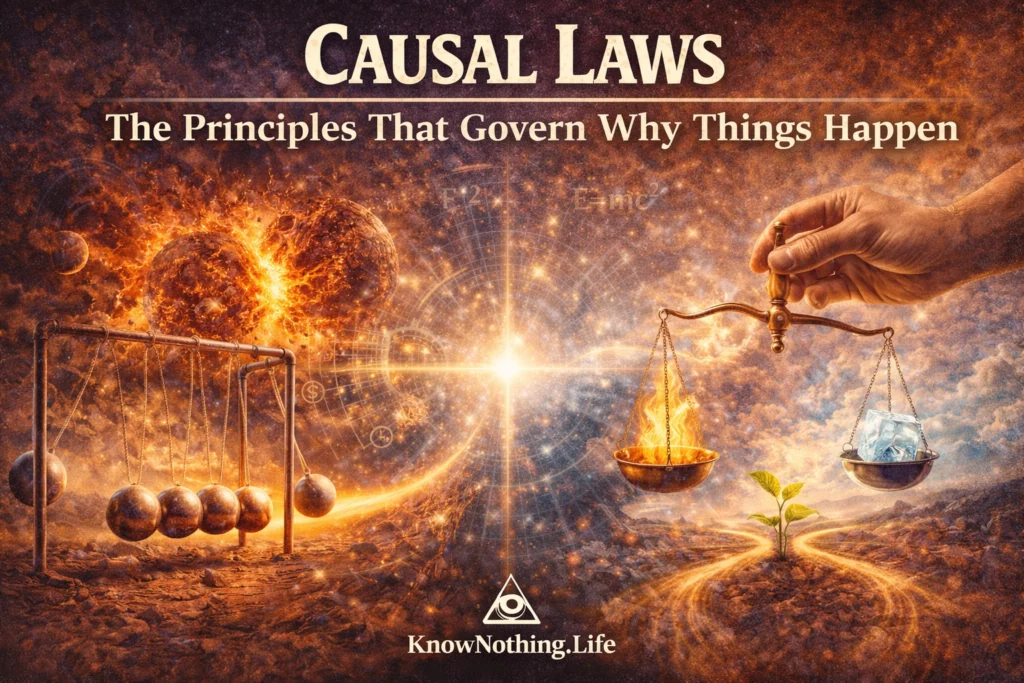
Causal laws are the backbone of explanation in both philosophy and science. They attempt to capture the regularities that govern how events unfold—why certain conditions reliably produce certain outcomes. Whether expressed as physical laws, biological processes, or everyday generalizations, causal laws provide the framework through which the world becomes intelligible.
Yet the nature of these laws is far from straightforward. Are causal laws real features of the universe, existing independently of human observation? Or are they descriptive tools—summaries of patterns we perceive? This question lies at the heart of metaphysics and epistemology, shaping how we understand causation, prediction, and scientific knowledge. The philosophical investigation of causal laws reveals a tension between necessity and regularity, between what must happen and what merely tends to happen.
Aristotle and Early Notions of Causal Order
The earliest systematic treatment of causation appears in the work of Aristotle, particularly in Physics and Metaphysics. Aristotle did not formulate causal laws in the modern scientific sense, but his theory of four causes laid the groundwork for thinking about structured explanations. He sought to understand not just that events occur, but why they occur in a coherent and ordered way.
For Aristotle, the world is intelligible because it follows patterns rooted in the nature of things. A seed becomes a tree not randomly, but because of its inherent form and purpose. This teleological perspective suggests that causal regularities are grounded in the essences of objects. While modern science has largely moved away from final causes, Aristotle’s emphasis on structured explanation continues to influence philosophical thought.
His approach highlights an important feature of causal laws: they are not merely about sequences of events but about intelligibility. To understand a phenomenon is to grasp the principles that govern its occurrence. This idea underlies the later development of scientific laws, even as the content of those laws changes.
Hume and the Regularity Theory
A major turning point in the philosophy of causal laws comes with David Hume, who offered a deeply skeptical analysis of causation. In An Enquiry Concerning Human Understanding, Hume argued that we never perceive causal necessity—only constant conjunction. When one type of event consistently follows another, we form the expectation that the pattern will continue.
Hume famously wrote, “All events seem entirely loose and separate. One event follows another; but we never can observe any tie between them.” This insight led to the regularity theory of causation, which holds that causal laws are nothing more than descriptions of observed patterns. There is no underlying necessity binding cause and effect—only the repetition of sequences.
This view has profound implications for the status of causal laws. If they are merely summaries of regularities, then they do not govern events but describe them. This challenges the idea that laws have any real power or necessity, reducing them to tools of prediction rather than explanations of why things must happen.
Kant and the Necessity of Causal Laws
In response to Hume’s skepticism, Immanuel Kant argued that causal laws are not derived from experience but are necessary conditions for it. In Critique of Pure Reason, Kant proposed that the mind imposes causal structure on the world, organizing sensory data into coherent sequences.
For Kant, causation is one of the fundamental categories of understanding. Without it, experience would be chaotic and unintelligible. He wrote that causality is a rule that “determines the connection of appearances.” This means that causal laws are not discovered in the world as independent entities but are essential for making sense of it.
Kant’s view restores necessity to causal laws, but locates it in the structure of human cognition rather than in the external world. This perspective bridges the gap between Hume’s empiricism and the need for stable, reliable laws. It suggests that causal laws are both indispensable and limited—indispensable for experience, but not necessarily reflective of ultimate reality.
Scientific Laws and the Nature of Explanation
In modern science, causal laws are often expressed as mathematical relationships that describe how variables interact. These laws allow for precise predictions and form the basis of scientific explanation. For example, Newton’s laws of motion describe how forces affect the movement of objects, providing a framework for understanding physical phenomena.
However, the philosophical interpretation of scientific laws remains contested. Are these laws merely descriptive, capturing regularities in nature, or do they reflect underlying causal mechanisms? Some philosophers argue for a realist view, in which laws correspond to real structures in the world. Others adopt an instrumentalist perspective, treating laws as useful models without committing to their literal truth.
The distinction between laws and explanations is also significant. A law may describe a pattern, but explaining why that pattern holds requires a deeper understanding of the mechanisms involved. This has led to the development of mechanistic theories of causation, which focus on the processes that produce observed regularities.
Counterfactuals and Modern Theories of Causal Laws
Contemporary philosophy has introduced new approaches to understanding causal laws, particularly through the use of counterfactual reasoning. David Lewis developed a counterfactual theory of causation, analyzing causal relationships in terms of what would happen under different conditions.
According to Lewis, a causal law can be understood as a pattern that supports counterfactual statements. If changing one condition would lead to a different outcome, this indicates a causal connection. This approach shifts the focus from observed regularities to hypothetical scenarios, providing a more flexible framework for analyzing causation.
Other philosophers emphasize the role of laws in supporting explanations and predictions. The best systems account, for example, suggests that causal laws are those that appear in the simplest and most informative systematization of the world. This perspective combines elements of realism and pragmatism, recognizing both the objective and functional aspects of laws.
Causal Laws and Human Understanding
Beyond their role in science, causal laws are central to human cognition. People naturally seek patterns and explanations, using causal reasoning to navigate the world. This tendency is evident in everyday judgments, from understanding social interactions to making decisions about the future.
Psychologically, humans often infer causal laws from limited data, sometimes leading to errors or biases. The tendency to see patterns where none exist reflects the importance of causation in making sense of experience. At the same time, it highlights the limitations of human reasoning, showing that our understanding of causal laws is shaped by both perception and interpretation.
Causal laws also play a role in shaping narratives. Individuals construct stories about events, linking causes and effects to create coherent accounts. These narratives provide meaning and direction, illustrating how causal reasoning extends beyond abstract theory into lived experience.
The Philosophical Significance of Causal Laws
The study of causal laws raises fundamental questions about the nature of reality. Are laws intrinsic to the universe, governing how events unfold, or are they constructs of human understanding? This question touches on broader issues of necessity, order, and explanation.
Causal laws also intersect with debates about determinism and free will. If the world is governed by strict laws, then events may be fully determined by prior conditions. If laws are less rigid or allow for exceptions, then there may be room for indeterminism and freedom. The interpretation of causal laws thus has implications for how we understand agency and responsibility.
Philosophically, causal laws represent an attempt to impose order on the complexity of the world. They reflect the human desire to find patterns and explanations, even in the face of uncertainty. This pursuit drives both scientific inquiry and philosophical reflection.
Conclusion
Causal laws remain a central concept in understanding why things happen. From the structured explanations of Aristotle to the skeptical analysis of David Hume, the transcendental framework of Immanuel Kant, and the modern theories of David Lewis, the concept has evolved across centuries.
These perspectives reveal that causal laws are not simple or self-evident. They involve complex interactions between observation, reasoning, and interpretation. Whether understood as real features of the world or as tools for organizing experience, they remain essential for making sense of reality.
Ultimately, the study of causal laws reflects the broader philosophical quest for explanation. It challenges us to consider not only what happens, but why it happens, and to explore the limits of our understanding. In doing so, it continues to shape both philosophy and science, guiding the search for knowledge and meaning.