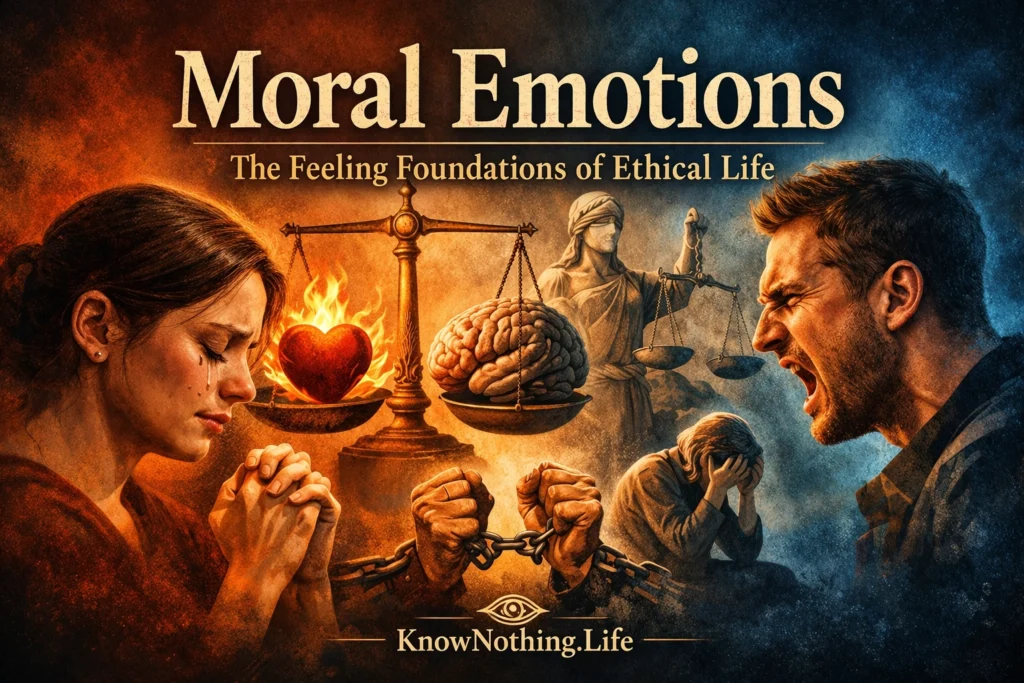
Moral emotions are the feelings that arise in response to moral situations—emotions such as empathy, guilt, shame, indignation, and compassion that shape how individuals perceive and respond to right and wrong. While traditional ethical theories often emphasize reason, rules, or consequences, the study of moral emotions reveals that ethical life is deeply rooted in human feeling. These emotions guide behavior, influence judgment, and motivate action, often operating more quickly and powerfully than deliberate reasoning.
The importance of moral emotions has been recognized since early philosophy. David Hume famously argued that morality is grounded in sentiment, asserting that “morality is more properly felt than judged.” This perspective challenges the rationalist view that ethical decisions are primarily the result of logical deliberation. Instead, it suggests that emotions are not obstacles to moral reasoning but essential components of it.
In contemporary research, moral emotions are studied across disciplines, including psychology, neuroscience, and philosophy. These fields converge on the idea that emotions play a central role in ethical life, shaping not only individual decisions but also social norms and institutions. Understanding moral emotions provides insight into how people develop moral values, respond to injustice, and navigate complex social relationships.
Historical Foundations and Philosophical Perspectives
The role of emotion in morality has been a subject of philosophical debate for centuries. David Hume’s sentimentalism stands as one of the most influential accounts, emphasizing that moral distinctions arise from feelings of approval and disapproval. In A Treatise of Human Nature, Hume argued that reason alone cannot motivate action; it is emotion that ultimately drives moral behavior. This view places moral emotions at the core of ethical life, suggesting that they are indispensable for understanding right and wrong.
In contrast, Immanuel Kant offered a rationalist account of ethics that downplays the role of emotion. In Groundwork of the Metaphysics of Morals, Kant argued that moral worth arises from acting out of duty, guided by rational principles rather than inclination. While he did not deny the existence of moral emotions, he regarded them as unreliable guides to ethical action. This tension between reason and emotion remains a central theme in the study of moral emotions.
Later philosophers sought to reconcile these perspectives. Adam Smith, in The Theory of Moral Sentiments, emphasized the role of sympathy in moral judgment. He argued that individuals evaluate actions by imagining how they would feel in another’s situation, a process that fosters empathy and social cohesion. Smith’s account highlights the social dimension of moral emotions, showing how they contribute to shared moral norms and mutual understanding.
Types of Moral Emotions
Moral emotions can be broadly categorized into self-directed and other-directed emotions, each playing a distinct role in ethical life. Self-directed emotions, such as guilt and shame, arise when individuals reflect on their own actions. Guilt typically involves recognition of wrongdoing and a desire to make amends, while shame is associated with a negative evaluation of the self. These emotions serve as internal regulators, encouraging individuals to adhere to moral standards.
Other-directed emotions, such as anger, indignation, and compassion, are responses to the actions and experiences of others. Moral anger arises when individuals perceive injustice or wrongdoing, motivating efforts to correct or punish it. Compassion and empathy, on the other hand, involve concern for the well-being of others and often lead to prosocial behavior. These emotions play a crucial role in fostering cooperation and social harmony.
A third category includes emotions related to admiration and elevation, which arise in response to virtuous behavior. Witnessing acts of kindness or courage can inspire individuals to emulate those actions, reinforcing positive moral norms. This dynamic illustrates how moral emotions not only regulate behavior but also promote the development of ethical character within communities.
Empathy and Compassion in Moral Judgment
Empathy is one of the most extensively studied moral emotions, defined as the ability to understand and share the feelings of others. It allows individuals to perceive the impact of their actions on others, fostering a sense of connection and responsibility. Martin Hoffman, in Empathy and Moral Development, argued that empathy is a key driver of moral behavior, particularly in early childhood. As individuals develop the capacity to empathize, they become more attuned to the needs and suffering of others.
Compassion builds on empathy by adding a motivational component—a desire to alleviate suffering. It is not merely about understanding another’s pain but about responding to it with care and action. Compassion plays a central role in many ethical traditions, from religious teachings to contemporary human rights discourse. It motivates acts of charity, caregiving, and social justice, reflecting the moral importance of attending to others’ well-being.
However, empathy and compassion are not without limitations. They can be biased, favoring those who are similar or close to us, and may not always lead to fair or rational decisions. Critics argue that relying too heavily on empathy can result in partiality and emotional overwhelm. This has led some philosophers to advocate for a balance between emotional engagement and rational deliberation in moral judgment.
Guilt, Shame, and Moral Accountability
Guilt and shame are central to the experience of moral accountability, shaping how individuals respond to their own wrongdoing. Guilt is typically associated with specific actions and involves a recognition of harm caused to others. It often motivates reparative behavior, such as apologizing or making amends. In this sense, guilt plays a constructive role in maintaining moral relationships and social cohesion.
Shame, by contrast, involves a broader evaluation of the self and can be more psychologically complex. It may lead to withdrawal, defensiveness, or attempts to restore one’s social standing. While shame can reinforce moral norms, it can also have negative effects, particularly when it becomes excessive or stigmatizing. Understanding the distinction between guilt and shame is important for assessing their roles in ethical life.
June Tangney has conducted extensive research on these emotions, highlighting their different psychological and behavioral outcomes. Her work suggests that guilt is generally associated with positive moral behavior, while shame can be more problematic. These findings underscore the importance of examining moral emotions not only in philosophical terms but also in empirical contexts.
Moral Emotions in Society and Culture
Moral emotions are not only individual experiences but also social phenomena that shape collective behavior and cultural norms. Emotions such as outrage, pride, and solidarity play a significant role in social movements and political discourse. They can mobilize individuals to take action, challenge injustice, and promote change.
Cultural differences influence how moral emotions are expressed and interpreted. What evokes shame or pride in one society may differ in another, reflecting variations in values and social expectations. This highlights the importance of context in understanding moral emotions and their role in ethical life.
At the same time, certain moral emotions appear to be universal, rooted in shared human experiences. Empathy, for example, is observed across cultures and is often seen as a fundamental aspect of human morality. This suggests that while moral emotions are shaped by culture, they also reflect common features of human psychology.
Conclusion
Moral emotions are a fundamental component of ethical life, shaping how individuals perceive, evaluate, and respond to moral situations. From empathy and compassion to guilt and indignation, these emotions guide behavior, reinforce social norms, and motivate action. They reveal that morality is not only a matter of abstract principles but also of lived experience and human connection.
The contributions of thinkers such as David Hume, Adam Smith, and Martin Hoffman highlight the enduring importance of emotion in ethical theory and practice. Their work underscores the need to integrate emotional and rational perspectives in understanding morality.
Ultimately, moral emotions remind us that ethics is deeply human. By exploring the feelings that underlie moral judgment, we gain a richer understanding of how people navigate the complexities of right and wrong. In doing so, we can cultivate a more compassionate and reflective approach to ethical life.