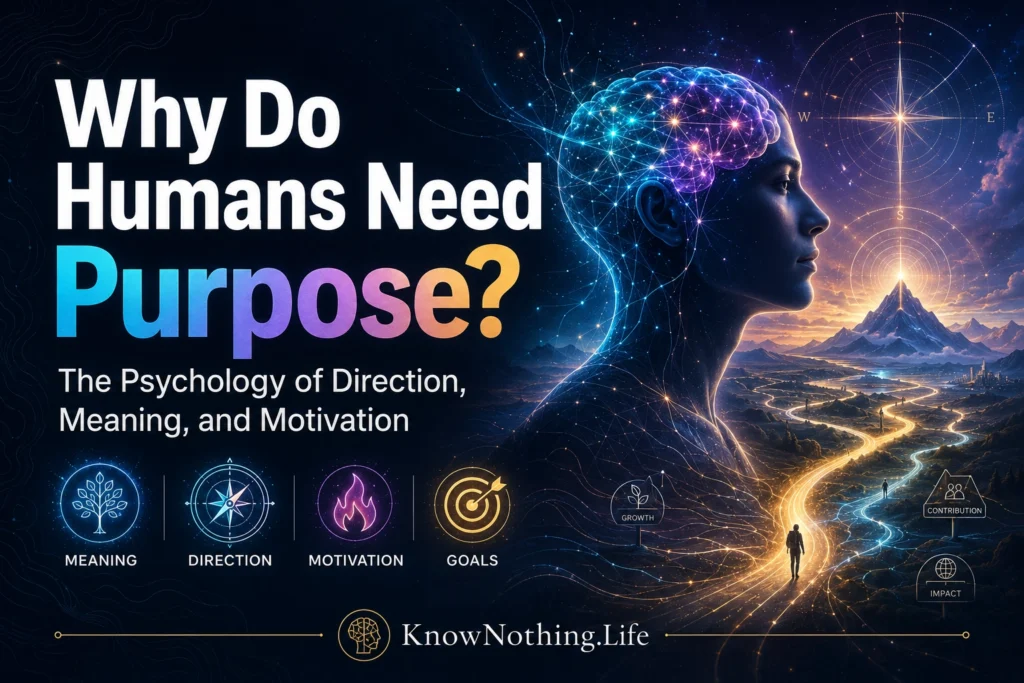
Purpose is a durable sense that life is directed toward goals that matter. It differs from pleasure, which concerns feeling good in the present, and from meaning more broadly, which can include the sense that life is coherent and significant. A person may understand why events happened yet still feel directionless, or may pursue a demanding purpose without feeling happy every day. Psychologist Carol Ryff treated purpose in life as one of six dimensions of psychological well-being. Her work helped establish that well-being involves more than positive emotion or life satisfaction; it also includes having aims and a sense of direction.
Humans do not need one grand, permanent mission, and purpose does not have to take the form of a prestigious career or historic achievement. It can be organized around raising children, mastering a craft, caring for relatives, serving a community, creating knowledge, or living according to deeply held values. Recent efforts to clarify the concept describe purpose as involving commitment, future direction, and personal significance. Its content varies across cultures and stages of life, but its function is similar: purpose links present actions to a future that feels worth helping to create.
Purpose Organizes Motivation
Human beings can imagine futures that do not yet exist and choose actions whose rewards may be delayed for years. That ability creates a motivational problem because numerous possible goals compete for attention. Purpose acts as a higher-order organizing principle, helping people decide which discomforts are worth tolerating, which opportunities deserve effort, and which short-term rewards should be declined. A student may continue through a difficult course because it serves a desired vocation; a caregiver may perform exhausting tasks because protecting another person is part of who they intend to be.
Self-determination theory helps explain why some purposes energize people while others become burdens. Edward Deci and Richard Ryan proposed that sustained motivation and well-being are supported by autonomy, competence, and relatedness: choosing one’s actions, becoming effective, and remaining connected to others. A purpose imposed through fear, shame, or status may motivate temporarily while producing alienation. One that reflects chosen values, allows growing competence, and connects a person with others is more likely to become self-sustaining. Purpose is not merely possession of a goal; it is the integration of goals with identity and psychological needs.
Purpose Creates Continuity and Identity
Life is experienced as changing roles, relationships, successes, disappointments, and accidents. Purpose helps arrange these events into a narrative. It tells a person not only what they are doing but why their actions belong together. Without that framework, work can feel like a collection of obligations and setbacks can appear meaningless. With it, the same effort may become evidence of persistence, service, learning, or commitment. Purpose gives the present a temporal structure by connecting memories of the past with intentions for the future.
Longitudinal research involving more than 11,000 American adults found that increases in purpose predicted later positive changes in several personality traits, including greater conscientiousness, emotional stability, and agreeableness. The relationship can also work in the other direction: organized, socially engaged people may find it easier to maintain purpose. Purpose is therefore both a product and a shaper of personality. Repeatedly acting toward valued goals can gradually change how people see themselves and which behaviors feel natural.
Purpose Helps People Endure Difficulty
Purpose does not remove pain, uncertainty, or loss. Its value is that it can place hardship inside a larger frame. Viktor Frankl’s Man’s Search for Meaning developed this idea through his account of imprisonment in Nazi concentration camps and his theory of logotherapy. Frankl argued that people can sometimes endure unavoidable suffering by locating a responsibility, relationship, or future task that still calls for a response. This should not be misread as saying that suffering is automatically meaningful or that victims must transform every trauma into growth.
Research supports a relationship between meaning and resilience. Greater meaning in life has been associated with less repetitive negative thinking and lower distress after stressors, while a recent project combining longitudinal analysis with a randomized intervention found that strengthening meaning could improve resilience. Meta-analytic evidence also links purpose with lower depression and anxiety, although the relationship is bidirectional: depression can erode the energy and future orientation needed to feel purposeful. Purpose is a psychological resource, not immunity from mental illness.
Purpose Is Usually Social
Many durable purposes extend beyond the isolated self. People often find direction through caregiving, teaching, friendship, faith communities, science, art, activism, mentorship, or building something that benefits others. Research suggests that goals connected with affiliation, kin care, and contribution are often experienced as purposeful. This fits a social species whose survival has long depended on cooperation. Purpose tells people where they are needed, and being needed can transform routine effort into evidence that one’s life has consequence.
The social nature of purpose helps explain why retirement, bereavement, unemployment, disability, or children leaving home can produce a crisis of direction. The loss may include the disappearance of a structure through which someone contributed and received recognition. Research among older adults links generativity—the desire to guide and support later generations—with greater purpose, partly through social support. New purpose often develops when people find a different form for the same underlying value, such as mentoring after retirement or volunteering after a caregiving role ends.
Purpose May Support Health and Longevity
Purpose is associated with a range of health outcomes, but the evidence requires caution. In a longitudinal study spanning adulthood, Patrick Hill and Nicholas Turiano found that greater purpose predicted a lower risk of death during follow-up. A 2026 meta-analysis combining data from 488,765 participants followed for as long as 32 years likewise found a consistent association between higher purpose and lower mortality risk. These studies do not prove that purpose directly lengthens life, because healthier people may find it easier to remain purposeful and social advantages may influence both.
Several pathways may contribute. Purpose can make future consequences feel relevant, encouraging physical activity, preventive care, medication adherence, and other health-supporting behavior. An outcome-wide longitudinal analysis of nearly 13,000 older Americans linked higher purpose with later improvements across numerous behavioral, physical, and psychosocial measures. Other studies have associated purpose with lower disability risk and better cognitive outcomes. One cohort linked greater purpose with reduced incidence of Alzheimer’s disease and mild cognitive impairment, although observational findings cannot establish that purpose prevents neurodegeneration.
Purpose Changes Across the Lifespan
Purpose is not discovered once and protected unchanged. Adolescents explore identities and possible futures. Early adulthood may emphasize vocation, partnership, and independence, while midlife often shifts toward caregiving, contribution, and generativity. Later life may require revising purpose after retirement, illness, bereavement, or reduced physical ability. A purpose that was adaptive in one period can become impossible in another. Psychological health depends partly on preserving direction while allowing its form to change.
Purpose can become harmful when it is excessively narrow, perfectionistic, or fused with one role. Someone who believes life has value only through professional success may collapse when a career ends. Collective purposes can motivate sacrifice while also being used to justify exclusion or self-neglect. Healthy purpose needs ethical limits, flexibility, and room for relationships, rest, and revision. It should organize life without consuming every part of it.
How People Build Purpose
People often wait for purpose to arrive as a revelation, but it more commonly develops through action. Research on its antecedents suggests that health, social connection, positive emotion, and active engagement can precede a stronger sense of direction. Purpose grows when people notice what repeatedly holds their attention, where their abilities meet a genuine need, and which responsibilities they remain willing to carry without recognition. Small commitments create evidence about what matters, and that evidence can become a larger direction.
Humans need purpose because consciousness reaches beyond immediate survival. People remember, anticipate, compare possible futures, and know that time is limited. Purpose turns values into goals and goals into daily behavior. It does not explain the cosmic meaning of existence, guarantee happiness, or protect anyone from loss. Its function is more grounded: it helps people decide what to move toward, why effort is worthwhile, and how an individual life can become connected to something larger than the present moment.