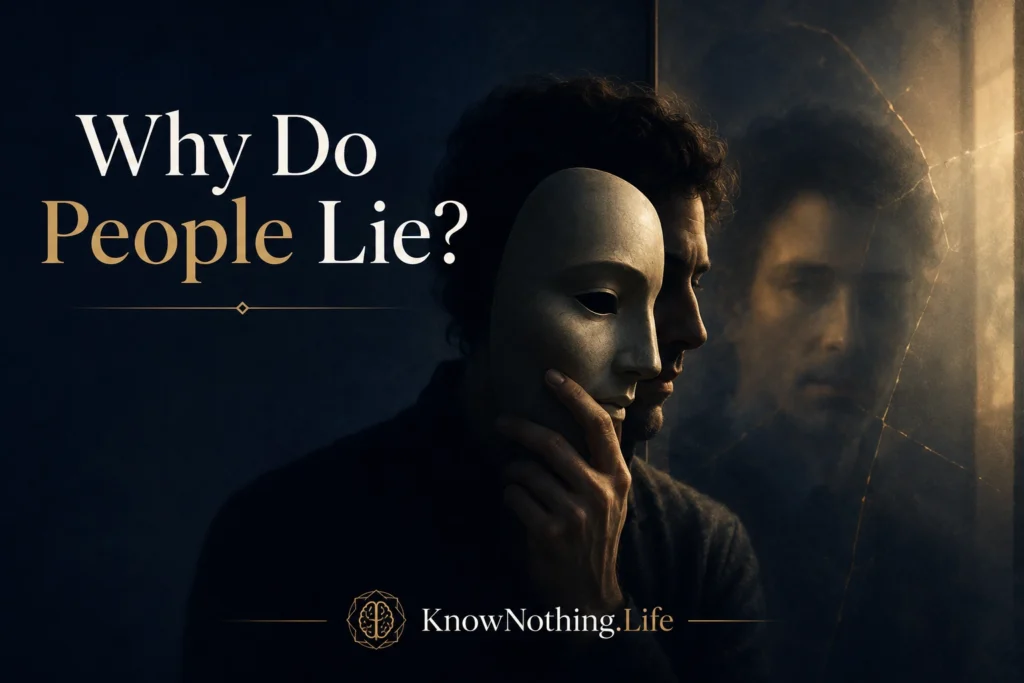
People lie for many reasons: fear, shame, advantage, politeness, self-protection, love, greed, insecurity, loyalty, or the desire to control how others see them. A lie may be cruel, strategic, cowardly, protective, playful, or desperate. A child denies breaking something because punishment feels too threatening. A politician hides a scandal to protect power. A friend says “I’m fine” because the truth feels too heavy to explain. A person exaggerates success because they fear being ordinary. Lying is not one simple behavior with one simple motive. It is a human strategy for managing danger, desire, identity, and social life.
A lie is usually defined as an intentional attempt to make someone believe something the speaker believes is false. That definition matters because people can say false things without lying if they believe them. They can also lie without speaking, through omission, silence, fake emotion, staged evidence, or selective truth. Lying requires imagination. The liar must think not only about reality, but about another person’s mind. This is why deception is closely related to theory of mind: the ability to understand that other people have beliefs, expectations, and blind spots that can be influenced.
The Moral History of Lying
Human societies have always feared lying because trust is one of the foundations of civilization. Courts, contracts, marriage, trade, education, religion, science, and friendship all depend on the belief that words usually connect to reality. Ancient legal codes punished false witness because justice collapses when testimony becomes unreliable. Religious traditions often treated lying as a spiritual danger because speech was seen as a bridge between the inner person and the public world. To corrupt speech was to corrupt the soul and the community at the same time.
Philosophers have disagreed about whether lying is always wrong. Augustine argued in On Lying that every lie is sinful because language exists to communicate truth. Immanuel Kant took an even stricter position. In his moral philosophy, lying violates duty because it treats another rational person as a tool rather than as someone capable of making their own judgment. Kant’s famous claim that one should not lie even to a murderer at the door remains controversial because it reveals the tension between moral principle and human consequence. If honesty leads to harm, is it still required? Kant says yes. Many later thinkers say morality must also consider outcomes.
Philosophical Views of Deception
Consequentialist philosophers such as Jeremy Bentham and John Stuart Mill judge lying by its results. From that view, a lie that saves a life, prevents cruelty, or protects someone from unjust harm may be morally different from a lie used to exploit or betray. Virtue ethics, rooted in Aristotle, asks a different question: what does lying do to the character of the liar? Even small lies can train the soul toward cowardice, manipulation, or self-division. A person becomes what they repeatedly practice, and a habit of dishonesty may slowly weaken the ability to face reality.
Friedrich Nietzsche complicated the issue by questioning whether human beings truly love truth as much as they claim. In “On Truth and Lies in a Nonmoral Sense,” he suggested that what people call truth often rests on metaphor, convention, and shared illusion. Nietzsche did not simply defend lying, but he exposed something uncomfortable: people often prefer useful illusions to painful truths. Modern psychology confirms this in ordinary life. People do not only deceive others. They rationalize, minimize, exaggerate, and rewrite their own motives. The lie told outwardly often begins as a compromise made inwardly.
Psychological Motives for Lying
The most common motive for lying is self-protection. Truth can carry consequences: punishment, rejection, humiliation, conflict, loss of status, or exposure. When the truth feels dangerous, lying becomes a shield. This begins early in childhood. A child who learns that honesty brings explosive anger may discover that denial sometimes feels safer. Adults repeat the pattern in more sophisticated forms. They conceal mistakes at work, hide financial problems, deny emotional affairs, exaggerate competence, or avoid difficult conversations because the immediate cost of honesty feels too high.
Another motive is impression management. Sociologist Erving Goffman, in The Presentation of Self in Everyday Life, argued that social interaction often resembles performance. People present different versions of themselves depending on the audience. Not all performance is dishonest; politeness, privacy, and restraint are necessary parts of social life. But the boundary becomes thin when self-presentation turns into deliberate distortion. Many lies are attempts to appear more desirable, successful, generous, intelligent, loyal, or innocent than one feels. The person is not only hiding facts. They are trying to manage identity.
Schools of Psychology and the Meaning of Lies
Psychoanalytic theory sees lying partly as defense. Sigmund Freud’s ideas about repression, rationalization, and unconscious conflict suggest that people may hide truth because it threatens the ego. A person may insist they are not angry, not jealous, not afraid, or not guilty because admitting the feeling would disturb their self-image. In this sense, lying is sometimes a symptom of inner division. The person cannot tell the truth to others because they have not fully admitted it to themselves.
Behaviorism explains lying through reinforcement. If lying helps someone avoid punishment, gain reward, receive attention, or escape discomfort, the behavior becomes more likely. Cognitive psychology studies the mental work involved: lying requires memory, inhibition, planning, and monitoring the listener’s beliefs. Social psychology studies how groups, authority, competition, and anonymity affect honesty. Evolutionary psychology adds a darker insight: deception can be adaptive. It can help organisms gain resources, avoid threats, attract mates, or protect alliances. Human morality did not erase deception. It created norms to control a behavior that has always had survival value.
What University Studies Show About Lying
Modern research suggests that lying is common, though not evenly distributed. Psychologist Bella DePaulo’s classic diary studies found that college students reported telling about two lies per day, while community members reported about one lie per day. Many of these were not dramatic betrayals but everyday lies used to protect the self, avoid conflict, or smooth interaction. This research matters because it shows that lying is not limited to criminals, narcissists, or pathological personalities. It is woven into ordinary social life.
Robert Feldman’s University of Massachusetts research reached a similar conclusion. His study found that 60 percent of participants lied at least once during a 10-minute conversation, often while trying to appear likable or competent. Dan Ariely, in The Honest Truth About Dishonesty, argues that people often cheat or lie just enough to benefit while still seeing themselves as good. This helps explain why many dishonest acts are small. People want the reward of lying without the identity of being a liar. They bend the rule, omit the fact, exaggerate the story, and then protect themselves with the thought that it was not serious.
The Psychological Cost of Lying
Lying affects the person who is deceived, but it also affects the liar. For the deceived person, a lie can damage trust, distort decisions, and create emotional injury. Betrayal hurts because it does not merely reveal false information; it rewrites the meaning of the past. A person discovers that they were making choices inside someone else’s hidden version of reality. This can produce grief, anger, anxiety, suspicion, and difficulty trusting again.
For the liar, deception creates cognitive and emotional burden. A lie must be remembered, protected, updated, and defended. The person may feel guilt, fear of exposure, or the numbness that comes from repeating dishonesty too often. University of Notre Dame research led by Anita Kelly found that when participants reduced everyday lies over a 10-week period, they reported improvements in mental and physical health. The finding is psychologically sensible: honesty reduces the strain of self-monitoring. A truthful life is not always easy, but it is often simpler.
Self-Deception and the Need to Believe
The most subtle form of lying is self-deception. People lie to themselves because some truths threaten identity, comfort, belonging, or hope. A person may deny addiction, excuse cruelty, minimize a failing relationship, exaggerate victimhood, or insist they are acting from noble motives when envy or fear is driving them. Self-deception protects the ego in the short term, but it weakens reality testing over time. The person becomes trapped inside a story that must be defended against evidence.
This is why honesty requires courage, not just facts. Many people know the truth before they admit it. They feel it in defensiveness, avoidance, resentment, repetition, and anxiety. The psychological task is not merely discovering what is true, but becoming strong enough to live with it. Truth can be painful because it removes excuses. It demands change. It may force apology, loss, responsibility, or grief. But it also restores contact with reality.
Final Thoughts on Why People Lie
People lie because they are human: afraid of pain, hungry for approval, protective of identity, tempted by advantage, and skilled at imagining what others might believe. Philosophy shows why lying troubles us morally: it threatens autonomy, trust, justice, and character. Psychology shows why lying persists anyway: it relieves fear, manages impressions, avoids punishment, protects the ego, and sometimes wins rewards.
The best answer to “Why do people lie?” is not that humans are simply evil. It is that humans are divided. We want truth, but we also want safety, love, power, status, and relief from shame. Honesty becomes possible when people can tolerate consequences, regulate fear, and value reality more than temporary comfort. A truthful life is not a life without privacy, kindness, or tact. It is a life in which words are not used to trap others inside false realities. Lies may protect the self for a moment, but truth is what makes trust, intimacy, justice, and genuine self-respect possible.