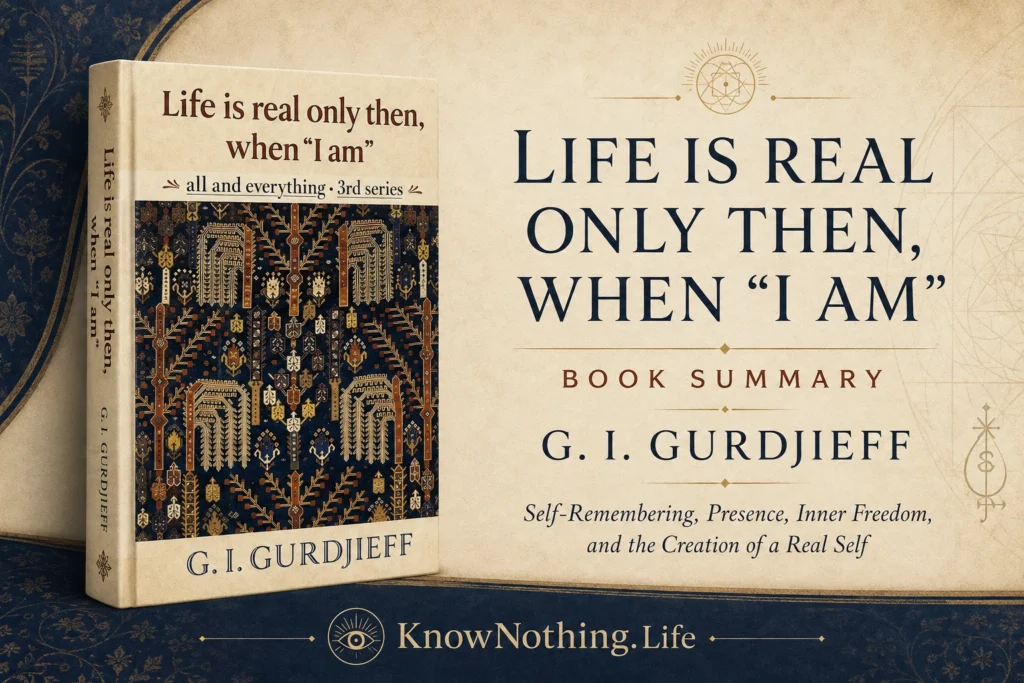
G. I. Gurdjieff’s Life Is Real Only Then, When “I Am” is the incomplete Third Series of All and Everything, following Beelzebub’s Tales to His Grandson and Meetings with Remarkable Men. The surviving text contains an extended autobiographical prologue and introduction, five talks delivered to followers in New York between November and December 1930, and a final chapter titled “The Outer and Inner World of Man.” That concluding chapter ends abruptly in mid-sentence. The manuscript was privately issued in 1975 and released publicly in 1981, decades after Gurdjieff’s death.
Its fragmentary character is central to the reading experience. Gurdjieff intended the Third Series to help readers form a more truthful representation of reality, but the surviving work offers no completed system or final set of instructions. Instead, it presents personal confession, psychological diagnosis, exercises, criticism of followers, and reflections on death, responsibility, authority, and the possibility of possessing a real “I.” The book is less a polished conclusion than a record of Gurdjieff attempting to communicate what he considered the most difficult dimension of his teaching: how a person might become inwardly present enough to exist by his or her own initiative.
Gurdjieff’s Confession and Inner Crisis
The prologue begins with the question “I am?” rather than with a doctrine. Gurdjieff describes searching for the full sensation of himself that he associated with self-remembering, conscious labor, and intentional suffering. He presents his writing as a response to physical exhaustion, personal failure, and the fear that he might die without transmitting what he believed he had discovered about the human inner world. Some manuscripts even described the prologue as a confession or the “quintessence” of his life’s inner activity.
This personal tone distinguishes the book from the cosmic satire of Beelzebub’s Tales. Gurdjieff does not portray himself as permanently enlightened or invulnerable. He recounts doubt, ambition, error, physical weakness, and the painful recognition that abilities acquired through years of discipline could also support vanity and harmful behavior. His decision to renounce certain personal “powers” is presented as an act of self-limitation—a deliberate attempt to prevent capacities developed for one aim from being appropriated by selfish motives.
What Does It Mean to Say “I Am”?
The title expresses Gurdjieff’s central distinction between existing biologically and possessing a stable, conscious presence. Ordinary speech assumes that the word “I” refers to one enduring subject. Gurdjieff argues that this unity is usually imaginary. A thought says “I,” then a desire, mood, sensation, fear, or social role takes its place. Each temporary state speaks for the whole personality even though it may contradict what another state wanted moments earlier.
Modern psychology does not endorse Gurdjieff’s hierarchy of human development, but it does recognize that the self-concept contains multiple, context-dependent aspects. Allen McConnell’s multiple self-aspects framework describes identity as a collection of selves activated by different relationships, roles, and environments. Psychology generally treats such multiplicity as normal and potentially adaptive; Gurdjieff treats unconscious fragmentation as evidence that a permanent center has not yet formed. His challenge is not to eliminate every role but to develop enough awareness and integration that one’s central commitments survive changing circumstances.
Self-Remembering and the Experience of Presence
For Gurdjieff, self-remembering is not autobiographical recollection or anxious self-consciousness. It is an attempt to sense one’s own existence while simultaneously perceiving the surrounding world. Ordinarily, attention disappears into an object, emotion, conversation, or fantasy. Self-remembering introduces a second direction: awareness includes both what is being experienced and the fact of one’s presence within the experience. The question “Who is here?” becomes practical rather than philosophical.
Research on meta-awareness provides a cautious comparison. Meta-awareness involves noticing the current contents and movements of the mind rather than simply being carried by them. Contemporary mindfulness research likewise studies whether attention and awareness can be sustained while a person remains engaged with an object or task. Meta-analyses suggest modest improvements in several aspects of cognitive functioning after mindfulness-based interventions, although results differ according to methods and outcome measures. These findings support the trainability of attention, not Gurdjieff’s stronger claims about higher states or the creation of an immortal being.
Conscious Labor and Intentional Suffering
“Conscious labor” means activity performed with presence, understanding, and a purpose that extends beyond immediate comfort. The same physical task can be mechanical or conscious depending on the quality of attention brought to it. “Intentional suffering” does not mean seeking injury or accepting abuse. At its most defensible, it refers to voluntarily enduring the discomfort involved in resisting automatic reactions, relinquishing flattering illusions, acknowledging responsibility, and acting against entrenched selfish habits.
This view resembles ancient virtue ethics more than modern self-help. Aristotle argues in Nicomachean Ethics that good character cannot be created through correct theories alone. Virtue depends on habituated action guided by practical wisdom—the ability to perceive what a particular situation requires and act accordingly. Gurdjieff is more severe because he doubts that the ordinary personality possesses sufficient unity to practice virtue consistently. Both perspectives, however, deny that knowing the good automatically produces good conduct.
A. R. Orage and the Problem of Spiritual Authority
The five New York talks revolve partly around A. R. Orage, the British editor who became one of Gurdjieff’s leading interpreters in the United States. Gurdjieff examines the loyalties, rivalries, idealizations, and misunderstandings that formed around Orage and the American groups. His concern is that students may substitute allegiance to a teacher, representative, or organization for direct understanding. A teaching intended to produce independence can become another source of imitation and group identification.
Yet Gurdjieff’s own methods create an unresolved tension. He seeks to break dependency while demanding intense personal commitments and confronting followers with tests of loyalty. Such methods may reveal hidden motives, but they may also strengthen the teacher’s control over how every response is interpreted. Resistance can be labeled mechanical; obedience can be treated as sincerity. The book is therefore valuable not only for what it teaches about authority but for the ethical questions its teaching style raises. Genuine inner work requires guidance without surrendering responsibility for judgment.
Death as an Instrument of Awakening
Orage’s death in 1934 becomes the setting for some of the book’s most uncompromising reflections. Gurdjieff rejects conventional expressions of sympathy when they function as automatic social performances. Instead of speaking sentimentally about another person’s death, he urges his listeners to recognize the certainty of their own. Awareness of mortality should interrupt trivial preoccupations and reveal whether one’s present conduct corresponds to what one claims to value.
Psychological research shows that reminders of death can influence judgment and behavior, often by increasing attachment to cultural identities or established worldviews. Earlier meta-analyses reported meaningful mortality-salience effects, although newer systematic assessments have raised concerns about publication bias, heterogeneity, and the robustness of parts of the literature. Gurdjieff proposes an alternative to defensive worldview attachment: mortality should be held consciously enough to intensify responsibility rather than merely strengthen inherited beliefs.
The Outer, Inner, and Third Worlds of Man
The unfinished final chapter contains the book’s most systematic psychological model. Gurdjieff distinguishes the outer world of impressions and circumstances from an inner world composed of bodily processes, inherited tendencies, automatic associations, and reflexive reactions. A person governed only by these two worlds remains a passive intersection of external pressures and internal mechanisms. Events stimulate the organism, reactions arise, and the individual afterward claims authorship over what has happened.
A third world must be intentionally formed through conscious contact between the first two. This “world of man” represents the possibility of independent initiative: a stable capacity to observe impressions, experience reactions, and respond without being completely determined by either. The idea resembles psychological decentering, in which thoughts and emotions are experienced as events rather than unquestioned commands. Studies associate self-distancing and decentering with more adaptive reflection and emotional regulation, although these findings do not establish Gurdjieff’s metaphysical account of a real “I.”
The Meaning and Limits of the Book
Life Is Real Only Then, When “I Am” argues that ordinary existence is dominated by forces people mistakenly call themselves. External impressions pull attention outward; internal associations, appetites, and emotions pull it inward. Between them, the supposedly unified person repeatedly disappears. A real “I” is not discovered as a hidden object waiting beneath personality. It must be formed through repeated acts of presence, sincerity, responsibility, and intentional choice.
The book is not established psychology, and its claims about higher consciousness, esoteric science, special powers, and the deliberate creation of a permanent being remain unverified. Its unfinished form also makes it hazardous to treat every episode as a definitive instruction. Its enduring value lies in the question encoded in its title. Gurdjieff asks whether a person is truly present when speaking, choosing, loving, suffering, or promising—or whether life is simply occurring through a succession of automatic selves. In his account, life becomes fully real only during those rare moments when awareness, feeling, and action gather around the direct recognition: “I am.”