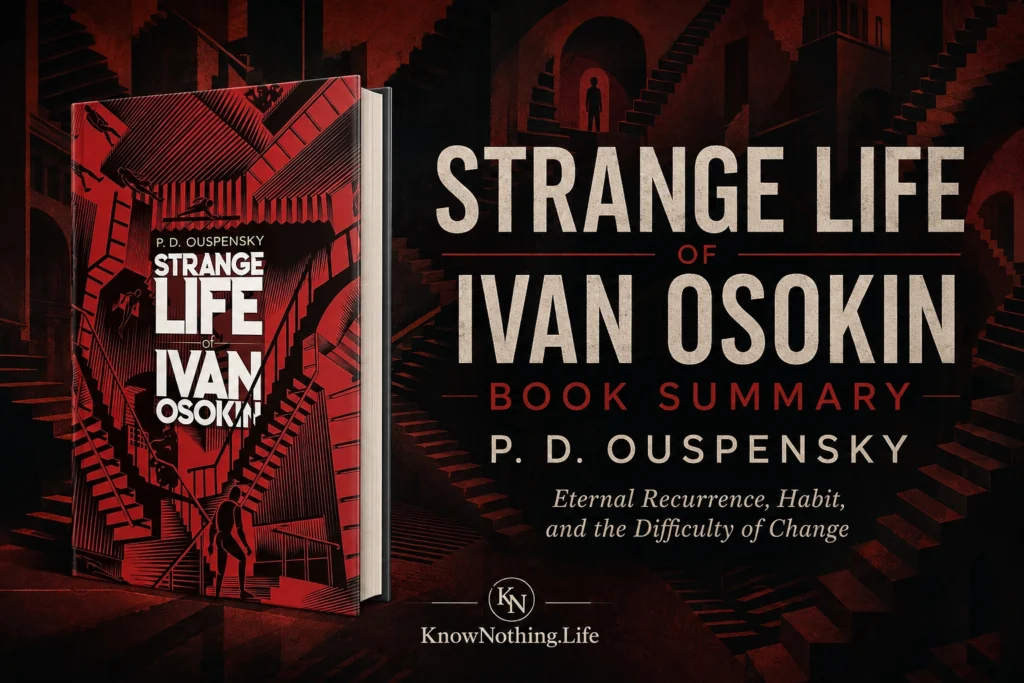
P. D. Ouspensky’s Strange Life of Ivan Osokin explores the fantasy of returning to the past with present knowledge and repairing a damaged life. Ouspensky wrote it in 1905, published it in Russian as Kinemadrama in 1915, and issued the English version in 1947. Its “cinema-drama” form explains the rapid, visually framed scenes. It turns eternal recurrence into a story about regret, self-deception, and the limits of will.
Ivan Osokin is twenty-six when the story opens at a Moscow railway station in 1902. Zinaida Krutitsky, the woman he loves, is leaving for Crimea and asks him to accompany her. Osokin is too poor to travel but too proud to explain. She interprets his inaction as indifference, and their relationship deteriorates. When he later hears that Zinaida plans to marry Colonel Minsky, he sees his life as a chain of wasted chances extending through school, work, love, and money. He approaches a mysterious magician and insists that foreknowledge would allow him to choose differently.
The Bargain with the Magician
The magician challenges Osokin’s account of his failures. Osokin believes he made mistakes because he lacked information: had he understood the consequences, he would have studied, avoided expulsion, used money responsibly, and acted decisively with Zinaida. The magician replies that Osokin often did know. Warnings were available, consequences were visible, and he sometimes recognized the correct action while doing the opposite. Nevertheless, the magician returns him to his school days while allowing him to retain some memory of the life already lived.
Osokin receives the advantage that should guarantee improvement. He recognizes places, anticipates conversations, and senses which incidents matter. Yet memory weakens whenever action becomes difficult. From a distance the pattern is clear; in the moment, embarrassment, boredom, pride, fear, and desire overwhelm it. The book’s disturbing proposal is not simply that fate is fixed, but that character repeatedly recreates circumstances from within.
School and Mechanical Repetition
Returned to adolescence, Osokin resolves to study, avoid the provocations that led to his expulsion, and prepare himself for the future. Almost immediately, the old environment activates the old personality. He becomes bored with lessons, resents authority, follows impulses he recognizes as dangerous, and repeats the disciplinary pattern he intended to escape. The earlier life soon feels dreamlike and weaker than present irritation or temptation.
Ouspensky’s concept of “mechanicality” has a modern parallel in habit research. Wendy Wood, Jeffrey Quinn, and Deborah Kashy found that behaviors repeatedly performed in stable contexts often proceed with little behavior-related thought; familiar cues can initiate responses while attention is elsewhere. Reviews similarly describe habits as learned context-response associations that may operate independently of current goals. This does not establish Ouspensky’s metaphysics, but it helps explain why knowledge may fail when someone reenters the same setting with the same routines and emotional triggers.
New Places, the Same Personality
After school, Osokin searches for the external change that will finally make him different. New cities, artistic ambitions, friendships, and romances seem to offer fresh beginnings. In Paris he enters wealthier social circles, loses money at roulette, and again lets immediate excitement undermine long-term aims. Each episode feels unique, but the structure remains stable: he dreams intensely, delays practical action, rejects ordinary help, and later explains the resulting failure through circumstances.
His recurring wish to begin again in Paris, Crimea, Australia, or elsewhere reveals a central self-deception. Osokin imagines that a new setting will free him from the personality making his choices. Yet changing scenery does not change the mechanism selecting his actions. His life is not ruined by one spectacular decision but by small evasions accumulating until the desired future becomes inaccessible. Novel circumstances do not produce inner change.
Zinaida and the Failure to Act
Osokin’s second encounter with Zinaida becomes the novel’s emotional center. He has imagined her for years and initially finds the real woman disappointing. As they spend time together, however, affection develops and Zinaida makes her interest unmistakable. She invites honesty and gives him opportunities to explain his poverty and uncertainty. Osokin understands what she wants and knows silence will hurt her, yet pride makes accepting help feel humiliating and fear prevents the intimacy he desires.
His problem is not lack of desire. He wants Zinaida intensely and imagines elaborate futures. The difficulty is translating intention into behavior at the critical moment. Research on implementation intentions distinguishes broad goals from specific if-then plans linking a recognizable situation to an action. Such planning can prepare responses to moments otherwise lost to hesitation. Osokin possesses wishes and explanations, but almost never a practical method for what he will do when fear, pride, or temptation appears.
Regret and Eternal Recurrence
The time loop literalizes counterfactual thought—the construction of alternatives to events that actually occurred. Research suggests that imagining better outcomes can help when it identifies causes and informs later behavior. It can also become rumination when it produces distress without a workable correction. Osokin is skilled at imagining the life he should have lived, but his insight is strongest after opportunities have vanished and weakest while action remains possible.
Ouspensky’s recurrence also invites comparison with Friedrich Nietzsche’s thought experiment in The Gay Science. Nietzsche asks whether someone could affirm life if every event returned in exactly the same sequence. Ouspensky gives the idea a darker psychological form. Osokin is horrified to discover that remorse and foreknowledge do not prevent repetition. Nietzsche’s recurrence tests whether a person can say yes to an entire life; Ouspensky’s version tests whether the self condemning the past is truly different from the self that produced it.
The Magician’s Diagnosis
After reliving the same failures, Osokin can no longer claim that one missing fact ruined him. He possessed memory, warning, and desire, yet repeated the pattern. The magician tells him that nothing will change by itself and that Osokin cannot change his life without first changing himself. Knowing about recurrence is insufficient because knowledge does not automatically create the attention, discipline, and emotional strength required to act differently.
The magician asks Osokin to abandon effortless autonomy and seek help. Meaningful change, he argues, requires sacrifice: Osokin must place his life under the magician’s direction for fifteen or twenty years. The ending anticipates the Fourth Way, in which habitual personality requires prolonged work, guidance, and self-observation. Its broader insight is compelling even without accepting the esoteric framework: commitment becomes real when it imposes costs and reorganizes conduct rather than remaining an inspiring idea.
Freedom, Sacrifice, and the Unresolved Ending
The magician’s demand is also the novel’s most ethically difficult element. Transformation may need commitment and accountability, but unquestioning obedience to a charismatic teacher is not necessarily safe. The distinction between disciplined guidance and surrender of judgment remains essential. The novel is strongest when diagnosing self-deception, not when the magician’s authority is treated as self-validating.
The ending remains deliberately unresolved. Osokin walks through waking Moscow, postponing his answer until tomorrow even while recognizing postponement as the mechanism of his defeat. He considers seeing Zinaida and wonders whether the experience was only a dream. Yet something has shifted: he now sees that confidence in his independent will may itself be part of the trap. Whether that recognition becomes action is left unanswered.
Meaning and Lasting Value
Strange Life of Ivan Osokin is not evidence that lives literally recur, nor is it a scientific theory of personality. Its power comes from converting ordinary regret into a severe philosophical test. People often imagine that wisdom means discovering what went wrong. Ouspensky asks the harder question: would that knowledge possess enough force to compete with the same habits, fears, social pressures, and desires when the decisive moment returned?
Osokin’s tragedy is that he confuses understanding with transformation. He can describe his pattern, condemn it, and foresee its consequences without becoming capable of interrupting it. A second chance matters only when it is met by a different quality of attention and action. Without that inner difference, the past needs no supernatural machinery to return. It is reconstructed through the habits by which a person remains the same.