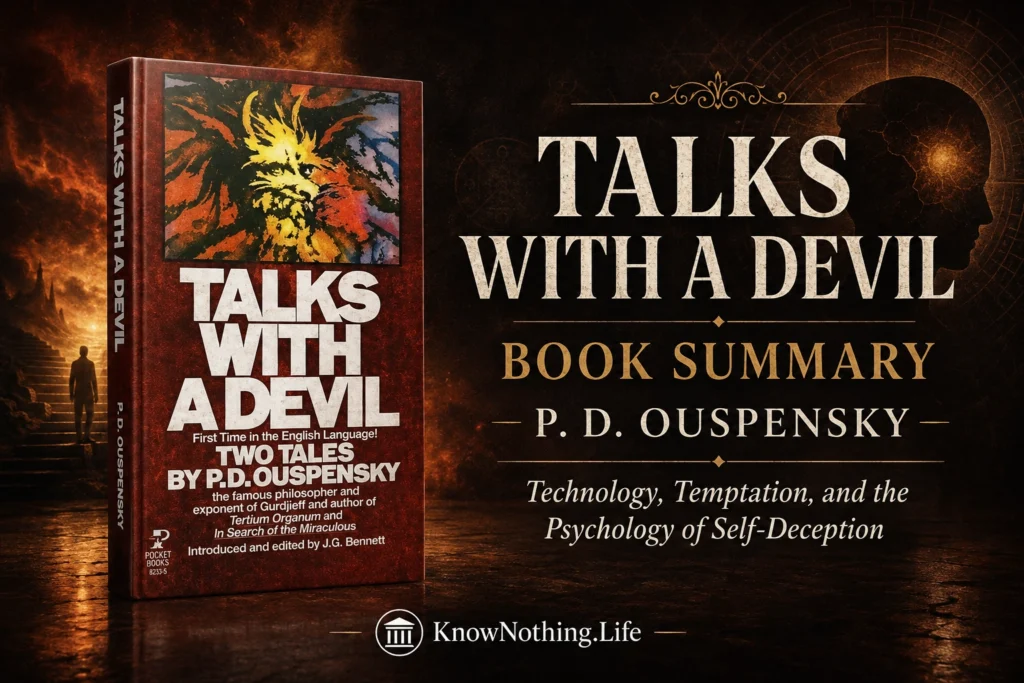
P. D. Ouspensky’s Talks with a Devil consists of two philosophical stories, “The Inventor” and “The Benevolent Devil.” First published in Russian in 1916, the collection appeared in English decades later in a translation by Katya Petroff edited by J. G. Bennett. Ouspensky later regarded the stories as immature and declined to translate them himself, yet they reveal his ideas in an unusually dramatic form. Instead of lectures, he uses satire, fantasy, and dark comedy to investigate technology, ambition, appetite, spiritual aspiration, and the tendency to disguise destructive motives with noble language.
The Devil who narrates and participates in the stories is not an all-powerful supernatural enemy. He insists that human beings create their own devils and that he usually observes or collects evil rather than producing it. Evil does not need to enter life from outside when vanity, resentment, greed, habit, and rationalization already perform its work. Ouspensky acknowledges the literary shadow of the Devil who visits Ivan in Dostoevsky’s The Brothers Karamazov, but his figure is especially interested in matter: whatever keeps attention fixed on possession, bodily gratification, status, and the apparent finality of ordinary life.
“The Inventor” and the Birth of a Weapon
“The Inventor” follows Hugh B., a gifted but embittered engineering draftsman trapped by factory employment, poverty, and a failing marriage. Convinced that inventions should liberate him, he grows alienated when his projects receive no recognition. He decides to die by suicide and visits a gun shop to purchase a revolver. While inspecting its mechanism, however, he conceives a new automatic pistol. The idea interrupts his despair. On the beach where he intended to die, Hugh fires the weapon into the distance and returns to work, believing he has found freedom.
The invention succeeds technically but struggles against bureaucracy, corporate indifference, and lack of capital. Hugh eventually builds a company, and sensational violence advertises the pistol more effectively than any planned campaign. A notorious Paris crime produces worldwide publicity; later shootings, political unrest, and wars generate enormous demand. The device that saved its inventor from death becomes an efficient means of causing death elsewhere. Ouspensky refuses a simple lesson. The Devil begins by forbidding the listener to ask for a moral and ends the tale enraged when asked whether Hugh was right to pursue invention or should have accepted ordinary life.
Progress Without Moral Foresight
Hugh does not intend to become a merchant of death. He wants independence, creative work, reconciliation with Madge, travel, knowledge, and support for other inventors. His wealth eventually finances worker housing, pensions, philanthropy, art, astronomy, and an institute for neglected talent. At the same time, his company produces pistols, rifles, rapid-firing guns, explosives, and poisonous gases. Ouspensky places genuine benevolence beside industrialized violence. The contradiction cannot be solved by declaring Hugh secretly evil, because many of his aspirations remain generous and serious.
This structure resembles what psychologist Albert Bandura later called moral disengagement: harmful conduct can be reconciled with a positive self-image through moral justification, sanitized language, displacement of responsibility, and minimization of consequences. Hugh does not pull the trigger, while the organization around him converts suffering into orders, production targets, employment, and progress. Stanley Milgram’s obedience research likewise showed how harmful action becomes easier when responsibility is embedded in a legitimate system and divided among roles. Ouspensky’s broader warning is that technical capability may develop faster than the moral awareness required to govern it.
The Benevolent Spirits of Matter
“The Benevolent Devil” begins in the cave temples of Ellora, where the narrator encounters the Devil in a dream. The Devil claims that his kind are not spirits from another realm but “spirits of matter” who keep human beings attached to the earth. He retells the Fall of Adam and Eve as a gradual loss of perception. The decisive fruit is not forbidden knowledge but appetite. Once Adam and Eve eat for pleasure, habit and scarcity occupy their attention; irritation, possessiveness, boredom, and quarrels follow. The miraculous dimension of life fades as material need becomes psychologically absolute.
The fable is neither scientific anthropology nor literal history. Ouspensky divides humanity into “descendants of Adam,” capable of creative and spiritual perception, and “descendants of animals,” associated with imitation, materialism, and domination. This hierarchy is an esoteric metaphor burdened by elitism and dated assumptions. Its more useful psychological meaning is that different tendencies coexist within people: one seeks coherence and freedom, while another repeats routines and serves immediate rewards. The Devil wins whenever appetite ceases to be one part of life and becomes the standard by which reality is judged.
Leslie White and the Defeat of a Higher Aim
The story becomes concrete through Leslie White, a British official in Ceylon sincerely interested in yoga and higher consciousness. An elderly Indian tells him that spiritual work does not require abandoning ordinary life; it requires subjecting life to a higher aim. Leslie should observe what he thinks, says, and does, ask whether each action is necessary, stop unnecessary thought, and cultivate inner silence. The advice anticipates Ouspensky’s later emphasis on self-observation and the use of ordinary circumstances as material for inner work.
A small devil is assigned to prevent Leslie from following through. It does not refute yoga or destroy his books. Instead, it works through meals, alcohol, fatigue, social invitations, romantic fantasy, comfort, and delay. Leslie believes that serious work will begin later—after breakfast, an appointment, a nap, or tomorrow. The satire parallels research showing how often immediate desires conflict with longer-term goals. In an experience-sampling study, Wilhelm Hofmann and colleagues found that desire was common and that enactment depended on its strength, conflict, social context, and attempts at resistance. Ouspensky’s devil succeeds by making distraction feel ordinary rather than wicked.
Evil Made Respectable by Ideas
The most penetrating passages concern corrupted ideals. The Devil describes persuading people dedicated to fighting evil that evil must form part of a higher plan, provide necessary suffering, and assist human evolution. Their campaign gradually becomes an intellectual justification of wrongdoing. He also boasts that fine phrases about civilization, sacrifice, religion, equality, and concern for others are effective because people prefer to experience themselves as principled. A lie works best when it borrows the vocabulary of truth.
Ziva Kunda’s account of motivated reasoning provides a modern parallel. People do not always evaluate evidence neutrally; desired conclusions can influence which memories, arguments, and standards they recruit, provided they can construct a plausible justification. Bandura’s theory explains why euphemism and elevated purpose are powerful: they do not silence morality but redirect it in support of conduct it would normally condemn. Ouspensky therefore locates the Devil less in open cruelty than in reasoning that enables cruelty to appear necessary, progressive, compassionate, or sacred.
Meaning and Limits of Talks with a Devil
The stories complement each other. “The Inventor” shows creativity directed outward transforming the world without transforming the creator’s moral awareness. “The Benevolent Devil” shows how someone who turns inward can still be defeated by appetite, fantasy, inertia, and self-flattering explanations. Hugh acts with extraordinary persistence but rarely sees the whole consequence of his work. Leslie recognizes the possibility of a higher life but cannot sustain the attention needed to pursue it. One is captured by achievement; the other by postponement.
Talks with a Devil is not established psychology, theology, or social science. Its metaphysics are speculative, its human types reductive, and some portraits reflect the prejudices of their period. Its strength lies in its satire of self-deception. Ouspensky suggests that evil seldom requires dramatic temptation. It can operate through a useful invention detached from consequences, a good intention converted into vanity, a philosophy used to excuse passivity, or a pleasant distraction placed between a person and a difficult aim. The Devil’s most unsettling claim is that he does not have to defeat human beings. He only has to help them continue doing what they already prefer.