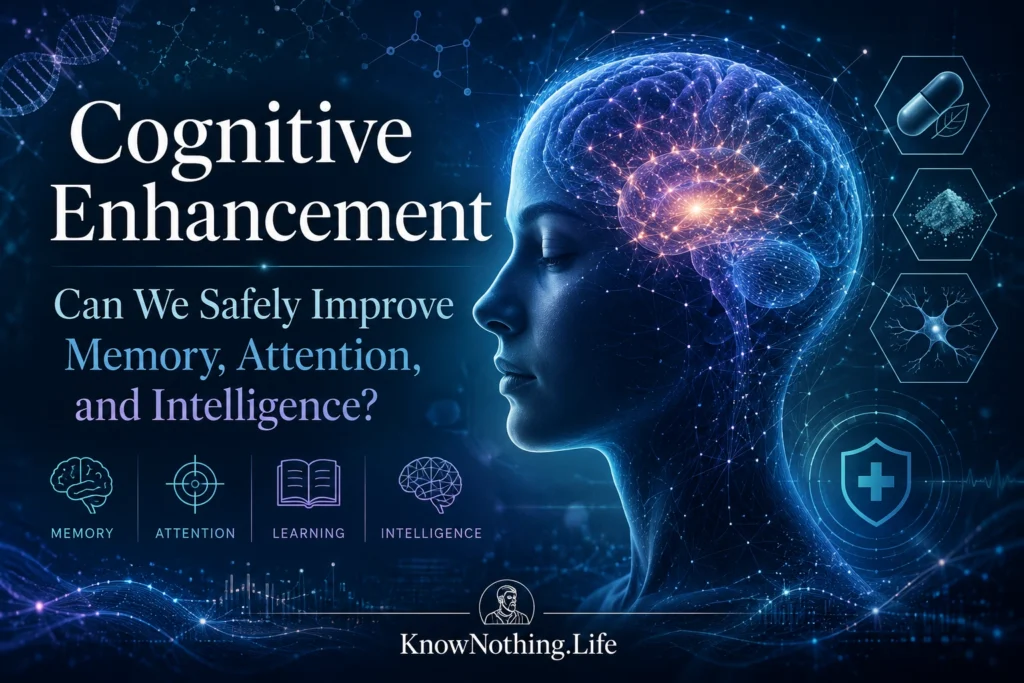
Cognitive enhancement refers to attempts to improve mental abilities such as attention, memory, learning, creativity, decision-making, and self-control. The term can describe ordinary practices such as education, sleep, exercise, and caffeine use, as well as prescription drugs, dietary supplements, computerized training, electrical stimulation, and emerging neurotechnology. Some interventions are developed to restore abilities impaired by illness or injury, while others are used by healthy people hoping to perform beyond their usual level. The boundary between treatment and enhancement is not always clear because cognitive ability exists on a continuum rather than dividing neatly into normal and abnormal categories.
Enhancement is also more difficult to measure than the concept initially suggests. Cognition is not one general resource that can simply be increased. An intervention might improve wakefulness while reducing sleep quality, strengthen focused attention while narrowing creativity, or improve performance on a practiced task without helping people solve unfamiliar problems. Results may depend on baseline ability, age, genetics, fatigue, motivation, dosage, and the particular test used. Cognitive enhancement should therefore be evaluated in terms of specific abilities, real-world usefulness, duration, side effects, and possible tradeoffs rather than advertised as a universal increase in intelligence.
Prescription Stimulants and Wakefulness Drugs
Methylphenidate, amphetamine-based medications, and modafinil are among the most discussed pharmaceutical cognitive enhancers. These drugs were developed for clinical conditions such as attention-deficit/hyperactivity disorder, narcolepsy, and other disorders involving attention or wakefulness. Healthy students and professionals sometimes use them without a medical indication in the hope of studying longer, maintaining concentration, or working through fatigue. Because the drugs affect neurotransmitter systems involved in motivation and attention, it is plausible that they could alter cognitive performance, but their effects in healthy users are usually smaller and less consistent than popular descriptions suggest.
A systematic review by Dimitris Repantis and colleagues found that methylphenidate produced some improvement in memory but did not consistently enhance other cognitive domains in healthy adults. A later series of meta-analyses led by Carl Roberts concluded that methylphenidate, modafinil, and dextroamphetamine can improve certain subdomains, yet effect sizes vary according to the task and drug. Modafinil has shown benefits in attention, executive functions, and learning during demanding tests, but it can also impair divergent creative thinking in some situations. Mixed amphetamine salts produced no more than small objective benefits in one controlled study, even though participants believed the drug had improved their performance.
Caffeine, Supplements, and Nootropics
Caffeine is probably the world’s most familiar cognitive enhancer. By blocking adenosine receptors, it reduces the subjective feeling of tiredness and can improve alertness, vigilance, attention, and reaction time. Its strongest effects often appear when a person is fatigued or performing a monotonous task. Evidence for improvements in complex reasoning, judgment, memory, and creativity is less consistent. Regular users also develop tolerance, and part of the apparent improvement after caffeine consumption may reflect the reversal of withdrawal symptoms rather than performance beyond the person’s ordinary baseline.
The evidence for commercial “nootropic” supplements is even more uneven. Products may contain herbal extracts, vitamins, amino acids, choline compounds, omega-3 fatty acids, creatine, or proprietary mixtures. A systematic review of dietary supplement ingredients for healthy adults found that studies differed greatly in their populations, products, doses, duration, and outcome measures, making strong general conclusions difficult. Creatine has shown possible benefits for memory, particularly in older adults and people with lower dietary intake, but it is not a universal intelligence booster. Supplement labels can also imply a level of scientific certainty that is not supported by large, independently replicated trials.
Noninvasive Brain Stimulation
Noninvasive brain-stimulation techniques attempt to influence cognition by altering the excitability or timing of neural activity. Transcranial direct current stimulation delivers a weak electrical current through electrodes placed on the scalp, while transcranial magnetic stimulation uses magnetic pulses to induce electrical activity in cortical tissue. Researchers have tested these methods for working memory, attention, language learning, mathematical performance, creativity, and motor learning. Consumer versions of electrical stimulators have also been marketed to people seeking greater focus or faster learning.
Early experiments produced exciting results, but later studies revealed substantial variability. The effects of stimulation depend on electrode placement, current intensity, stimulation duration, brain anatomy, baseline performance, and the task performed during stimulation. A meta-analysis of tDCS in healthy older adults found some evidence of cognitive and motor improvement, while more recent work suggests that combining stimulation with structured cognitive training may be more promising than stimulation alone. Even under identical protocols, participants can show improvement, no change, or worse performance. These methods should not be treated as harmless shortcuts simply because they do not require surgery.
Cognitive Training and the Problem of Transfer
Computerized cognitive training is designed to strengthen mental abilities through repeated practice. Working-memory programs, attention exercises, strategy games, and commercial brain-training platforms often produce improvement on the tasks being practiced. This is known as near transfer. The more important question is whether training transfers to unpracticed skills, academic achievement, job performance, or everyday reasoning. People can become highly skilled at a particular memory game without experiencing a broad increase in intelligence.
Meta-analyses generally find that cognitive training can improve selected measures of memory and executive function, especially among older adults, but broad far-transfer effects are smaller and less reliable. Programs targeting several abilities may create somewhat wider benefits than repetitive practice of one narrow task, although differences among studies remain substantial. Cognitive training is most credible when it teaches useful strategies, provides progressively difficult practice, and is connected to meaningful activities. Claims that a few minutes of daily gameplay will permanently transform general intelligence go beyond the available evidence.
Sleep, Exercise, and the Biological Foundations of Performance
Many people seek enhancement while neglecting the conditions necessary for ordinary cognitive function. Sleep supports attention, emotional regulation, learning, and the consolidation of new memories. Staying awake longer with stimulants may increase the number of available working hours without preserving the quality of thought produced during those hours. A systematic review of sleep and memory in healthy people found broad support for the role of sleep in cognitive processing and memory consolidation across the lifespan. Meta-analytic evidence also indicates that sleep benefits motor learning and the consolidation of newly learned words.
Physical activity is another evidence-based route to supporting cognition. Exercise increases cardiovascular fitness, influences neurotrophic signaling, and can improve mood, sleep, and metabolic health, all of which affect mental performance. A large 2023 meta-analysis found that exercise interventions benefited cognitive functions across healthy children, adults, and older adults, while later reviews reported improvements in working memory, cognitive flexibility, and inhibitory control among middle-aged and older people. These gains are generally modest, but exercise offers broader health benefits and fewer ethical concerns than experimental drugs or consumer brain stimulators.
Why Enhancement Effects Depend on the Person
An intervention may provide its greatest benefit to someone whose performance is temporarily or clinically reduced. Caffeine has more room to improve vigilance in a tired person than in someone who is already alert. A stimulant may normalize attention in a patient with ADHD without producing the same benefit in a healthy individual. Cognitive training may produce greater gains in an older adult with declining processing efficiency than in a younger adult already performing near the upper limit of a task. Enhancement frequently follows an inverted-U pattern: too little neural activation impairs performance, an intermediate level supports it, and excessive activation can make performance worse.
This baseline dependency explains why average study results may hide very different individual responses. Genetics, sleep, stress, personality, drug metabolism, brain anatomy, previous experience, and expectations can all influence outcomes. Placebo effects and subjective impressions are especially important because increased energy or motivation may feel like improved intelligence even when objective accuracy changes little. Enhancement research should therefore measure not only test scores but also confidence, errors, risk-taking, creativity, emotional effects, sleep, and performance after repeated use.
Fairness, Pressure, and the Ethics of Enhancement
Cognitive enhancement raises questions that cannot be answered by neuroscience alone. If a drug safely improves examination performance, is using it comparable to drinking coffee, hiring a tutor, or cheating? The answer depends partly on access, rules, risk, and the values attached to achievement. Wealthier individuals may gain earlier access to effective enhancements, widening existing educational and occupational inequalities. Workplaces, schools, or military organizations could also create indirect coercion if people feel unable to refuse enhancement while competitors accept it.
Barbara Sahakian and Sharon Morein-Zamir identified safety, informed choice, fairness, and social pressure as central concerns in pharmacological enhancement. Anjan Chatterjee similarly warned that neuroenhancement could affect distributive justice, character, and autonomy. The ethical problem is not simply that an intervention changes the brain, because education, exercise, psychotherapy, and ordinary learning also change it. The more important questions are whether users understand the risks, whether benefits are distributed fairly, whether refusal remains genuinely possible, and whether institutions reward healthy performance or normalize unsustainable demands.
The Future of Cognitive Enhancement
Future enhancement may combine personalized drugs, closed-loop brain stimulation, neurofeedback, artificial-intelligence tutors, wearable sensors, and brain–computer interfaces. These systems could adapt training or stimulation to a person’s real-time neural and behavioral state. The most valuable applications may involve restoring communication, supporting rehabilitation, delaying age-related decline, or helping people function under unavoidable impairment rather than creating dramatically superhuman minds.
The history of cognitive enhancement suggests caution. Mental performance is produced by interconnected systems, so improving one process may create costs elsewhere. Current interventions generally produce narrow, context-dependent gains rather than permanent increases in overall intelligence. The safest and most reliable forms of enhancement remain less glamorous: sufficient sleep, physical activity, education, deliberate practice, meaningful social engagement, and treatment of genuine medical problems. Drugs and neurotechnology may eventually expand these possibilities, but responsible enhancement must be judged by long-term wellbeing, fairness, and real-world functioning—not by a temporary rise on a laboratory test.