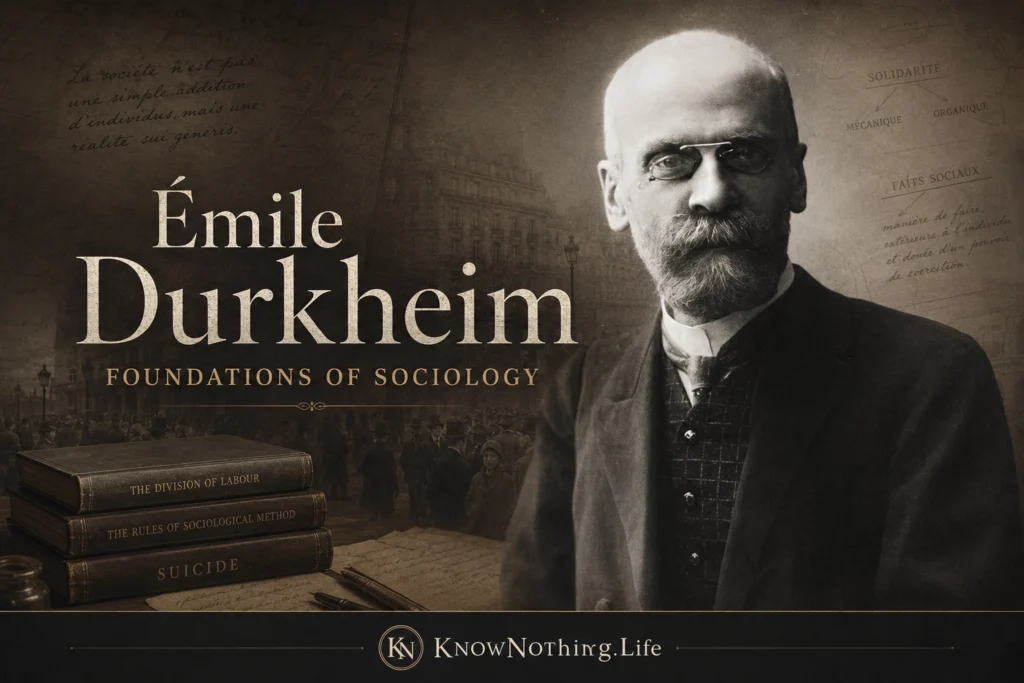
Émile Durkheim was a French sociologist, educator, and social theorist who helped establish sociology as an independent academic discipline. At a time when human behavior was commonly explained through philosophy, biology, individual psychology, or moral judgment, Durkheim argued that society possessed structures and forces of its own. Laws, customs, religions, languages, institutions, and collective expectations existed before any particular person and continued after that person’s death. They shaped thought and conduct so thoroughly that individuals often mistook social influences for personal choices. Durkheim’s achievement was to make these invisible pressures available for systematic investigation.
His major works—The Division of Labor in Society, The Rules of Sociological Method, Suicide, and The Elementary Forms of Religious Life—created a connected theory of social order. Durkheim examined how communities hold together, why modernization can weaken moral regulation, how group membership affects individual well-being, and why religious rituals generate feelings of sacred power. His concepts of social facts, collective consciousness, mechanical and organic solidarity, anomie, social integration, and collective effervescence remain fundamental across sociology, anthropology, political theory, religious studies, education, and public health.
Early Life and Education
David Émile Durkheim was born on April 15, 1858, in Épinal, a town in the Lorraine region of France. He came from a close-knit Jewish family with a long rabbinical tradition: his father, grandfather, and great-grandfather had all served as rabbis. Durkheim received some religious instruction and initially appeared likely to follow the same path, but he abandoned plans for the rabbinate while still young. Although he later distanced himself from formal Judaism, his upbringing exposed him to the power of shared rituals, inherited obligations, moral discipline, and communal solidarity—themes that would eventually occupy the center of his sociology.
After excelling at the Collège d’Épinal, Durkheim moved to Paris and sought admission to the prestigious École Normale Supérieure. He failed the entrance examination twice before gaining admission in 1879. The school’s literary emphasis often frustrated him because he wanted a more scientific approach to morality and society, yet he studied among an exceptional generation that included Henri Bergson, Pierre Janet, and his lifelong friend Jean Jaurès. Durkheim passed the agrégation examination in philosophy in 1882 and began teaching in French secondary schools. His growing interest in German philosophy, psychology, and social science helped him formulate the idea that moral life could be studied empirically rather than treated only as abstract speculation.
Establishing Sociology in France
Durkheim’s decisive academic opportunity arrived in 1887, when he was appointed to teach social science and pedagogy at the University of Bordeaux. The appointment brought sociology officially into the French university system, even though the new field still faced suspicion from philosophers and historians. Durkheim taught education during the week and offered public lectures on subjects including family life, law, religion, socialism, crime, suicide, and social solidarity. His aim was not merely to introduce another university subject. He wanted to establish a science capable of identifying the causes, functions, and historical development of social institutions.
The Bordeaux years produced the core of Durkheim’s intellectual legacy. He published The Division of Labor in Society in 1893, The Rules of Sociological Method in 1895, and Suicide in 1897. He also founded L’Année sociologique, an influential journal and collaborative research network that gathered scholars around a shared sociological program. In 1902, Durkheim moved to the Sorbonne in Paris, becoming a full professor in 1906. His chair was formally renamed Science of Education and Sociology in 1913, confirming the discipline’s institutional legitimacy. Through his teaching, journal, books, and students, Durkheim helped create not simply a body of theory but a professional school of French sociology.
Social Solidarity and the Division of Labor
In The Division of Labor in Society, Durkheim examined how different kinds of communities maintain social unity. He distinguished between mechanical solidarity, characteristic of less differentiated societies, and organic solidarity, associated with complex modern societies. Mechanical solidarity arises from resemblance: people perform similar tasks, share strong beliefs, and experience themselves primarily as members of a collective. Law in such societies is often repressive because an offense is understood as an attack upon the shared moral order. Individual differences remain limited because the collective consciousness occupies much of social and personal life.
Organic solidarity develops as work becomes increasingly specialized. People may possess different beliefs, occupations, and lifestyles, but they depend more heavily upon one another because no individual can perform every necessary social function. Modern unity therefore resembles the interdependence of organs within a living body. Durkheim did not believe specialization automatically produced harmony. An unregulated division of labor could become coercive, unjust, or anomic when institutions failed to coordinate specialized roles morally. His central question was therefore not whether individualism would replace society, but what new institutions and ethical bonds could support freedom while preserving cooperation.
Social Facts and Sociological Method
Durkheim explained his scientific program in The Rules of Sociological Method. Sociology required a distinct subject matter, and he located it in social facts: collective ways of acting, thinking, and feeling that confront individuals as external realities. Language, money, professional customs, religious practices, educational expectations, and legal rules are not invented independently by each person. Individuals encounter them already formed and experience consequences when they resist them. Durkheim’s famous methodological instruction was to “consider social facts as things”—not because social conventions were physical objects, but because researchers had to approach them as realities that could not be explained away by intuition or personal opinion.
This method required sociologists to define phenomena carefully, discard preconceptions, compare societies, and explain one social fact through other social facts. Durkheim’s position did not mean that a mysterious group mind floated above human beings. Collective realities emerge from interaction, become institutionalized, and then influence the individuals who inherit them. Social facts exist through people, yet they cannot be reduced to the intentions of any one person. Critics have sometimes accused Durkheim of portraying individuals as powerless before society, but his larger argument was more reciprocal: society creates social persons, while individuals continually reproduce, interpret, and sometimes transform collective life.
Suicide, Integration, and Anomie
Durkheim applied his method to an apparently private act in Suicide. Rather than attempting to explain individual cases or denying the importance of psychological suffering, he investigated why suicide rates differed consistently among social groups and historical periods. He argued that these patterned variations revealed collective conditions. His analysis distinguished egoistic suicide, associated with insufficient integration; altruistic suicide, associated with excessive integration; anomic suicide, associated with inadequate regulation; and fatalistic suicide, associated with oppressive regulation. The categories formed a broader theory of how people depend upon society for both belonging and moral limits.
Durkheim concluded that “suicide varies inversely with the degree of integration” of the groups to which a person belongs. Family, religion, political community, and occupational life can supply meaning by connecting personal existence to durable collective purposes. Yet belonging alone is insufficient. People also require socially supported expectations that place realistic boundaries around desire. Durkheim called the breakdown of such regulation anomie. Economic collapse could produce anomie, but sudden prosperity could do the same by disrupting accepted limits and awakening ambitions that society could not satisfy. Although later researchers have challenged elements of his data and interpretations, Suicide remains a foundational demonstration that intimate suffering can be patterned by social organization.
Religion and Collective Life
Durkheim’s final major book, The Elementary Forms of Religious Life, appeared in 1912. He defined religion through the distinction between the sacred and the profane. Sacred things are separated from ordinary life and surrounded by prohibitions, rituals, and collective respect. Religious beliefs and practices unite participants within a moral community, allowing a society to represent its own authority symbolically. Gods and sacred objects mattered sociologically because they embodied forces that individuals genuinely experienced as greater than themselves—the accumulated moral and emotional power of collective life.
Religious ceremonies periodically bring people together, intensify shared emotions, and renew attachment to the group. Durkheim later became associated with the term collective effervescence for this heightened energy of communal participation. During rituals, commemorations, political gatherings, and public celebrations, individuals may feel lifted beyond private concerns and connected to a larger reality. Yet Durkheim maintained that society was not independent of human participants; as he wrote, “society exists and lives only in and through individuals.” His reliance on secondhand accounts of Indigenous Australian religions has been heavily criticized, but his broader insight—that rituals, symbols, and shared emotions help produce solidarity—continues to shape research on religion, nationalism, sports, political movements, and popular culture.
Final Years and Lasting Influence
Durkheim regarded education as one of the principal ways societies transmit morality to new generations. His later writings and lectures explored moral education, professional ethics, civic institutions, individual rights, and the possibility of creating solidarity in increasingly diverse societies. He defended Alfred Dreyfus and supported the emerging ideal of universal human dignity, describing modern respect for the person as a kind of “cult of the individual.” This did not mean selfishness. It meant that freedom, equality, justice, and the protection of human personality had themselves become sacred collective values capable of uniting people who no longer shared a traditional religion.
The First World War devastated Durkheim personally and intellectually. Several members of his scholarly circle died, and his son André was killed while serving in the French army. Durkheim never fully recovered from the loss. After suffering a stroke, he died in Paris on November 15, 1917, at the age of fifty-nine. His unfinished work on morality remained incomplete, but his central project survived: the scientific study of how individuals are formed through social relationships. Durkheim’s enduring lesson is that society is not merely a collection of separate people. It is a moral and symbolic reality built through institutions, rituals, obligations, memories, and shared ideals—and it becomes most visible when those bonds begin to weaken.