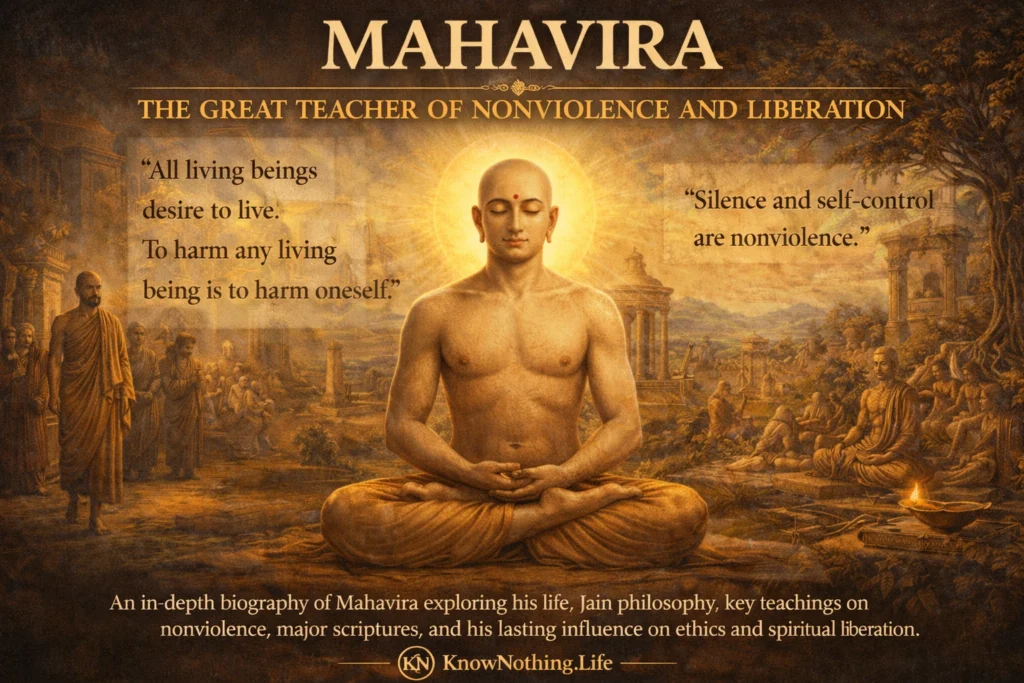
Among the foundational figures of ancient Indian philosophy, Mahavira stands as a towering presence whose teachings shaped one of the world’s oldest continuous spiritual traditions. Known as the 24th Tirthankara of Jainism, Mahavira did not claim to invent a new system of thought, but rather to revive and clarify an ancient path of discipline, nonviolence, and liberation. His life and teachings offer a rigorous philosophical framework centered on self-mastery, ethical conduct, and the purification of the soul.
What distinguishes Mahavira is the uncompromising depth of his commitment to truth and nonviolence. His philosophy goes beyond moral instruction, presenting a complete worldview that addresses the nature of reality, the structure of the cosmos, and the path to spiritual freedom. Through strict discipline and profound insight, he articulated a path that continues to influence ethical thought, spirituality, and philosophical inquiry across centuries.
Early Life and Background
Mahavira was born around the 6th century BCE in the region of present-day Bihar, India, into a royal Kshatriya family. His birth name was Vardhamana, a name associated with growth and prosperity. According to traditional accounts, his early life was marked by privilege, stability, and access to education. Yet even within this environment, there were signs of an inward-looking temperament and a sensitivity to the deeper questions of existence.
Raised in a society where spiritual inquiry was already an active part of cultural life, Mahavira was exposed to various philosophical traditions from an early age. His family was associated with the Jain tradition, which predated him and emphasized ascetic practices and ethical discipline. However, his eventual contribution would go far beyond inheritance; he would refine and intensify these teachings into a systematic path of liberation.
Despite the comforts of his upbringing, Mahavira became increasingly aware of the limitations of worldly life. Observing the inevitability of suffering, change, and death, he began to question the value of attachment to material and social status. This realization laid the foundation for his eventual renunciation and the pursuit of a higher truth.
Renunciation and Ascetic Practice
At the age of 30, Mahavira renounced his worldly life, leaving behind his family, wealth, and social position. This decision marked the beginning of an intense spiritual journey characterized by extreme asceticism and unwavering discipline. Unlike moderate approaches to spirituality, Mahavira embraced a path of rigorous self-denial, seeking to eliminate all attachments and purify the soul.
For approximately twelve years, he practiced severe austerities, including prolonged fasting, meditation, and silence. He endured physical hardship, exposure to the elements, and social isolation. These practices were not acts of self-punishment, but deliberate methods aimed at breaking the bonds of karma—the subtle matter believed to bind the soul to the cycle of birth and death.
During this period, Mahavira cultivated complete control over his senses and emotions. He developed an extraordinary level of awareness and equanimity, remaining undisturbed by pain, insult, or discomfort. Through this disciplined approach, he sought to transcend the limitations of the body and mind, preparing himself for the realization that would define his legacy.
Enlightenment and Kevala Jnana
Mahavira’s spiritual journey culminated in the attainment of Kevala Jnana, or absolute knowledge. This state represents complete and perfect awareness, free from ignorance and illusion. Having achieved this level of insight, Mahavira became a Jina—“the conqueror”—one who has overcome inner obstacles and attained liberation.
His enlightenment was not framed as a mystical revelation granted by an external force, but as the natural result of disciplined effort and self-purification. Through direct experience, he understood the nature of the soul, karma, and the mechanisms that bind beings to the cycle of rebirth. This understanding formed the foundation of his teachings, which he would spend the rest of his life sharing.
Following his enlightenment, Mahavira began to teach extensively, attracting followers from diverse backgrounds. He established a community of monks, nuns, and lay practitioners, creating a structured system for preserving and transmitting his teachings. His emphasis on discipline and ethical rigor set a high standard for those who sought to follow his path.
Core Teachings and Philosophy
At the heart of Mahavira’s philosophy is the principle of Ahimsa, or nonviolence. This concept extends far beyond the avoidance of physical harm; it encompasses thoughts, words, and intentions. According to Mahavira, all living beings possess a soul and are interconnected within a vast web of existence. To harm another being is to accumulate karma and hinder one’s own spiritual progress.
In addition to nonviolence, Mahavira taught the importance of truth (satya), non-stealing (asteya), celibacy (brahmacharya), and non-possession (aparigraha). These principles form the ethical foundation of Jain practice, guiding individuals toward a life of discipline and integrity. By adhering to these vows, practitioners gradually reduce the karmic bonds that tie them to the cycle of rebirth.
Another key aspect of his philosophy is the concept of anekantavada, or the doctrine of multiple viewpoints. Mahavira emphasized that truth is complex and cannot be fully captured from a single perspective. This approach encourages intellectual humility and openness, recognizing that different viewpoints may each contain elements of truth. It represents a sophisticated understanding of epistemology that remains relevant in philosophical discourse.
Scriptures and Recorded Teachings
Unlike later traditions with a single canonical text, the teachings of Mahavira were preserved through oral transmission and later compiled into a body of scriptures known as the Agamas. These texts contain dialogues, ethical guidelines, and philosophical discussions attributed to Mahavira and his disciples.
The Agamas serve as the primary source of Jain doctrine, outlining the principles of conduct, metaphysics, and spiritual practice. They provide detailed instructions for both ascetics and lay followers, ensuring that the teachings remain accessible across different levels of commitment. While variations exist among Jain sects regarding the preservation of these texts, their core message remains consistent.
In addition to the Agamas, later commentaries and philosophical works have expanded upon Mahavira’s teachings, interpreting them in new contexts. These writings have helped sustain the tradition over centuries, allowing it to adapt while preserving its essential principles.
Key Teachings and Quotes
Mahavira’s teachings are often expressed through concise statements that capture the depth of his philosophy. One of his most well-known teachings is: “All living beings desire to live. To harm any living being is to harm oneself.” This statement reflects the central role of nonviolence in his worldview, emphasizing the interconnectedness of life.
Another important teaching is: “Silence and self-control are nonviolence.” Here, Mahavira highlights the importance of internal discipline, suggesting that true nonviolence begins with the regulation of thoughts and speech. By cultivating awareness, individuals can prevent harm before it manifests in action.
He also addressed the nature of attachment: “Attachment and aversion are the root causes of karma.” This insight underscores the importance of detachment in the pursuit of liberation. By releasing emotional reactions and desires, individuals can move closer to a state of purity and freedom.
These teachings continue to resonate because they address fundamental aspects of human behavior. They offer practical guidance for living with integrity, compassion, and awareness, providing a pathway toward both personal and collective well-being.
Legacy and Influence
The influence of Mahavira extends across religious, philosophical, and ethical domains. Jainism, as shaped by his teachings, has endured for over two millennia, maintaining a strong presence in India and influencing global discussions on nonviolence and sustainability. The principle of ahimsa, in particular, has had a profound impact beyond Jain communities.
Notably, figures such as Mahatma Gandhi drew inspiration from Jain principles, incorporating nonviolence into political and social movements. Gandhi’s philosophy of peaceful resistance reflects the enduring relevance of Mahavira’s teachings, demonstrating their applicability beyond strictly religious contexts.
In modern times, the ethical framework established by Mahavira continues to inform discussions on environmental responsibility, animal rights, and global ethics. His emphasis on minimizing harm aligns with contemporary concerns about sustainability and the impact of human activity on the planet.
Conclusion
Mahavira’s life represents a profound commitment to truth, discipline, and liberation. Through his teachings, he provided a comprehensive framework for understanding the nature of existence and the path to spiritual freedom. His emphasis on nonviolence, self-control, and intellectual humility offers a timeless guide for navigating the complexities of life.
Unlike philosophies that rely on external authority, Mahavira’s approach places responsibility firmly on the individual. Liberation is not granted, but earned through effort, awareness, and ethical conduct. This perspective empowers individuals to take control of their spiritual journey, fostering a sense of accountability and purpose.
In a world often marked by conflict, excess, and distraction, the teachings of Mahavira remain strikingly relevant. They invite a reconsideration of values, encouraging a shift toward compassion, simplicity, and mindful living. Through this lens, his legacy continues to inspire those seeking clarity, balance, and freedom from the cycles of suffering.