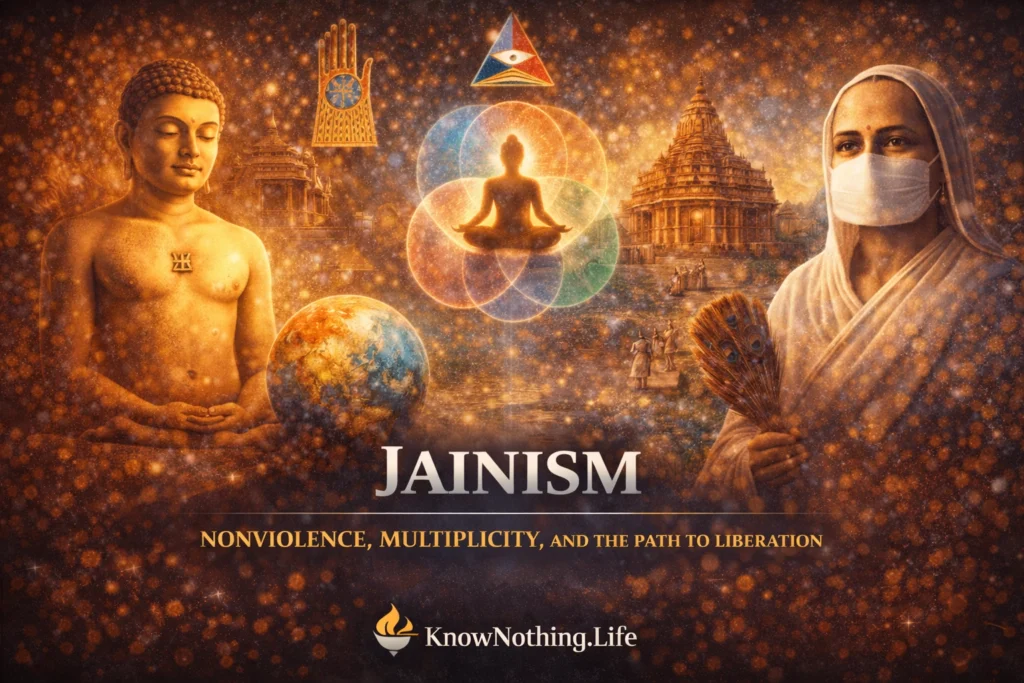
Jainism is one of the most ancient philosophical and religious traditions of India, distinguished by its uncompromising commitment to nonviolence, its sophisticated metaphysics, and its rigorous path toward spiritual liberation. Emerging alongside early Hindu and Buddhist traditions, Jainism offers a unique perspective on the nature of reality, emphasizing the individuality of the soul, the ethical consequences of action, and the possibility of complete freedom from the cycle of birth and death. It is not merely a system of belief but a disciplined way of life centered on self-restraint, awareness, and compassion for all living beings.
At the heart of Jain philosophy lies the conviction that every living being possesses a soul (jiva) that is inherently pure, conscious, and capable of infinite knowledge. However, this pure state is obscured by the accumulation of karma, conceived not as a metaphor but as a subtle material substance that binds to the soul through actions, thoughts, and intentions. Liberation (moksha) is achieved by eliminating this karmic accumulation through ethical conduct, ascetic practice, and deep spiritual insight. This framework gives Jainism a distinctive emphasis on personal responsibility and moral discipline as the means to ultimate freedom.
Historical Foundations and the Teachings of Mahavira
Jainism traces its origins to a lineage of spiritual teachers known as Tirthankaras, or “ford-makers,” who guide others across the river of suffering. The most recent and historically significant of these figures is Mahavira, who lived in the 6th century BCE. A contemporary of Siddhartha Gautama, Mahavira renounced a life of privilege to pursue asceticism and spiritual awakening. After years of intense discipline and meditation, he attained kevala jnana, or omniscience, and began teaching a path of liberation grounded in nonviolence and self-restraint.
Mahavira’s teachings are preserved in Jain scriptures such as the Agamas, which outline ethical principles, metaphysical doctrines, and practical guidelines for spiritual practice. Central to his message is the principle of ahimsa, or nonviolence, which extends to all forms of life, from humans and animals to plants and even microorganisms. He is traditionally quoted as saying, “All living beings desire to live; none wishes to suffer. Therefore, one should not harm any living being.” This radical commitment to nonviolence shapes every aspect of Jain life, from dietary practices to social interactions.
The historical development of Jainism reflects both continuity and adaptation, as its teachings were transmitted through oral tradition before being codified in written form. Over time, different sects emerged, such as the Digambara and Svetambara traditions, each with its own interpretations of doctrine and practice. Despite these differences, the core principles established by Mahavira remain central to Jain identity and philosophy.
Metaphysics: The Nature of Reality and the Soul
Jain metaphysics presents a detailed and systematic account of reality, distinguishing between living (jiva) and non-living (ajiva) substances. The universe, according to Jain thought, is eternal and uncreated, consisting of an infinite number of individual souls coexisting with various forms of matter, space, time, and motion. Each soul is inherently pure and endowed with infinite perception, knowledge, and bliss, but its true nature is obscured by karmic particles that attach to it through actions and desires.
This conception of karma as a material substance sets Jainism apart from other Indian traditions. Karma is understood as a fine, physical matter that binds to the soul and influences its experiences across lifetimes. Actions driven by attachment, anger, pride, or deceit attract karmic particles, while disciplined conduct and detachment help to shed them. Liberation is achieved when all karmic matter is removed, allowing the soul to return to its natural state of purity and omniscience.
Jain philosophy also emphasizes the multiplicity of perspectives through the doctrine of anekantavada, which holds that reality is complex and cannot be fully captured by any single viewpoint. This principle encourages intellectual humility and openness, recognizing that different perspectives may reveal different aspects of truth. As later Jain thinkers articulated, “Reality is multifaceted, and any single statement about it is only partially true.” This insight has significant implications for both philosophy and ethics, promoting tolerance and dialogue in the pursuit of understanding.
Ethics and the Principle of Nonviolence
Ethics occupies a central place in Jainism, with the principle of ahimsa serving as its foundation. Nonviolence is not merely the absence of physical harm but a comprehensive commitment to avoiding injury in thought, word, and deed. This principle extends to all living beings, reflecting the belief that every soul is worthy of respect and compassion. As a result, Jain practitioners often adopt practices such as vegetarianism, careful movement to avoid harming small creatures, and mindfulness in speech and intention.
In addition to ahimsa, Jain ethics includes other key principles, such as truthfulness (satya), non-stealing (asteya), celibacy or chastity (brahmacharya), and non-possessiveness (aparigraha). These principles are formalized in the five great vows (mahavratas) taken by ascetics and the corresponding smaller vows observed by lay followers. Together, they provide a comprehensive framework for ethical living, guiding individuals toward greater self-discipline and spiritual awareness.
The emphasis on non-possessiveness reflects a broader concern with attachment and desire as sources of karmic accumulation. By limiting material possessions and cultivating detachment, individuals can reduce their involvement in harmful actions and move closer to liberation. Jain ethics thus integrates personal conduct with metaphysical insight, linking everyday choices to the ultimate goal of spiritual freedom.
Knowledge, Logic, and Epistemology
Jainism makes significant contributions to the study of knowledge and logic, particularly through its development of sophisticated epistemological frameworks. Knowledge (jnana) is classified into different types, ranging from sensory perception to omniscience, with each level representing a deeper understanding of reality. The highest form of knowledge, kevala jnana, is attained by liberated beings who have completely removed karmic obstructions.
A key aspect of Jain epistemology is the doctrine of syadvada, or the theory of conditioned predication. This approach asserts that statements about reality must be qualified by context, recognizing that any claim is true only from a particular perspective. For example, a statement may be true in one sense and false in another, depending on the conditions under which it is considered. This nuanced approach to truth reflects the broader principle of anekantavada and provides a logical framework for understanding complexity and contradiction.
Jain philosophers have also engaged in debates with other Indian schools, contributing to the development of logic and argumentation. Their emphasis on multiple perspectives and conditional reasoning offers a valuable alternative to more rigid systems of thought, encouraging a more flexible and inclusive approach to knowledge. This intellectual tradition demonstrates that Jainism is not only a path of ethical and spiritual practice but also a rich and rigorous philosophical system.
Practice, Asceticism, and the Path to Liberation
The path to liberation in Jainism is marked by rigorous discipline and ascetic practice, particularly for monks and nuns who renounce worldly life. These practitioners follow strict rules governing behavior, diet, and interaction with the environment, aiming to minimize harm and eliminate karmic accumulation. Practices such as fasting, meditation, and self-reflection are central to this path, helping individuals cultivate detachment and awareness.
For lay followers, the path is less austere but still demanding, involving adherence to ethical principles and regular spiritual practice. Rituals, festivals, and community activities provide opportunities for reflection and renewal, reinforcing the values of nonviolence and self-discipline. The ultimate goal for all practitioners is to progress toward liberation, even if it may take many lifetimes to achieve.
The emphasis on asceticism reflects the Jain belief that liberation requires a radical transformation of one’s relationship to the world. By reducing attachment and purifying the soul, individuals can gradually free themselves from the cycle of birth and death. This path is both challenging and profound, offering a vision of spiritual freedom grounded in discipline and compassion.
Contemporary Relevance and Global Influence
In the modern world, Jainism continues to offer valuable insights into ethical living and environmental responsibility. Its emphasis on nonviolence and respect for all forms of life resonates strongly with contemporary concerns about animal rights, sustainability, and ecological balance. Jain communities around the world have contributed to these discussions, promoting practices that minimize harm and support the well-being of all living beings.
Jain philosophy also provides a framework for navigating complexity and diversity in an increasingly interconnected world. The principles of anekantavada and syadvada encourage dialogue and understanding across different perspectives, fostering a spirit of tolerance and cooperation. These ideas have relevance not only in philosophical discourse but in social and political contexts, where the ability to appreciate multiple viewpoints is essential.
As global awareness of ethical and environmental issues continues to grow, the teachings of Jainism offer a powerful reminder of the importance of compassion, restraint, and responsibility. Its ancient wisdom remains deeply relevant, providing guidance for individuals and societies seeking to live in harmony with themselves and the world around them.
Final Reflections on Jainism
Jainism stands as a remarkable testament to the depth and rigor of human philosophical inquiry, offering a comprehensive vision of reality, ethics, and liberation. Its commitment to nonviolence, its recognition of the complexity of truth, and its emphasis on personal responsibility create a framework for living that is both demanding and transformative.
As Mahavira taught, “One who neglects or disregards the existence of earth, air, fire, water, and vegetation disregards his own existence.” This insight captures the interconnected vision at the heart of Jain philosophy, reminding us that our actions have consequences not only for ourselves but for the entire web of life.
In the end, Jainism offers more than a set of doctrines; it presents a way of being that integrates thought, action, and awareness in the pursuit of freedom. Its enduring legacy lies in its ability to challenge individuals to live with greater care, clarity, and compassion, illuminating a path toward a more harmonious and enlightened existence.