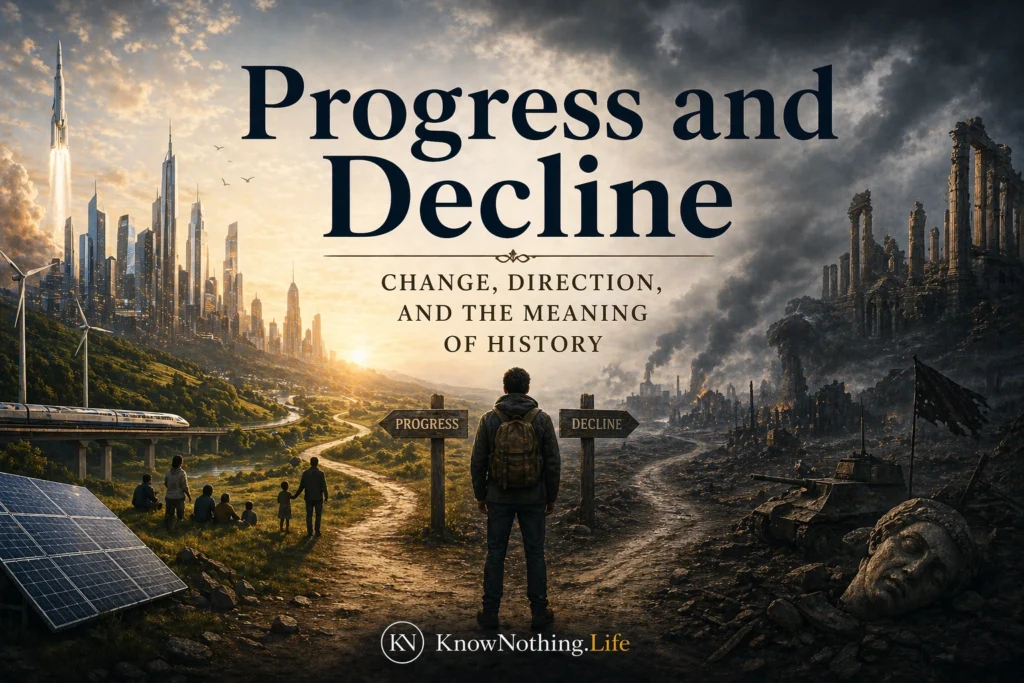
The ideas of progress and decline have long shaped how societies interpret their past and imagine their future. At stake is a fundamental question: does human history move forward toward improvement, or does it oscillate between periods of growth and decay? The concept of progress suggests that humanity advances over time—morally, intellectually, technologically—while the notion of decline warns that civilizations can stagnate, deteriorate, or collapse. These competing narratives are not merely descriptive; they reflect deeper philosophical assumptions about human nature, time, and the structure of history.
The tension between progress and decline is visible in nearly every era. Periods of innovation and expansion are often accompanied by anxieties about loss, fragmentation, or moral decay. Modern societies, despite unprecedented technological achievements, continue to grapple with questions about whether these advancements translate into genuine human betterment. The philosophy of progress and decline invites a critical examination of these assumptions, challenging us to consider what counts as improvement and whether such judgments can be sustained across different contexts.
The Idea of Progress
The concept of progress is closely associated with the Enlightenment, a period marked by confidence in reason, science, and human potential. Thinkers such as Immanuel Kant argued that humanity possesses the capacity for moral and intellectual development, suggesting that history could be understood as a gradual movement toward greater enlightenment. This perspective emphasizes cumulative knowledge, institutional refinement, and the expansion of human rights as indicators of progress.
Progress is often measured through tangible achievements, such as technological innovation, economic growth, and improvements in living standards. Advances in medicine, communication, and infrastructure have undeniably transformed human life, reducing suffering and expanding opportunities. However, the assumption that such changes constitute progress depends on the values used to evaluate them. If progress is defined narrowly in terms of efficiency or productivity, it may overlook broader questions about well-being, meaning, and sustainability.
The Reality of Decline
In contrast to the optimism of progress narratives, the idea of decline emphasizes the fragility of human achievements. Civilizations rise and fall, and periods of prosperity can give way to stagnation or collapse. Historical examples, from the fall of ancient empires to more recent social and economic crises, illustrate that advancement is neither guaranteed nor irreversible.
Philosophers like Oswald Spengler developed comprehensive theories of decline, arguing that cultures follow life cycles similar to living organisms, moving from growth to maturity and eventual decay. This perspective challenges linear views of history, suggesting that progress may be temporary or illusory. The concept of decline also reflects concerns about moral and cultural erosion, raising questions about whether technological advancement can coexist with deeper forms of deterioration.
Cyclical and Linear Views of History
The debate between progress and decline is closely tied to different conceptions of historical time. Linear models of history portray change as a continuous trajectory, often moving toward improvement or fulfillment. These models underpin many modern theories of progress, emphasizing accumulation and forward movement.
In contrast, cyclical models view history as a series of recurring patterns, where periods of growth are followed by decline and renewal. Ancient thinkers frequently adopted this perspective, interpreting history as a repeating cycle rather than a one-directional process. The tension between these models reflects broader philosophical disagreements about whether history has a purpose or direction, or whether it is governed by recurring dynamics that resist permanent advancement.
Progress in Science and Technology
One of the strongest arguments for progress lies in the realm of science and technology. The accumulation of knowledge and the development of new tools have enabled humanity to achieve levels of control over the natural world that were previously unimaginable. From medical breakthroughs to digital communication, technological progress has reshaped nearly every aspect of life.
However, the relationship between technological advancement and overall progress is not straightforward. While new technologies can improve efficiency and convenience, they can also introduce new risks and ethical dilemmas. Environmental degradation, surveillance, and the potential misuse of powerful technologies highlight the complexities of equating innovation with progress. The question is not simply whether technology advances, but whether those advancements contribute to human flourishing.
Moral and Cultural Dimensions
Progress is often evaluated not only in material terms but also in moral and cultural dimensions. The expansion of human rights, the decline of certain forms of violence, and the increasing recognition of equality are frequently cited as evidence of moral progress. These developments suggest that societies can evolve toward more just and inclusive forms of organization.
At the same time, concerns about cultural decline persist. Critics argue that modern societies may experience a loss of meaning, community, or moral clarity, even as they achieve material success. The tension between moral progress and cultural anxiety reflects the difficulty of assessing values across different domains. What appears as progress in one area may be perceived as decline in another, complicating attempts to form a unified evaluation of historical change.
Economic Growth and Inequality
Economic development is another domain where the interplay between progress and decline is evident. Growth can lead to increased wealth, improved infrastructure, and greater opportunities, suggesting a form of collective advancement. However, this growth is often accompanied by rising inequality, environmental challenges, and social tensions.
The benefits of economic progress are not always evenly distributed, leading to disparities that can undermine social cohesion. This raises questions about whether progress should be measured by aggregate outcomes or by the distribution of those outcomes. The coexistence of prosperity and inequality highlights the complexity of evaluating progress, as gains in one dimension may be offset by losses in another.
The Role of Values in Defining Progress
At its core, the concept of progress is deeply value-laden. Determining whether a society has advanced requires criteria for judgment, and these criteria vary across cultures and philosophical traditions. Some emphasize material well-being, while others prioritize moral development, spiritual fulfillment, or environmental sustainability.
This diversity of values means that progress cannot be understood as a purely objective phenomenon. It reflects the priorities and perspectives of those making the assessment. Recognizing this subjectivity does not invalidate the concept of progress but encourages a more nuanced approach, one that considers multiple dimensions and acknowledges the possibility of conflicting evaluations.
Contemporary Debates
In the modern world, debates about progress and decline are shaped by global challenges such as climate change, technological disruption, and political polarization. These issues raise questions about whether current trajectories represent genuine advancement or contain the seeds of future decline. The rapid pace of change adds urgency to these discussions, as societies must navigate complex trade-offs and uncertainties.
Some perspectives emphasize resilience and adaptability, suggesting that progress lies in the ability to respond effectively to challenges. Others highlight the risks of overconfidence, warning that unchecked growth or technological power could lead to unintended consequences. These debates reflect the ongoing relevance of the concepts of progress and decline in understanding contemporary conditions.
Conclusion
The interplay between progress and decline is a central theme in the philosophy of history, shaping how we interpret the past and envision the future. While evidence of advancement is visible in many areas of human life, the persistence of challenges and the possibility of regression remind us that progress is neither inevitable nor uniform.
Ultimately, the question is not simply whether history moves forward or backward, but how we define and evaluate change. By examining the assumptions underlying ideas of progress and decline, we gain a deeper understanding of the values that guide human societies. This reflection encourages a more critical and balanced perspective, recognizing both the achievements and the vulnerabilities that characterize the human condition.