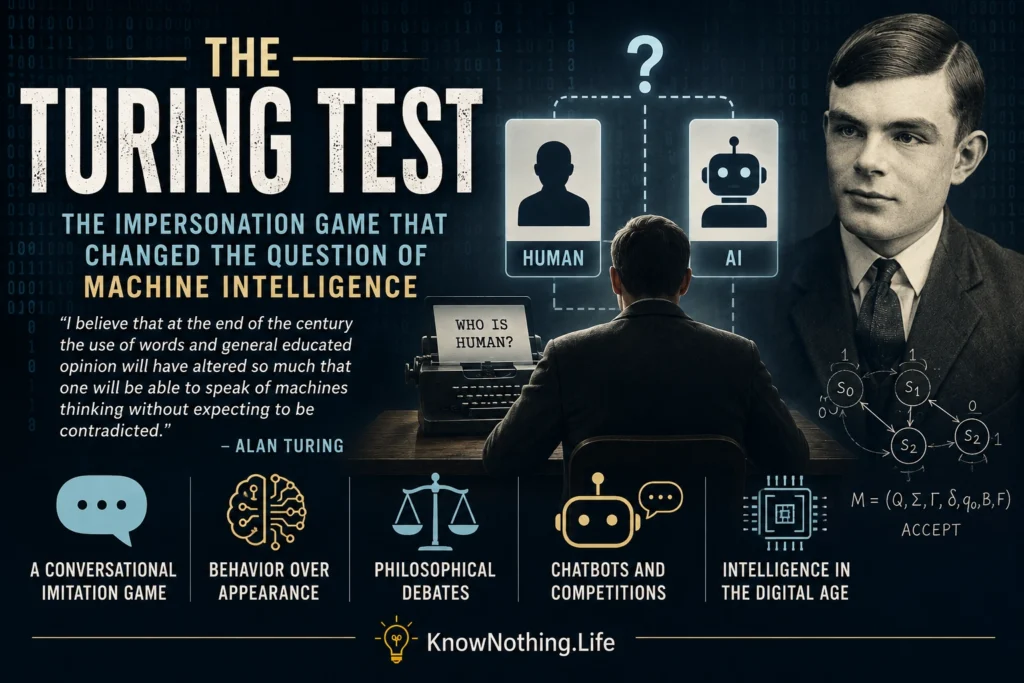
In 1950, British mathematician Alan Turing opened his landmark paper “Computing Machinery and Intelligence” with a deceptively simple question: “Can machines think?” He quickly argued that this wording created more confusion than clarity because both “machine” and “thinking” could be defined in competing ways. Rather than becoming trapped in a debate over definitions, Turing replaced the original question with an experiment based on observable behavior. The result became known as the Turing Test, one of the most influential thought experiments in computer science, artificial intelligence, cognitive science, and the philosophy of mind.
The test asks whether a computer can participate in a written conversation convincingly enough that a human evaluator cannot reliably distinguish it from a human participant. Text-based communication removes clues based on appearance, voice, bodily movement, and physical construction. Turing’s proposal therefore transformed an apparently inaccessible question about a machine’s inner experience into a practical question about performance. Instead of asking for direct proof that a machine possesses a mind, he asked what publicly observable evidence would justify treating its behavior as intelligent.
What Turing Actually Proposed
Turing called his procedure the “imitation game.” His paper began with a game involving a man, a woman, and an interrogator who communicated through written messages while attempting to identify the participants correctly. Turing then altered the game by asking what would happen when a digital computer took the place of one participant. The machine would attempt to produce answers resembling those of a human closely enough to confuse the interrogator. Its task was not merely to calculate correctly but to navigate the flexibility, ambiguity, humor, memory, and unpredictability of conversation.
Turing predicted that within roughly fifty years, computers with sufficient storage could perform well enough that an average interrogator would have no more than a 70 percent chance of identifying the participants correctly after five minutes of questioning. This prediction is sometimes presented as a formal rule that a machine passes by fooling 30 percent of judges. Turing, however, did not create a universally standardized contest with fixed scoring procedures. His paper offered a philosophical argument, a technological forecast, and a challenge to future researchers rather than a complete experimental protocol.
Why Conversation Became the Standard
Conversation is a demanding test because it requires many abilities at once. A convincing participant must interpret language, remember earlier statements, recognize indirect meanings, apply background knowledge, and adjust to unexpected questions. An interrogator can move rapidly between mathematics, personal experiences, jokes, literature, ethics, emotions, or common sense. A computer that succeeds throughout an unrestricted exchange appears to display something broader than the ability to solve one predetermined problem.
The test also reflects a basic limitation in how people recognize other minds. No one directly observes another person’s consciousness. People infer thought and understanding from language, actions, memories, emotional reactions, and other outward signs. Turing’s challenge was partly directed at critics who were willing to accept behavioral evidence of intelligence in humans but demanded inaccessible proof when evaluating machines. The argument did not necessarily claim that behavior and thought are identical. It suggested that sufficiently rich behavior may be the strongest public evidence available for attributing intelligence.
ELIZA and the Appearance of Understanding
Joseph Weizenbaum’s ELIZA program demonstrated how readily conversational behavior can create an impression of understanding. Described in a 1966 paper in Communications of the ACM, ELIZA analyzed user statements through keyword-triggered decomposition rules and generated responses through corresponding reassembly rules. Its most famous script imitated a nondirective psychotherapist, often turning a user’s comments into questions or requests for elaboration.
ELIZA did not possess a detailed model of the user’s life or emotions, yet some interactions seemed surprisingly meaningful. Its success exposed a weakness in conversational evaluation: people actively interpret language, fill in missing context, and attribute intention to ambiguous responses. A system may therefore appear intelligent partly because the human participant performs interpretive work on its behalf. This tendency is often called the ELIZA effect—the inclination to attribute more understanding, empathy, or awareness to a computer than its underlying process warrants.
The Chinese Room Objection
The most influential philosophical criticism of behavioral tests came from John Searle’s 1980 paper “Minds, Brains, and Programs.” Searle imagined a person who knows no Chinese sitting inside a sealed room with a detailed rulebook. Chinese symbols enter the room, the person follows formal instructions for arranging other symbols, and convincing Chinese responses emerge. To outside observers, the room may appear fluent, yet the individual manipulating the symbols understands none of them.
Searle used the Chinese Room to distinguish syntax from semantics. A computer program manipulates symbols according to formal rules, but successful manipulation does not necessarily produce meaning or understanding. From this perspective, passing the Turing Test might demonstrate a successful simulation of thought without demonstrating actual thought. Critics have answered that Searle focuses too narrowly on the person inside the room: perhaps the complete system—the person, instructions, memory, and symbol-processing operation—understands Chinese. The debate remains unresolved because it concerns what understanding is, not merely what computers can do.
Meaning, Experience, and Embodiment
Stevan Harnad developed a related problem in his 1990 paper “The Symbol Grounding Problem.” A purely symbolic system defines symbols through relationships with other symbols, but this can create an endless circle of definitions. It resembles attempting to learn an unfamiliar language from a dictionary written entirely in that same language. Harnad argued that some symbols must ultimately be grounded in nonsymbolic capacities such as perception, categorization, and interaction with objects and events.
Robert French likewise argued that a rigorous Turing Test could probe “subcognitive” associations accumulated through embodied and cultural experience. Questions about which objects seem comforting, which situations feel awkward, or which words naturally belong together may reveal networks of association developed through living in a particular body and society. French concluded that the test could be too anthropocentric as a general measure of machine intelligence because it asks a machine not simply to be intelligent, but to reproduce the distinctive cognitive history of a human being.
Competitions and Practical Problems
Attempts have been made to transform Turing’s thought experiment into organized competitions. The best-known was the Loebner Prize, first held in 1991, in which judges exchanged messages with computers and human participants. Such events attracted public attention, but their scientific value was disputed. Stuart Shieber’s analysis of an early restricted competition argued that limited topics, short conversations, inconsistent judging, and unclear objectives prevented the contest from producing meaningful evidence about machine intelligence.
A chatbot may appear more human by making spelling mistakes, changing the subject, claiming ignorance, using humor, or adopting a persona that excuses weak answers. Judges also differ in technical knowledge, conversational ability, suspicion, and expectations. A result may consequently measure the program’s intelligence, its skill at deception, the evaluator’s assumptions, and the rules of the event simultaneously. Claims that a machine has “passed” are therefore difficult to assess without knowing the test’s duration, comparison group, questioning freedom, scoring method, and statistical threshold.
What Passing Would—and Would Not—Prove
Passing a carefully designed Turing Test would still represent an extraordinary accomplishment. It would demonstrate advanced language use, contextual adaptation, broad knowledge, memory, and the ability to handle unpredictable interaction. The test remains valuable because it demands observable competence and prevents intelligence from being defined in a way that automatically excludes machines. The extensive review by Ayşe Pınar Saygin, Ilyas Cicekli, and Varol Akman in “Turing Test: 50 Years Later” showed how the proposal shaped decades of debate across artificial intelligence, psychology, linguistics, and philosophy.
Conversational indistinguishability cannot by itself prove consciousness, emotion, self-awareness, moral agency, or subjective experience. Nor does failure prove an absence of intelligence. A scientific system might discover patterns, solve problems, or control machinery with abilities far beyond those of humans while remaining unconvincing in casual conversation. Human imitation is therefore one possible benchmark rather than a complete theory of intelligence.
Why the Turing Test Still Matters
The Turing Test survives because it exposes a fundamental problem: what would count as evidence that a nonhuman entity thinks? Standards can be set too low, allowing superficial conversational tricks to qualify as intelligence, or too high, requiring forms of proof that cannot even be obtained for other humans. Turing’s lasting achievement was not a final definition of thought. It was a method of turning an abstract philosophical disagreement into a challenge that could be debated, refined, and experimentally investigated.
Its greatest value may ultimately be diagnostic rather than decisive. The test reveals how strongly people associate fluent language with understanding, how readily they project minds onto responsive systems, and how uncertain their own criteria for intelligence remain. It also shows that questions about artificial minds inevitably become questions about human minds. Before people can confidently decide whether a machine thinks, they must explain why they believe anyone else does.