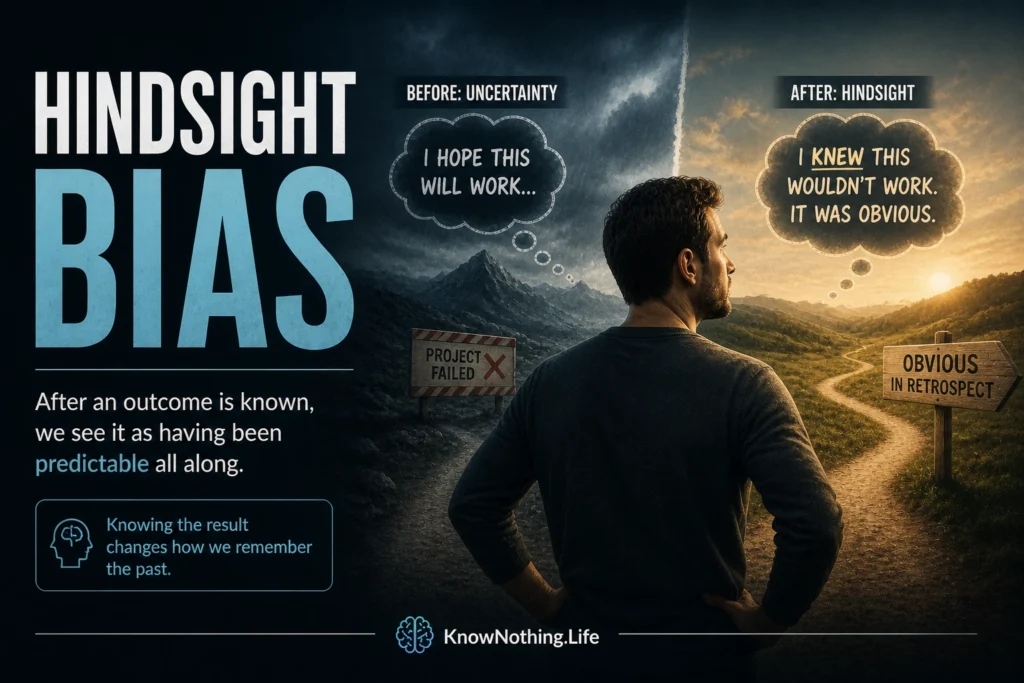
Hindsight bias is the tendency to perceive past events as having been more predictable than they actually were. Often summarized as the “I knew it all along” effect, this bias leads individuals to reconstruct their prior beliefs after an outcome is known, making the result seem obvious or inevitable. While hindsight bias can create a sense of understanding and coherence, it also distorts memory and impairs accurate evaluation of decisions and outcomes.
The systematic psychological study of hindsight bias began with the work of Baruch Fischhoff, whose experiments in the 1970s demonstrated how knowledge of outcomes alters people’s recollections of their earlier judgments. In one classic study, participants were asked to estimate the likelihood of various outcomes of historical events; after learning the actual outcome, they significantly overestimated how likely they had believed it to be. Fischhoff concluded that “people exaggerate what they knew in foresight once they know the outcome,” highlighting a fundamental distortion in human memory.
Hindsight bias is not merely a curiosity of cognition; it has important implications for learning, decision-making, and judgment. By examining how this bias operates, researchers have gained insight into the ways individuals interpret past events and construct narratives about their experiences. This article explores the cognitive mechanisms of hindsight bias, its effects across different domains, and strategies for mitigating its influence.
Cognitive Mechanisms of Hindsight Bias
Hindsight bias arises from the reconstructive nature of memory. Rather than storing exact records of past beliefs, individuals reconstruct their memories based on current knowledge and understanding. When an outcome is known, it becomes integrated into the memory of the event, making it difficult to recall the uncertainty that existed beforehand. This process creates the illusion that the outcome was predictable all along.
One key mechanism underlying hindsight bias is memory distortion. Research by Elizabeth Loftus has shown that memory is highly malleable and susceptible to suggestion. While her work primarily focused on eyewitness testimony, the same principles apply to hindsight bias. As Loftus noted, “memory is not a precise recorder of events,” and this lack of precision allows new information to reshape past recollections.
Another mechanism involves the need for cognitive coherence. Individuals prefer to see the world as orderly and understandable, and hindsight bias helps create a sense of predictability. By aligning past beliefs with known outcomes, individuals reduce uncertainty and maintain a coherent narrative. This tendency reflects a broader cognitive drive to make sense of events, even at the cost of accuracy.
Hindsight Bias and Decision-Making
Hindsight bias has significant implications for decision-making, particularly in how individuals evaluate past choices. When outcomes are known, people may judge decisions based on the result rather than on the information available at the time. This outcome bias can lead to unfair evaluations, where good decisions with poor outcomes are criticized and poor decisions with good outcomes are praised.
In professional contexts, such as business or medicine, hindsight bias can affect learning and accountability. For example, a manager may view a failed project as obviously flawed in retrospect, overlooking the uncertainty and constraints present during decision-making. Similarly, physicians may perceive diagnostic errors as more predictable than they actually were, leading to overconfidence in future judgments.
The work of Daniel Kahneman has highlighted the impact of hindsight bias on judgment. Kahneman observed that “once you adopt a new view of the world… you immediately lose much of your ability to recall what you used to believe before your mind changed.” This insight underscores the difficulty of maintaining an accurate record of past beliefs and the challenge of learning from experience.
Social and Legal Implications
Hindsight bias plays a crucial role in social and legal contexts, where judgments about responsibility and causation are often made after outcomes are known. In legal settings, jurors and judges may evaluate actions based on what is known after the fact, rather than on what could reasonably have been anticipated. This can lead to harsher judgments, as outcomes appear more foreseeable in hindsight.
For example, in cases of negligence, decision-makers may overestimate the predictability of an event, concluding that it should have been prevented. This can influence verdicts and penalties, raising concerns about fairness. The bias can also affect public opinion, where individuals judge leaders or institutions more harshly after negative outcomes, regardless of the uncertainty they faced.
Socially, hindsight bias can influence how people interpret events and assign blame. After a negative outcome, individuals may believe that warning signs were obvious, leading to criticism of those involved. This can create unrealistic expectations and hinder constructive analysis. By recognizing the role of hindsight bias, it becomes possible to approach such judgments with greater nuance and fairness.
Emotional and Motivational Functions
Despite its distortive effects, hindsight bias serves important emotional and motivational functions. By creating a sense of predictability, it can enhance feelings of control and reduce anxiety about uncertainty. Believing that events were foreseeable may provide comfort, as it suggests that the world is more orderly than it might otherwise appear.
Hindsight bias can also protect self-esteem. When individuals believe they “knew it all along,” they may feel more competent and knowledgeable. This aligns with broader patterns of self-enhancement in cognition, where individuals interpret information in ways that maintain a positive self-concept. However, this protective function can come at the cost of accurate self-assessment and learning.
The interplay between emotional benefits and cognitive distortions highlights the complexity of hindsight bias. While it can provide psychological comfort, it can also hinder growth by obscuring the role of uncertainty and chance. Balancing these effects is a key challenge in understanding and addressing the bias.
Hindsight Bias in Learning and Expertise
Hindsight bias has important implications for learning and the development of expertise. Effective learning requires accurate reflection on past decisions, including an understanding of the information and uncertainty present at the time. Hindsight bias can interfere with this process by creating the illusion that outcomes were predictable, reducing the perceived need for improvement.
Experts are not immune to hindsight bias, although experience may help mitigate its effects. In some cases, expertise can even amplify the bias, as individuals develop stronger narratives about how events unfold. This can lead to overconfidence and reduced openness to alternative perspectives. Recognizing the limitations of hindsight is therefore essential for maintaining effective judgment.
Educational approaches that emphasize probabilistic thinking and uncertainty can help counteract hindsight bias. By encouraging individuals to consider multiple possible outcomes and to reflect on their reasoning processes, it is possible to foster more accurate and adaptive learning. This approach aligns with broader efforts to improve decision-making through awareness of cognitive biases.
Mitigating Hindsight Bias
Reducing hindsight bias requires deliberate strategies that promote accurate memory and evaluation. One effective approach is to document decisions and predictions before outcomes are known. By creating a record of initial beliefs, individuals can compare them with actual outcomes, reducing the tendency to reconstruct memories.
Another strategy involves adopting a perspective of uncertainty. Actively considering alternative outcomes and acknowledging the limits of knowledge can help counteract the illusion of inevitability. This practice encourages a more realistic understanding of events and supports better decision-making.
Structured reflection and feedback can also play a role in mitigating hindsight bias. By analyzing decisions in a systematic way and considering the context in which they were made, individuals can develop a more accurate understanding of their reasoning. While it may not be possible to eliminate hindsight bias entirely, these strategies can significantly reduce its impact.
Conclusion
Hindsight bias is a powerful cognitive phenomenon that shapes how individuals perceive and interpret past events. By making outcomes appear more predictable than they were, it creates a sense of coherence and understanding, but at the cost of accuracy. The work of Baruch Fischhoff, Elizabeth Loftus, and Daniel Kahneman has provided valuable insights into the mechanisms and consequences of this bias.
Understanding hindsight bias is essential for improving decision-making, learning, and judgment. By recognizing the role of uncertainty and resisting the temptation to reconstruct past beliefs, individuals can develop a more accurate and nuanced understanding of events. This awareness is particularly important in contexts where fairness and accountability are at stake.
Ultimately, hindsight bias highlights the reconstructive nature of memory and the challenges of achieving objectivity. It reminds us that the past is not simply recalled but actively interpreted, shaped by current knowledge and beliefs. By acknowledging these limitations, individuals can approach their experiences with greater humility and insight, fostering better decisions and deeper understanding.