Most people understand how a toilet works. Or at least they believe they do. They know what happens when the handle is pressed, recognize the sound of rushing water, and understand that waste disappears through the plumbing. Yet when asked to explain precisely how the flushing mechanism operates, how water pressure changes, or what prevents the bowl from overflowing, that confidence often begins to disappear. The same phenomenon occurs with bicycles, refrigerators, zippers, financial systems, and countless other familiar objects and processes. We recognize what these things do, but our ability to explain how they accomplish it is frequently much weaker than we imagine.
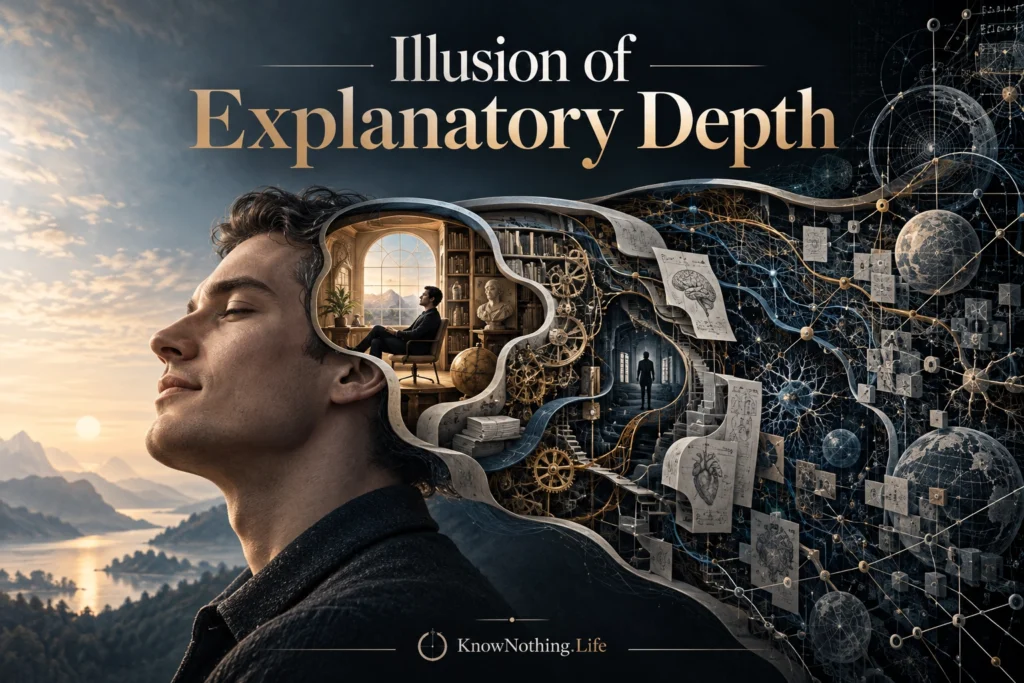
Psychologists call this tendency the illusion of explanatory depth (IOED), a cognitive bias in which individuals substantially overestimate the completeness and sophistication of their understanding. Unlike ordinary ignorance, the illusion involves a failure to recognize the limits of one’s own knowledge. It reveals something fundamental about human cognition: familiarity can create the subjective experience of understanding without supplying the underlying explanation. Research suggests that this discrepancy influences education, political beliefs, technological literacy, decision-making, and even how people judge their own intelligence.
What Is the Illusion of Explanatory Depth?
The illusion of explanatory depth describes the gap between how thoroughly people believe they understand something and how thoroughly they can actually explain it. A person might confidently claim to understand inflation, natural selection, or the functioning of an automobile engine, only to discover substantial gaps when asked to describe the sequence of causal relationships involved. Knowing that inflation involves rising prices is not equivalent to understanding the economic mechanisms that produce different forms of inflation. Similarly, knowing that natural selection involves survival and reproduction does not necessarily mean understanding inherited variation, differential reproductive success, and population-level evolutionary change.
Importantly, this illusion is not identical to general overconfidence. People can often accurately assess whether they remember a historical date, recognize a person’s name, or know the steps of a familiar procedure. Explanatory understanding presents a different challenge because it requires constructing a coherent account of how something works. The mind may possess scattered facts, familiar images, and simplified conceptual models without recognizing that the connections between them are incomplete. As cognitive scientists Leonid Rozenblit and Frank Keil demonstrated, people are particularly vulnerable when judging their understanding of complex causal mechanisms.
The Original Experiments by Rozenblit and Keil
The illusion was systematically investigated by psychologists Leonid Rozenblit and Frank C. Keil in their influential 2002 paper, The Misunderstood Limits of Folk Science: An Illusion of Explanatory Depth, published in Cognitive Science. Across twelve studies, the researchers examined how accurately individuals evaluated their understanding of ordinary objects, biological phenomena, and mechanical systems. Their work began with the observation that people often possess intuitive explanations that appear sufficiently complete until they are required to articulate them. The researchers summarized the phenomenon by noting that people believe they understand complex subjects with substantially greater precision and detail than their actual knowledge supports.
In a central experimental procedure, participants first rated how well they understood various mechanisms, such as the operation of everyday devices. They were then asked to explain those mechanisms in detail and subsequently reassess their knowledge. After attempting the explanations, participants generally lowered their understanding ratings, often recognizing that their initial confidence had been excessive. This pattern was particularly pronounced for explanatory knowledge compared with knowledge involving facts, procedures, or narratives. The critical discovery was not simply that people lacked detailed knowledge; it was that they were frequently unaware of that limitation until the act of explanation made it apparent.
Why the Brain Creates an Illusion of Understanding
One explanation involves the distinction between recognizing information and possessing a working causal model. When an object behaves predictably, the brain develops expectations about what will happen without necessarily representing the mechanisms responsible. A person learns that pressing a light switch illuminates a room, but this successful prediction requires little knowledge of electrical circuits. Repeated experience strengthens the feeling of familiarity, and familiarity can be mistaken for explanatory understanding. The mind effectively substitutes a simpler judgment—whether something feels familiar—for the more demanding question of whether its underlying processes are understood.
Another contributing factor is the way human cognition compresses information. The world contains vastly more detail than any individual can mentally represent, making simplified models essential for efficient thinking. Rather than continuously analyzing every component of a system, people rely on broad causal assumptions and expectations. These mental shortcuts usually work well enough for daily functioning, but they become problematic when confidence extends beyond the information actually represented. Rozenblit and Keil proposed that our interactions with visible mechanisms and our reliance on partially understood causal explanations contribute to this distorted assessment of knowledge. The result is an efficient cognitive system that sometimes mistakes a useful outline for a complete explanation.
The Difference Between Knowing Facts and Understanding Causes
The illusion becomes clearer when distinguishing descriptive knowledge from causal understanding. Descriptive knowledge identifies characteristics, events, or relationships, while causal explanation examines the processes that produce them. Someone may know that certain medications affect neurotransmitter signaling without understanding the complex biological pathways connecting those effects to clinical outcomes. Likewise, memorizing the stages of photosynthesis does not necessarily establish an understanding of how light energy is converted into chemical energy. Explanatory depth requires more than possessing accurate information; it involves understanding how the relevant components interact and why particular outcomes follow.
This distinction also has philosophical roots. In Posterior Analytics, Aristotle argued that scientific understanding involves knowledge of causes rather than merely recognizing that something is true. Although modern cognitive psychology approaches the issue experimentally, the underlying question is similar: What does it mean to genuinely understand something? Scientific explanations must connect evidence, mechanisms, and consequences in ways that survive questioning. A shallow explanation may appear convincing because it contains familiar technical terminology, but its weaknesses become apparent when someone asks why a particular step occurs, what would happen if conditions changed, or how an alternative explanation could be ruled out.
The Knowledge Illusion and Collective Intelligence
The illusion of explanatory depth is closely connected to the social nature of human knowledge. In their 2017 book, The Knowledge Illusion: Why We Never Think Alone, cognitive scientists Steven Sloman and Philip Fernbach argued that individuals routinely confuse the knowledge they personally possess with knowledge available through their communities. Modern civilization depends on extraordinary specialization. Engineers design transportation systems, physicians investigate disease, programmers develop software, and scientists study processes that other specialists may understand only superficially. Individuals benefit from these achievements without needing to reproduce the expertise behind them.
This collective arrangement is enormously successful, but it creates a psychological ambiguity about where personal knowledge ends and external knowledge begins. A person who uses a smartphone every day may feel knowledgeable about mobile technology despite understanding little about semiconductor manufacturing, wireless communication protocols, or operating-system architecture. Sloman and Fernbach suggest that our capacity to rely on other people’s expertise can blur the distinction between individual and collective understanding. The illusion is therefore not simply an intellectual defect. It may partly reflect the same socially distributed cognitive system that allows human societies to accomplish tasks far beyond the capacity of any isolated individual.
Political Beliefs and the Illusion of Understanding
The implications extend beyond mechanical devices into politics and public policy. In a 2013 study published in Psychological Science, Philip Fernbach, Todd Rogers, Craig Fox, and Steven Sloman investigated whether the illusion of explanatory depth contributed to political extremity. Participants were asked to evaluate their understanding of complex public policies and then explain, in causal detail, how those policies would produce their intended consequences. After struggling to construct complete explanations, participants tended to report lower levels of understanding and expressed more moderate positions. Crucially, simply asking people to list reasons supporting their preferences did not produce the same effect.
These findings suggest that explaining a policy’s mechanisms can reveal uncertainty that ordinary political argument leaves untouched. However, the relationship between explanatory depth and polarization is not universal. A 2022 follow-up investigation by Steven Sloman and Marc-Lluís Vives examined mixed replication evidence and found that explanation reduced attitude extremity for issues centered on consequences, but not for issues involving protected values or deeply held moral commitments. This distinction matters because political beliefs arise from different sources. Some depend heavily on assumptions about practical outcomes, while others express moral identity, loyalty, or ethical principles. Discovering gaps in causal understanding may soften confidence in the former without necessarily altering the latter.
How the Internet Can Inflate Our Sense of Knowledge
Digital technology introduces another way of confusing accessible information with personal understanding. In 2015, Matthew Fisher, Mariel Goddu, and Frank Keil published Searching for Explanations: How the Internet Inflates Estimates of Internal Knowledge in the Journal of Experimental Psychology: General. Across nine experiments, they found that searching the internet for explanations could increase participants’ estimates of their own knowledge, including their perceived ability to answer questions unrelated to the original search. The effect occurred under some conditions even when searches failed to produce satisfactory answers. Participants appeared to confuse access to a vast external information system with knowledge stored in their own minds.
This finding has become increasingly relevant in an environment dominated by search engines, instant summaries, and conversational artificial intelligence. These technologies can provide valuable explanations and accelerate learning, but receiving a coherent answer is not the same as being able to reconstruct, evaluate, or apply it independently. The original experiments examined internet searching rather than today’s generative AI systems, so their conclusions should not automatically be treated as direct evidence about AI use. Nevertheless, they suggest an important question for digital learning: Does technology help individuals develop deeper understanding, or can its ease of use sometimes make borrowed explanations feel like personal expertise?
The Illusion of Explanatory Depth in Education
Educational environments provide especially important opportunities to recognize this cognitive bias. Students frequently mistake recognizing information for mastering it. A textbook passage may seem completely understandable during reading, particularly when its terminology and examples are familiar. Yet when students are asked to explain the concept without consulting the material, uncertainty often emerges. This discrepancy resembles the illusion of explanatory depth because the subjective experience of comprehension can exceed the knowledge available for independent use. Effective education must therefore distinguish between exposure to an explanation and the ability to generate a meaningful explanation.
Research on self-explanation offers a practical response. In a landmark 1989 study, Michelene Chi and colleagues investigated how students learned from worked examples of physics problems. Stronger learners generated explanations connecting individual problem-solving steps to underlying principles, while weaker learners relied more heavily on the examples without constructing those connections. A related developmental investigation by Candice Mills and Frank Keil in 2004 demonstrated that elementary-school children could also exhibit the illusion of explanatory depth when evaluating mechanical devices. Second- and fourth-grade students recognized gaps in their understanding after attempting explanations, suggesting that this vulnerability emerges relatively early and that explanation can help reveal it.
Recognizing and Overcoming the Illusion
One useful strategy for confronting the illusion of explanatory depth is to attempt a complete explanation before consulting outside information. Choose a familiar subject—such as how a refrigerator cools food, why airplanes generate lift, or how interest rates influence borrowing—and write an explanation using only existing knowledge. Avoid replacing mechanisms with labels or broad statements. Describe each major step, identify what causes the next event, and explain why the process produces its outcome. When the explanation becomes vague, mark the missing connection rather than filling it with an assumption. This exercise creates an opportunity to compare perceived understanding with demonstrated understanding, echoing the central method used in the original research.
A second strategy involves questioning explanations instead of merely collecting facts. Asking what would happen under different conditions can reveal whether a causal model is flexible or superficial. Teaching a concept to someone else may also expose missing steps, provided the learner is willing to acknowledge uncertainty rather than improvise convincing answers. Consulting reliable evidence, comparing competing explanations, and revisiting the subject after time has passed can further strengthen understanding. These practices do not guarantee immunity from cognitive bias, but they help replace the passive feeling of comprehension with observable demonstrations of knowledge. The goal is not to eliminate confidence, but to align confidence more closely with what can actually be explained.
Intellectual Humility and the Limits of Human Knowledge
The illusion of explanatory depth illustrates a broader problem in epistemology: people must evaluate the reliability of knowledge using minds that are themselves imperfect judges of understanding. Confidence is a psychological experience, not an independent measurement of truth. A coherent story can feel explanatory even when important causal relationships remain unexamined. This helps explain why simple narratives often appear persuasive and why unfamiliar complexity can be underestimated. Genuine intellectual humility does not require abandoning conclusions or doubting everything. It requires recognizing the difference between knowing a fact, understanding a mechanism, trusting a qualified expert, and merely feeling familiar with an idea.
Yet there is also a constructive interpretation of the research. Human intelligence was never designed around the expectation that every person would understand every system they encounter. Specialization, communication, shared inquiry, and institutional knowledge make sophisticated societies possible. The danger arises when individuals mistake participation in these systems for independent mastery of their underlying mechanisms. The more productive response is neither intellectual arrogance nor permanent skepticism, but a willingness to investigate uncertainty and acknowledge dependence on other sources of expertise.
Final Thoughts on the Illusion of Explanatory Depth
The illusion of explanatory depth reveals that understanding is often less complete than it feels. From household devices to economic policy, individuals construct mental models that provide a convincing sense of comprehension while leaving important mechanisms unexplained. Research beginning with Rozenblit and Keil’s 2002 experiments demonstrates how attempting detailed explanations can expose this discrepancy. Later studies have extended the investigation into childhood development, education, political reasoning, and digital information seeking, showing that the relationship between knowledge and confidence has consequences far beyond the psychology laboratory.
Perhaps the most important lesson is that discovering what we do not understand represents intellectual progress rather than failure. Explanation transforms vague familiarity into a testable account of how the world works. When an explanation breaks down, it identifies where further learning can begin. Understanding the limits of knowledge is therefore inseparable from developing deeper knowledge itself. The illusion of explanatory depth reminds us that genuine understanding does not begin with the conviction that we already know, but with the willingness to discover how much remains unexplained.