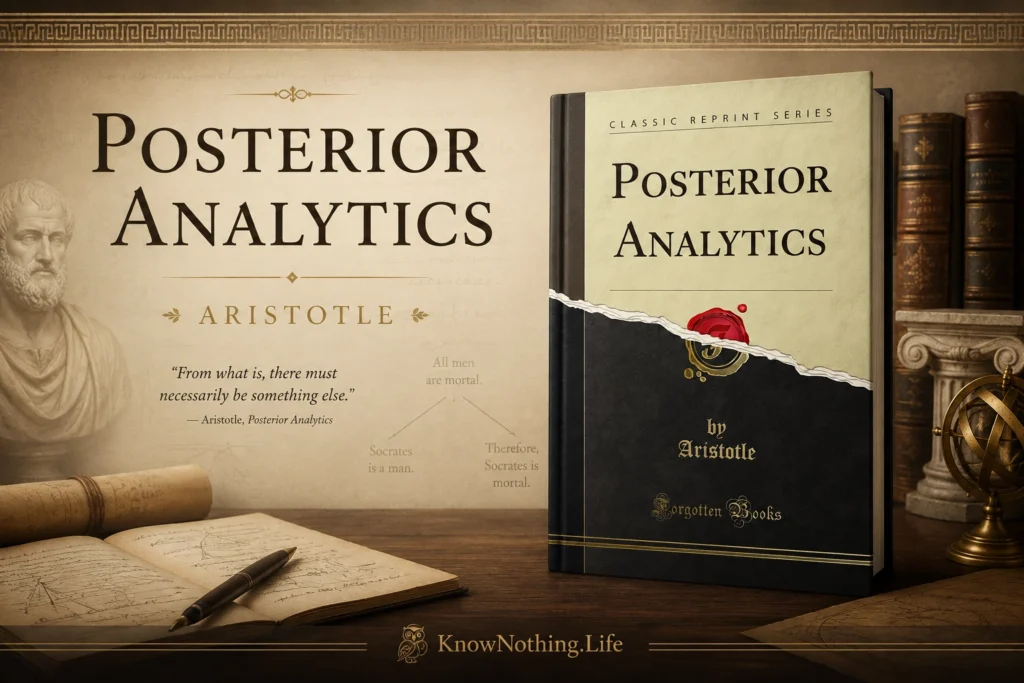
Aristotle’s Posterior Analytics is one of the foundational works in the philosophy of science and epistemology. Where the Prior Analytics develops the machinery of syllogistic deduction—asking what makes an inference logically valid—the Posterior Analytics asks a more demanding question: when does valid reasoning amount to knowledge? A perfectly constructed argument can begin from false, accidental, or poorly understood premises and therefore fail to explain anything about reality. Aristotle wants to know what distinguishes such reasoning from epistēmē, the systematic knowledge characteristic of a genuine science. His answer is that knowledge does not consist merely in possessing true conclusions. To know something scientifically is to understand why it must be so by grasping the principles and causes that make it so. The treatise therefore moves beyond formal logic into an investigation of explanation, evidence, causation, definition, learning, and the origins of human understanding.
This makes Posterior Analytics the natural continuation of Prior Analytics. Aristotle defines demonstration, or apodeixis, as a deduction that produces scientific knowledge. The premises of such a demonstration cannot simply be convenient assumptions. They must be true, primary, immediate, prior to and better known than the conclusion, and appropriately explanatory of it. This requirement transforms logic into a theory of explanation. Knowing that a conclusion follows is not identical to knowing why the conclusion is true. In this respect Aristotle anticipates one of the enduring problems of science: a model may predict phenomena successfully without revealing the mechanisms responsible for them. Posterior Analytics asks what additional structure must be present before prediction becomes understanding.
Demonstration and the Architecture of Scientific Knowledge
Book I develops Aristotle’s theory of demonstrative knowledge. Scientific knowledge is organized as a hierarchy in which conclusions are demonstrated from principles that are epistemically more fundamental. If every proposition required another demonstration, however, explanation would continue indefinitely. Aristotle therefore rejects an infinite regress and maintains that demonstration must ultimately terminate in first principles that are not themselves demonstrated. “Not all knowledge is demonstrative,” he argues; knowledge of immediate premises must have another source. A science consequently resembles a structured explanatory system rather than a loose collection of observations. Some propositions function as starting points, others follow from them, and the strongest demonstrations reveal how particular truths are grounded in the necessary structure of the subject being investigated.
This point also clarifies why Aristotle does not equate certainty with deduction alone. The validity of a syllogism guarantees that the conclusion follows from its premises, but it does not guarantee that those premises correspond to the world. The Posterior Analytics thus adds epistemological demands to the logical framework developed in the Prior Analytics. A demonstrative premise must identify something essential rather than accidental. If one happens to observe that every member of a small group possesses a characteristic, for example, the resulting generalization does not yet reveal whether the characteristic belongs to the group necessarily or merely by coincidence. Scientific understanding requires discovering relationships that belong to a subject in itself. Aristotle’s project can therefore be read as an early attempt to separate explanation from pattern recognition—a distinction still crucial in contemporary discussions of scientific inference.
Knowing That Something Happens and Knowing Why
One of Aristotle’s most important distinctions is between knowing that something is the case and knowing why it is the case. Observation may establish a fact without revealing its cause. A person might reliably know that the Moon is eclipsed at particular times while remaining ignorant of what produces eclipses. In Book II Aristotle makes inquiry itself central to knowledge, identifying questions concerning whether something occurs, why it occurs, whether something exists, and what it is. Finding that an event happens ends one inquiry but begins another. The intellectually deeper question is usually the causal one.
This distinction remains surprisingly modern. Contemporary science repeatedly separates description, prediction, and causal explanation. Statistical association can show that two variables systematically vary together, yet such evidence alone does not establish that one produces the other. Psychologists Craig McGue and colleagues, for example, emphasize that valid causal inference remains essential even when researchers possess strong observational associations, because confounding and alternative explanations can produce misleading relationships. Likewise, a 2022 study by Colleen Seifert and colleagues found that college students frequently drew inappropriate causal conclusions from short reports of behavioral-science research. Aristotle lacked modern statistics and experimental design, but his insistence that knowing a phenomenon is different from knowing its cause captures the same epistemological warning: regularity is not yet explanation.
The Middle Term as the Cause
The middle term of a demonstrative syllogism plays an especially important role in Posterior Analytics. In an ordinary syllogism it connects the major and minor terms so that a conclusion follows. In genuine scientific demonstration, however, the middle term should do something stronger—it should reveal the cause responsible for the conclusion. Aristotle therefore connects logical structure with causal structure. In Book II he explicitly argues that scientific understanding involves knowing the cause and relates demonstrative explanation to the different kinds of causes familiar from his broader philosophy. Logic becomes not merely a device for deriving statements but a means for making the intelligibility of the world visible.
The approach is closely tied to Aristotle’s distinction among material, formal, efficient, and final causes developed elsewhere, particularly in the Physics and Metaphysics. A satisfactory explanation depends on the kind of question being asked. Why does an organism possess a particular structure? Why did a physical event occur? What makes a geometrical property necessary? Different explanatory contexts may require different senses of “because.” Modern science no longer adopts Aristotle’s causal framework unchanged, particularly his extensive use of teleological or final explanation, yet his broader insight survives: answering a question requires identifying the right kind of cause. Contemporary causal models similarly distinguish prediction from intervention and seek structures capable of explaining what would happen if a causal variable were changed. Judea Pearl’s influential work on causal inference makes this distinction central to modern methodology.
Definition, Essence, and Explanation
Book II investigates the relationship between demonstration and definition. Aristotle does not regard a definition as merely a dictionary description. A scientifically significant definition should capture what a thing is—its essence—and the deepest definitions often become inseparable from causal explanation. Consider an eclipse. Simply defining it as a particular darkening of the Moon identifies the phenomenon, but understanding what an eclipse is in the scientific sense requires connecting that phenomenon with its cause. Aristotle’s eclipse examples illustrate how discovering the causal middle term can simultaneously deepen both explanation and definition. The movement from naming something to understanding its nature is therefore one of the central intellectual transitions described in Posterior Analytics.
This view has interesting parallels with research on human concepts. Psychologist Tania Lombrozo has argued that explanations play an important role in learning, induction, and conceptual representation, rather than merely supplying verbal justifications after knowledge has already been acquired. Later experiments have shown that different kinds of explanations can influence which properties people generalize from one case to another. Aristotle’s essentialism cannot simply be mapped onto contemporary cognitive science, but the underlying insight is recognizable: what people believe explains a phenomenon influences how they categorize it, what they expect from similar cases, and which features they treat as fundamental rather than incidental.
The Problem of First Principles
The theory of demonstration creates an obvious problem. If scientific knowledge depends upon premises, but the most fundamental premises cannot themselves be demonstrated, how can anyone know them? Aristotle confronts this problem most famously in the final chapter of Book II. His answer begins with perception. Repeated perceptions can leave memories; accumulated memories generate experience; from experience the intellect becomes capable of apprehending something universal. First principles therefore originate in engagement with particulars rather than arriving as fully formed propositions already present in the mind. Scholars have consequently connected Posterior Analytics II.19 with the closely related account in Metaphysics I.1, where Aristotle again describes a progression from perception through memory and experience toward higher understanding.
Aristotle calls the intellectual grasp of first principles nous, often translated as intellect or intuitive understanding. Demonstrative science depends upon nous because deduction cannot establish its own ultimate foundations without circularity or regress. This creates an important balance in Aristotle’s epistemology: neither raw experience nor pure deduction is sufficient. Perception provides the material from which understanding develops, while intellect extracts the universal structures that demonstrations require. His position differs from Plato’s account of recollection in the Meno, where learning is linked to knowledge somehow already possessed by the soul. Aristotle instead grounds the acquisition of principles in cognitive development from perceptual experience, even while insisting that scientific knowledge ultimately concerns universals rather than isolated sensations.
Aristotle and the Psychology of Learning
Modern research on causal learning makes this aspect of Posterior Analytics particularly striking. Developmental psychologists have shown that even young children do more than memorize associations: they search for causal structures and use patterns of evidence to determine how objects and events interact. Research associated with Alison Gopnik, David Sobel, and others suggests that children can infer novel causal relationships from patterns of variation and intervention. Sobel and colleagues have also examined how guided discovery can improve children’s understanding of causal systems, supporting the broader idea that knowledge develops through structured interaction with evidence rather than passive receipt of propositions.
Perhaps even more Aristotelian is research showing that the act of explaining can change learning itself. Cristine Legare and colleagues found that prompting learners to explain promotes causal learning and generalization, although it does not benefit every form of learning equally. Walker and colleagues similarly found that children encouraged to explain evidence were more likely to generalize on the basis of causally informative properties rather than superficial similarities. These studies do not prove Aristotle’s epistemology, but they reinforce one of its deepest psychological insights: genuine understanding is not simply the storage of correct answers. Asking why reorganizes knowledge. Explanation identifies which relationships matter, distinguishes essential structure from coincidence, and allows information to travel beyond the particular case from which it was learned.
The Lasting Importance of Posterior Analytics
Aristotle’s conception of science is not modern science in embryonic form. He places greater emphasis on necessary truths than most contemporary empirical disciplines can sustain, and his essentialism, syllogistic framework, and theory of causes were substantially revised by later philosophy and scientific practice. Probabilistic reasoning, controlled experimentation, statistical inference, evolutionary explanation, and modern theories of causal identification all exceed the framework available to him. Yet Posterior Analytics remains remarkably relevant because it asks questions that technological improvements do not eliminate. What distinguishes evidence from explanation? When is a correlation causal? What justifies the principles on which reasoning depends? Why does knowing an answer sometimes feel fundamentally different from understanding it?
The book’s most enduring message is that knowledge has structure. Facts become scientifically valuable when they occupy an intelligible network of principles, causes, definitions, and demonstrations. Perception gives us particulars; experience allows patterns to accumulate; inquiry asks what and why; intellect identifies general principles; demonstration shows how conclusions depend upon them. Read alongside the Prior Analytics, Metaphysics, Physics, and Book VI of the Nicomachean Ethics, Posterior Analytics reveals Aristotle attempting something extraordinarily ambitious: not simply to teach people how to reason, but to explain what it means for reasoning to produce understanding. More than two millennia later, psychology and philosophy of science continue to investigate many of the same distinctions between observation and explanation, association and causation, memorization and comprehension. That persistence is what makes Posterior Analytics more than a historical work of logic. It is an early systematic investigation into one of humanity’s most difficult questions: what must the mind possess before it can truthfully say that it knows why the world is the way it is?