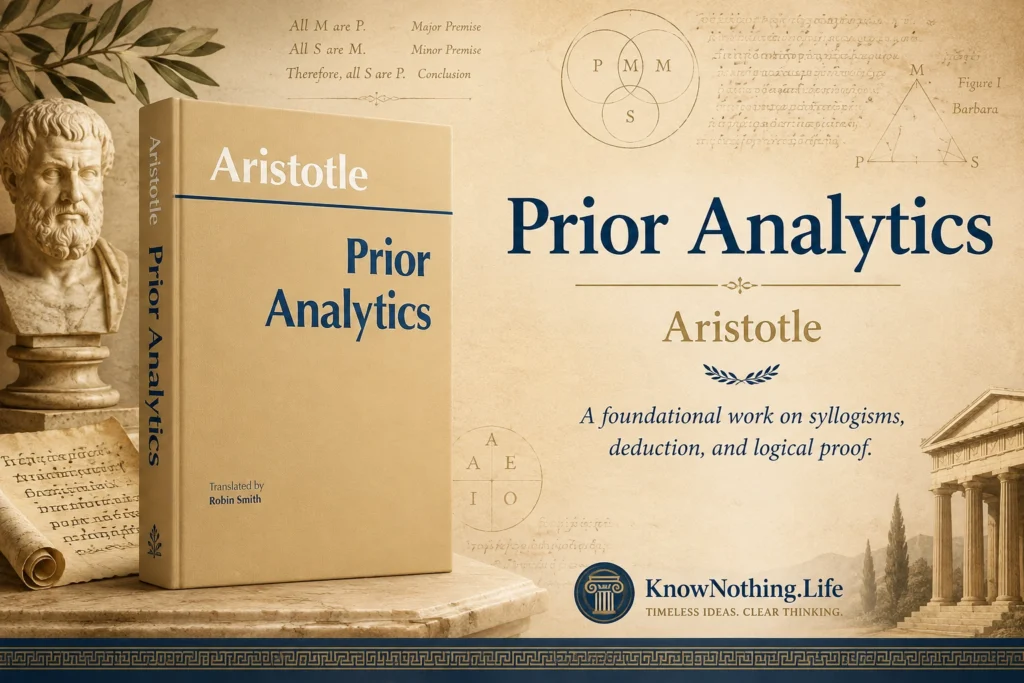
Aristotle’s Prior Analytics is one of the foundational works in the history of logic. Traditionally included in the Organon, the collection of Aristotle’s logical writings, the treatise develops the first systematic theory of deductive inference known from antiquity. Its central achievement is the theory later called syllogistic logic: a method for determining when a conclusion follows necessarily from two premises because of the formal relations among their terms. Aristotle is not merely collecting examples of good arguments. He is attempting something far more ambitious—identifying general patterns that distinguish valid reasoning from invalid reasoning regardless of the particular subject being discussed. The Stanford Encyclopedia of Philosophy describes Aristotle’s syllogistic as his most famous achievement as a logician and emphasizes that Prior Analytics gives a systematic theory of inferences built from categorical propositions.
This marks an extraordinary change in how reasoning itself is studied. Philosophers before Aristotle certainly argued, demonstrated, and criticized one another, but Prior Analytics turns inference into an object of formal analysis. The question becomes not merely whether a conclusion happens to be true, but whether it must follow if the premises are granted. That distinction lies behind almost every later development in deductive logic. In this sense Aristotle resembles the mathematician who stops solving individual problems long enough to ask what makes a proof a proof. His project also anticipates a central distinction in modern cognitive psychology: human beings can possess beliefs about the world while separately evaluating whether conclusions follow logically from assumptions. Research on syllogistic reasoning demonstrates that these processes frequently interact—but are not identical.
What Aristotle Means by a Syllogism
Aristotle defines a syllogism as a discourse in which, once certain things have been stated, something different follows of necessity because those things are so. The essential word is necessity. A genuine deduction does not merely make its conclusion plausible. If the premises are true and the inference is valid, the conclusion cannot be false. Consider the familiar form: every human is mortal; Socrates is human; therefore Socrates is mortal. The subject matter could be replaced without changing the logical structure. What matters is the relationship among the terms, not what those terms happen to designate.
This distinction separates deduction from prediction, persuasion, and probability. A persuasive argument can be invalid; a valid argument can begin from false premises; and a statistically likely conclusion need not follow deductively. Aristotle even examines cases in which false premises produce a true conclusion, emphasizing that the truth of a conclusion does not by itself prove that the reasoning used to reach it was sound. Philosophically, this is one of Prior Analytics’ most enduring lessons. Reasoning has a structure that can be evaluated independently of our agreement with its content. That insight eventually makes formal logic possible because arguments can be examined as patterns rather than merely as collections of beliefs.
Terms, Premises, and the Middle Term
Aristotle analyzes syllogisms through terms. Each categorical premise connects two terms through relations such as “belongs to all,” “belongs to none,” or “belongs to some.” In a complete syllogism there are three terms. Two appear in the conclusion, while the third—the middle term—appears in both premises but disappears from the conclusion. The middle term creates the connection that allows the other two terms to be related. The Stanford Encyclopedia summarizes Aristotelian syllogistic as reasoning from two categorical premises that share exactly one term to a conclusion containing the two remaining terms.
The importance of the middle term becomes even clearer in Aristotle’s later Posterior Analytics, where scientific explanation depends on finding the appropriate middle term connecting cause and conclusion. But the logical architecture is already established here. The middle term is what makes inference possible. Psychologically, this resembles the construction of an internal representation linking otherwise separate pieces of information. Modern mental-model theories of reasoning suggest that people often solve deductions by constructing representations of possible relationships among categories rather than applying formal rules consciously. Studies of individual differences in syllogistic reasoning have found evidence that successful reasoners consider more possible relational models and alternatives than weaker reasoners. Aristotle supplied the formal structure; cognitive psychology investigates how human minds actually manage that structure.
Figures, Valid Forms, and the Architecture of Deduction
A major portion of Prior Analytics classifies syllogisms according to what Aristotle calls figures. The figure depends on the position of the middle term within the premises. Aristotle systematically examines which combinations of universal, particular, affirmative, and negative premises yield necessary conclusions. Some patterns work immediately; others do not. His first figure receives special importance because certain syllogisms within it are “perfect”: their necessity is evident from the premises without requiring an additional transformation or auxiliary argument. Other valid forms are “imperfect” and must be reduced or demonstrated through procedures such as conversion.
The achievement here is methodological as much as logical. Aristotle does not rely on intuition alone. He attempts an exhaustive classification of possible forms and develops procedures for showing why valid ones succeed and invalid ones fail. Later medieval logicians expanded and standardized this system, turning Aristotelian syllogistic into the dominant framework for formal logic for many centuries. The theory of non-modal categorical syllogisms presented in Prior Analytics was so developed that later commentators regarded it as remarkably complete. Even after modern symbolic logic surpassed term logic in expressive power, the Aristotelian method remained historically decisive because it introduced the idea that valid arguments can be grouped and tested by form.
Validity Is Not the Same as Believability
One of the most philosophically important consequences of Aristotle’s system is that a conclusion’s believability is irrelevant to whether an argument is deductively valid. If the form is correct, the conclusion follows from the premises even when the conclusion is strange or conflicts with ordinary knowledge. Conversely, an argument may end in an obviously true conclusion while remaining logically invalid. This separation between truth and consequence requires a kind of intellectual discipline: the reasoner must temporarily ask not “Do I believe this?” but “Would this have to follow if these premises were granted?”
Modern psychology shows how difficult that separation can be. In a classic series of experiments, Jonathan Evans, Julie Barston, and Paul Pollard found substantial belief bias in syllogistic reasoning. Participants were more likely to accept conclusions that fit their existing beliefs even when logic did not support them, while unbelievable conclusions were more likely to be rejected. Yet logical validity also influenced responses, revealing an ongoing conflict between formal reasoning and prior knowledge. More recent research continues to observe belief bias in syllogistic tasks. Aristotle’s formal method can therefore be understood as a kind of cognitive technology: by stripping away content and examining structure, it helps counter the mind’s tendency to confuse what seems plausible with what has actually been demonstrated.
Mental Models, Working Memory, and Why Syllogisms Can Be Difficult
Aristotle treats valid inference normatively—he tells us what follows from what. Cognitive psychology asks a different question: how do actual people perform such reasoning? Mental-model theory proposes that people often represent possible arrangements satisfying the premises and then test whether the proposed conclusion holds across those representations. A syllogism requiring only one obvious model may feel easy; a problem requiring several possible arrangements places greater demands on cognition. Research comparing better and poorer syllogistic reasoners found that stronger reasoners appeared more willing or able to consider multiple alternatives rather than settling on the first available representation.
Working memory also matters. Experiments manipulating memory demands have found that syllogistic reasoning performance changes when people must retain and manipulate more information, and later studies have linked working-memory span with reasoning accuracy. This adds an important psychological qualification to Aristotle. A logically necessary inference may be objectively simple while remaining cognitively demanding for a human reasoner. Logic specifies the standard; psychology explains why people sometimes fail to meet it. The distinction resembles the difference between mathematics and mathematical cognition: the truth of an equation is one question, while the mental processes required to solve it are another.
Necessity, Possibility, and Aristotle’s Modal Logic
Prior Analytics goes beyond ordinary categorical syllogisms by examining modal propositions—claims involving necessity and possibility. Aristotle distinguishes propositions stating what simply is the case from propositions concerning what must be the case or may be the case. Already at the opening of the treatise he notes that premises may concern what belongs, what necessarily belongs, or what possibly belongs to a subject. From there he investigates how these modal qualifications affect syllogistic inference.
This part of the work is considerably more difficult than Aristotle’s ordinary syllogistic and has generated centuries of interpretation. Yet the philosophical issue is fundamental. There is a profound difference between saying “All A are B,” “All A must be B,” and “All A may be B.” Modern modal logic would eventually develop much more powerful formal systems for analyzing necessity and possibility, but Aristotle had already recognized that modality changes the inferential relationship among propositions. Contemporary reconstructions have shown that important elements of Aristotle’s modal syllogistic can be related to concepts used in modern modal logic. His willingness to formalize not only actuality but possibility illustrates the enormous scope of the logical project begun in Prior Analytics.
Reductio ad Absurdum and Testing What Cannot Be True
Aristotle does not restrict proof to direct deduction. Book II discusses reasoning per impossibile, usually known today as reductio ad absurdum or reduction to the impossible. The strategy begins by supposing the contradictory of the proposition to be proved. If combining that supposition with an accepted premise necessarily generates an impossible conclusion, the supposition must be rejected, leaving its contradictory established. Aristotle carefully distinguishes this procedure from simply assuming a contrary proposition and shows why the contradictory, rather than merely the contrary, must be used in the proof.
The method remains central to mathematics and philosophy because it transforms reasoning into a search for inconsistency. Rather than constructing a conclusion directly, the thinker asks what would happen if the opposite were true. Psychologically, this requires counterfactual reasoning—the ability to represent a state of affairs one does not actually accept and follow its implications. That capacity is important far beyond formal logic. Scientific hypothesis testing, legal argument, troubleshooting, and everyday decision-making all rely partly on imagining alternatives and asking what they would imply. Aristotle’s formalization of indirect proof therefore captures a general feature of rational thought: sometimes the best way to establish a position is to discover what becomes impossible when it is denied.
Logic as a Method for Discovering Proof
Prior Analytics is not concerned solely with verifying arguments after someone has already produced them. Aristotle also asks how a reasoner can find an appropriate syllogism. Later portions of Book I investigate how to search for middle terms capable of connecting a proposed subject and predicate. This turns logic from a passive test into an active method of discovery. A proof is not simply a conclusion with two premises attached; it requires identifying the relationship that makes the conclusion necessary. Modern scholarship has emphasized that Aristotle’s discussion of finding middle terms provides a systematic method for constructing syllogistic demonstrations rather than merely classifying completed arguments.
That feature gives Prior Analytics a close connection with problem solving. Searching for a proof resembles searching through a space of possible intermediate representations. Modern reasoning research similarly treats deduction as involving strategies, heuristics, mental representations, and alternative models rather than a single automatic logical mechanism. Hattori’s probabilistic theory of syllogistic reasoning, for example, attempts to integrate mental representations and heuristics, reflecting how active and varied actual human inference can be. Aristotle’s formal method and modern psychology therefore approach the same phenomenon from opposite directions: one asks which inferential paths are valid, while the other asks which paths the mind is likely to find.
What Prior Analytics Ultimately Teaches
The lasting achievement of Prior Analytics is the discovery that the validity of reasoning can be studied independently of subject matter. Aristotle shows that arguments possess forms, that terms occupy defined relationships, and that certain combinations force conclusions while others do not. He distinguishes necessary inference from mere plausibility, separates valid reasoning from true premises, classifies syllogistic structures, investigates necessity and possibility, and develops methods for direct and indirect proof. In doing so, he creates not merely a set of logical rules but a new intellectual object: deduction itself.
Modern psychology makes Aristotle’s accomplishment even more interesting. Human beings do not naturally behave like perfect Aristotelian reasoners. Believable conclusions influence judgment, working-memory limits constrain performance, and people often rely on mental models and heuristics rather than consciously applying formal rules. Formal logic is therefore not simply a description of ordinary thought. It is a standard against which thought can be examined and corrected. That may be the deepest lesson of Prior Analytics: reasoning becomes more reliable when we learn to separate what follows from what merely feels convincing. Aristotle’s syllogistic is no longer the whole of logic, but the intellectual move that created it—the attempt to expose the hidden structure of inference—remains at the foundation of philosophy, mathematics, science, and critical thinking.