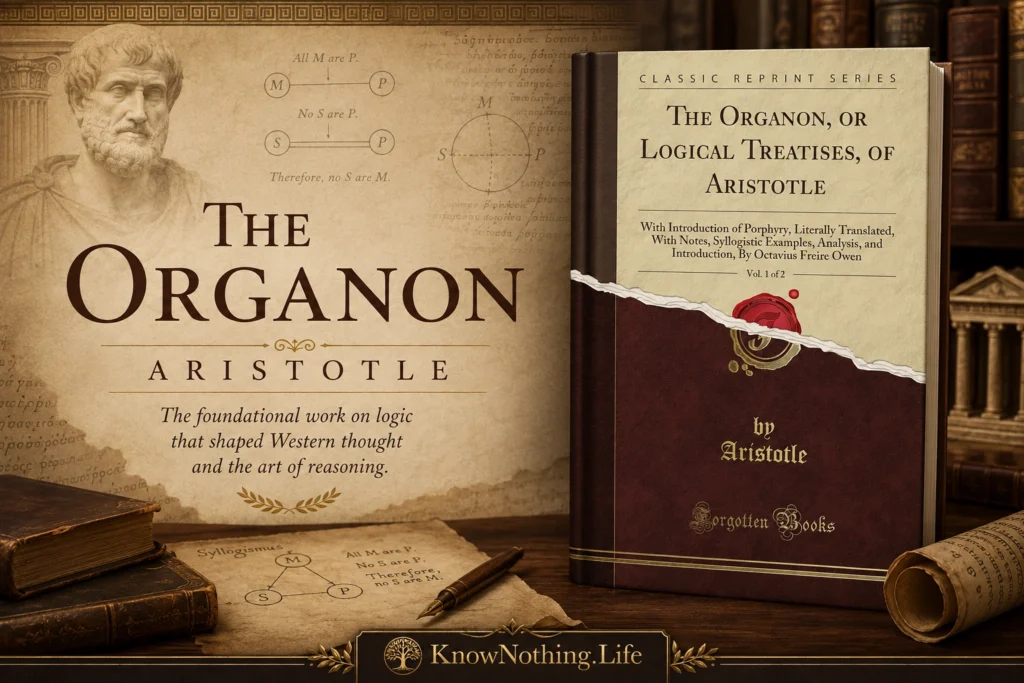
Aristotle’s Organon is not a single book written as a unified treatise but the traditional collection of six works that became the foundation of Aristotelian logic: Categories, On Interpretation, Prior Analytics, Posterior Analytics, Topics, and On Sophistical Refutations. Ancient and later commentators grouped these texts together and called them the Organon, the Greek word for “instrument” or “tool,” because they regarded logic as an instrument used by philosophy and the sciences rather than simply one branch of knowledge among others. Aristotle himself did not use Organon as the collective title, and the boundaries of his logical writings are not as neat as the later compilation suggests. He treated the two Analytics closely together, while On Sophistical Refutations functions largely as a continuation of the Topics. His logical ideas also extend into works such as the Metaphysics, Rhetoric, Nicomachean Ethics, and On the Soul.
Taken together, however, the six works form an extraordinary intellectual progression. Aristotle begins by asking how things can be classified and spoken about, then investigates how statements acquire truth and falsity, how deductions work, how scientific knowledge can be demonstrated, how plausible arguments can be constructed, and how deceptive arguments can be exposed. The result is much more than a textbook of formal logic. The Organon is an attempt to map the architecture of rational thought itself. Its central question is not simply “What should I believe?” but “What must be true of language, inference, evidence, and explanation for a belief to count as rationally justified?” Aristotle’s concept of a deduction—an argument in which, once certain things are assumed, something different follows from them necessarily—approaches what modern logic calls logical consequence. That concern with necessity made the Organon one of the most influential efforts in intellectual history to distinguish reasoning from mere persuasion.
Categories and On Interpretation: From Things to Statements
The Categories begins at a level even more basic than argument. Before we can reason correctly, Aristotle suggests, we need to understand what kinds of things our words and predicates signify. He famously distinguishes ten categories: substance, quantity, quality, relation, place, time, position, possession, action, and being acted upon. A particular person, for example, may be identified as a substance, described as six feet tall in terms of quantity, called educated in terms of quality, positioned beside another person through relation, and located in a particular place. Aristotle is therefore not merely sorting vocabulary. He is investigating the different ways in which something can be said to be. The distinction between primary substances—individual entities such as a particular human or horse—and secondary substances such as species and genera also establishes a framework connecting classification, predication, and ontology.
On Interpretation moves from terms to propositions. Words taken individually are neither true nor false; truth and falsity emerge when terms are combined into assertions. Aristotle examines affirmation and negation, universality and particularity, opposition among propositions, possibility, necessity, and contingency. These issues may sound remote from everyday life, but they concern something psychologically fundamental: human beings continually transform the complexity of experience into statements that can be accepted, rejected, contradicted, or inferred from one another. Once someone says “Every A is B” rather than simply uttering the words “A” and “B,” reasoning becomes possible. Aristotle’s study of propositions therefore establishes the bridge between language and logic. His distinctions also anticipate later investigations into modality—the logic of what must, may, or cannot be the case—and the Stanford Encyclopedia notes that several relations between possibility and necessity developed in On Interpretation resemble concepts later formalized in modal logic.
Prior Analytics: The Discovery of Systematic Deduction
In Prior Analytics, Aristotle turns from propositions to deductions and develops what became known as syllogistic logic. A syllogism combines premises so that a conclusion follows necessarily because of their structure. The familiar pattern “All humans are mortal; Socrates is human; therefore Socrates is mortal” captures the basic idea, although Aristotle’s own system analyzes a much larger range of categorical relationships involving universal and particular affirmations and negations. His great achievement was not merely noticing that some arguments are valid. People had reasoned deductively for centuries. What Aristotle did was investigate validity systematically, separating the form of an argument from the particular subject matter being discussed. His syllogistic identifies arrangements of terms in which a conclusion follows regardless of whether the argument concerns humans, animals, geometry, politics, or anything else. The Prior Analytics thus represents one of the earliest sustained attempts to construct a formal theory of inference.
The psychological significance of this distinction between validity and content became especially apparent in twentieth-century research. Experiments by Jonathan Evans, Julie Barston, and Paul Pollard demonstrated what became known as belief bias: people evaluating syllogisms were influenced not only by logical validity but also by whether the conclusion seemed believable. Participants showed substantial effects of both logic and prior belief, with belief exerting an especially strong influence on invalid arguments. Aristotle’s formalism can therefore be understood as a deliberate intellectual defense against a natural cognitive tendency. The point of formal logic is partly to strip away the seductions of familiar content and ask whether the conclusion actually follows. Modern studies suggest that this separation is psychologically difficult. Human reasoning is not a transparent logical engine; beliefs about the world can interfere with our judgments about argumentative structure.
Posterior Analytics: When Reasoning Becomes Knowledge
If Prior Analytics asks what makes a deduction valid, Posterior Analytics asks what makes a valid deduction scientifically informative. Aristotle calls the strongest form of reasoning demonstration, or apodeixis. A demonstration does not merely produce a conclusion that happens to be true. Its premises must be true, explanatory, and appropriately prior to the conclusion. Scientific knowledge, or epistēmē, therefore requires understanding why something is true. This creates one of the most enduring distinctions in Aristotle’s philosophy: knowing that something occurs is different from knowing the cause because of which it occurs. A person may observe a phenomenon repeatedly and possess accurate information about it without yet possessing scientific understanding. The logical connection between premises and conclusion must mirror an explanatory relationship in the world. Aristotle’s logic therefore becomes simultaneously a philosophy of science.
The difficulty is that demonstrations cannot proceed backward forever. If every scientific premise required another proof, no demonstration could ever begin. Aristotle concludes that first principles must ultimately be known without demonstration, and in the final portions of Posterior Analytics he connects their acquisition to a movement from perception through experience toward universal understanding. Induction therefore has an important role even within a system famous for deduction: particulars provide the basis from which the intellect comes to grasp general principles. This interplay between observation and inference has remained central to debates about scientific method. Aristotle’s formulation differs substantially from modern experimental science, but the underlying problem persists. Evidence alone does not explain itself; rational inquiry requires principles that organize observations into causal and explanatory structures.
Topics: Reasoning When Certainty Is Unavailable
Not every important question permits strict demonstration, and Aristotle understood this clearly. The Topics examines dialectical reasoning—argument beginning from reputable or widely accepted opinions rather than from scientifically certain premises. Dialectic is especially useful when investigating questions for which the truth has not yet been established. Rather than proving conclusions from indisputable foundations, participants test positions, expose contradictions, clarify definitions, and explore the consequences of rival assumptions. Aristotle describes strategies, or “topics,” that can help a reasoner discover relevant lines of argument. The practice belongs to philosophy, debate, teaching, and inquiry because it allows thinkers to reason productively under uncertainty. The Stanford Encyclopedia emphasizes that Aristotle often begins his own investigations by surveying established opinions and working through the puzzles they generate, a process closely related to this dialectical method.
This part of the Organon helps correct the misconception that Aristotle believed all rational thought should resemble mathematical proof. Much human reasoning begins with incomplete information and contested assumptions. Dialectic allows those assumptions to be examined rather than concealed. In psychological terms, this can be understood as a form of externalized metacognition: beliefs are made explicit, challenged by alternatives, and subjected to consequences that may not have been apparent when the belief was first formed. Modern dual-process theories of reasoning likewise distinguish fast, relatively automatic responses from slower forms of deliberative processing. Evans and Keith Stanovich argue that a broad distinction between rapid autonomous processing and more effortful analytic cognition remains useful despite disputes over how dual-process theories should be formulated. Aristotle obviously did not possess such a psychological theory, but his dialectical method similarly recognizes that disciplined reasoning requires effortful examination rather than mere confidence in an immediate response.
On Sophistical Refutations: How Arguments Mislead
The final traditional work of the Organon, On Sophistical Refutations, studies arguments that appear to establish something but fail to do so. Aristotle analyzes errors produced by ambiguity, misleading linguistic forms, irrelevant reasoning, false assumptions, begging the question, and confusion over what has actually been proved. In doing so, he creates one of the earliest systematic theories of fallacies. The treatise is closely connected to the Topics, since anyone engaged in debate must learn both how arguments work and how apparent arguments can imitate genuine ones. Modern discussions of informal fallacies continue to use distinctions that strongly resemble categories Aristotle examined more than two thousand years ago.
The psychological power of sophistical reasoning lies in the difference between what feels convincing and what is logically justified. Peter Wason’s influential 1960 experiment on hypothesis testing showed that participants often sought examples supporting a hypothesis instead of deliberately testing cases capable of disproving it. Only a minority reached the correct rule without first proposing incorrect hypotheses, while participants who accumulated several incorrect conclusions often failed to test their ideas in an eliminative way. Wason explicitly connected these findings with scientific thinking. Aristotle’s treatment of sophistry approaches the same broad human vulnerability from another direction. Bad arguments succeed because the mind can mistake plausibility, familiarity, verbal resemblance, or selective evidence for proof. Logical education is therefore partly an education in intellectual self-defense.
Logic Versus the Psychology of Human Reasoning
One of the most revealing modern perspectives on the Organon comes from recognizing that formal logic describes standards of inference, while psychology investigates how actual people reason. The two are not identical. Philip Johnson-Laird’s work on syllogistic reasoning proposed that people often reason by constructing mental models of possible situations rather than mechanically applying formal logical rules. Problems become more difficult when they require reasoners to represent and compare several possible models rather than a single straightforward interpretation. From this perspective, Aristotle’s syllogistic can serve as a normative framework—showing what conclusions follow—without implying that the human mind literally performs Aristotelian symbolic calculations.
The gap between normative logic and psychological reasoning makes Aristotle more relevant rather than less. The Organon provides intellectual techniques precisely because ordinary cognition is vulnerable to error. Belief bias shows that people confuse plausibility with validity; Wason’s experiments show that people may preferentially seek confirming evidence; mental-model research suggests that complexity can overwhelm our ability to represent alternatives. Aristotle’s project can therefore be read as an early attempt to build cognitive scaffolding around human judgment. Categories clarify what we are talking about. Propositional analysis clarifies what is being asserted. Syllogistic tests whether conclusions follow. Demonstration asks whether reasoning explains. Dialectic exposes assumptions. Sophistical analysis teaches us to recognize deception. Together these techniques convert thinking from an uncontrolled psychological process into something that can itself be examined.
The Lasting Importance of The Organon
Modern symbolic logic has far surpassed Aristotle’s system. The development of predicate logic by figures such as Gottlob Frege, followed by the work of Bertrand Russell and others, revealed serious limitations in the Aristotelian framework. Contemporary logic can represent mathematical relations, multiple quantification, complex propositional structures, and many forms of inference that syllogistic logic cannot easily accommodate. Modern scholars therefore do not regard Aristotle’s logic as an adequate foundation for all mathematics, science, or everyday reasoning. At the same time, Aristotle has gained renewed respect because his interest in the structure and properties of inferential systems resembles the concerns of modern metatheory. His importance lies less in providing the final logical calculus than in realizing that reasoning itself can become the object of systematic study.
The Organon ultimately presents rationality as a layered achievement. Before we can demonstrate, we must formulate propositions; before propositions can function clearly, their terms must be understood; before conclusions can count as knowledge, valid inference must be distinguished from causal explanation; and before argument can reliably guide us, we must learn to recognize both uncertainty and deception. That progression links the six works into a remarkably coherent intellectual project even though Aristotle never assembled them under the title Organon. Read alongside the Metaphysics, Rhetoric, Nicomachean Ethics, and Aristotle’s scientific writings, the collection reveals logic not as an isolated technical discipline but as a method for making thought accountable to itself. The enduring lesson of the Organon is therefore not simply how to construct a syllogism. It is that reason becomes more trustworthy when we examine the structures by which conclusions are formed, challenge the assumptions beneath them, and distinguish what appears persuasive from what genuinely follows.