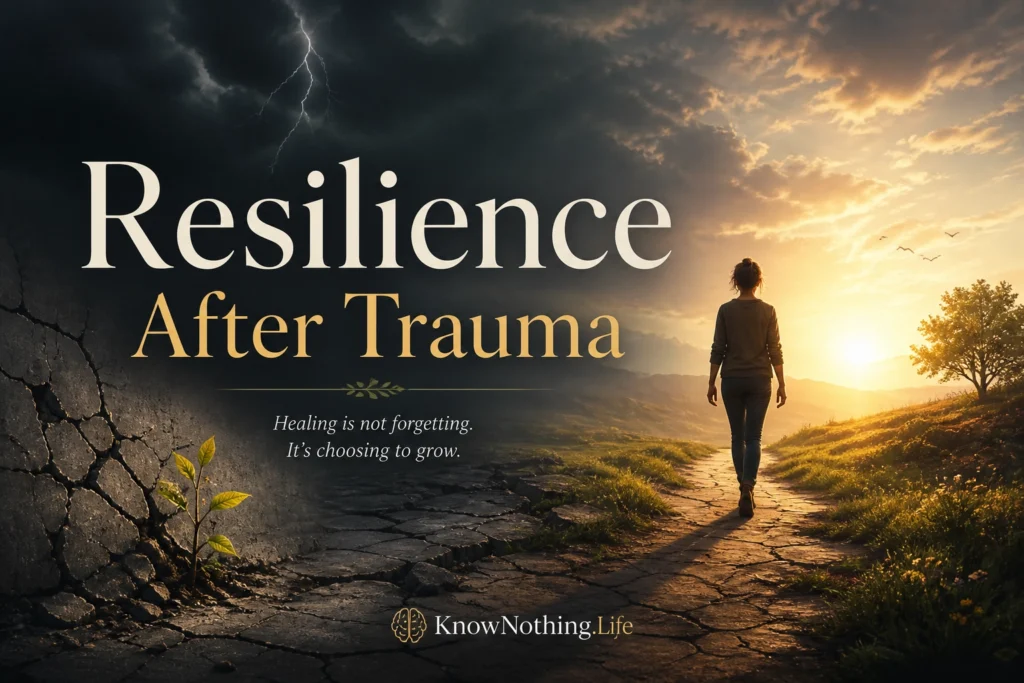
Resilience after trauma is the capacity to adapt, recover, and rebuild after experiences that overwhelm the mind, body, and sense of safety. It does not mean being untouched by suffering, unaffected by fear, or able to “move on” quickly. True resilience is not emotional hardness. It is the gradual restoration of life after disruption: the ability to regain stability, form safe relationships, make meaning, regulate distress, and reclaim a future that trauma once seemed to erase. Trauma may change a person, but resilience describes the human possibility of change continuing in another direction.
The study of resilience after trauma draws from clinical psychology, developmental psychology, neuroscience, attachment theory, trauma studies, and existential thought. Judith Herman’s Trauma and Recovery describes healing as a movement through safety, remembrance, mourning, and reconnection. Bessel van der Kolk’s The Body Keeps the Score emphasizes that resilience must involve the body as well as the mind. Ann Masten’s work on developmental resilience reframed resilience not as rare heroism but as “ordinary magic,” rooted in everyday systems of care, attachment, problem-solving, and support. Viktor Frankl’s Man’s Search for Meaning shows how meaning can help people survive profound suffering without denying its reality. Resilience after trauma is therefore not a personality trait possessed by a lucky few. It is a process that can be supported, strengthened, and rebuilt.
What Resilience Really Means
Resilience is often misunderstood as toughness, optimism, or independence. In reality, resilient people may cry, struggle, need help, feel fear, experience flashbacks, doubt themselves, and grieve deeply. Their resilience lies not in avoiding pain, but in continuing to respond to it in ways that support survival and growth. A trauma survivor may be resilient when they ask for help, set a boundary, return to therapy, rest after being triggered, tell the truth about what happened, or choose not to repeat an old survival pattern. These actions may look small from the outside, but psychologically they represent the rebuilding of agency.
Ann Masten’s phrase “ordinary magic” is important because it removes the myth that resilience is extraordinary invulnerability. In her research on children facing adversity, Masten argued that resilience often emerges from ordinary protective systems: caring adults, safe routines, emotional regulation, schools, communities, skills, and opportunities. This insight applies to adult trauma recovery as well. Resilience is not created by telling people to be stronger. It is created by strengthening the conditions that allow strength to return. Safety, connection, structure, and meaning are not luxuries in recovery; they are the foundations of resilience.
Trauma and the Disruption of Safety
Trauma disrupts the basic sense that the world is safe, the self has agency, and relationships can be trusted. Ronnie Janoff-Bulman’s work on “shattered assumptions” helps explain this rupture. Many people move through life with underlying beliefs that the world is somewhat predictable, that people are not usually dangerous, and that their own actions can influence outcomes. Trauma can break these assumptions suddenly or gradually. Afterward, the person may feel permanently unsafe, helpless, contaminated, betrayed, or disconnected from ordinary life.
Resilience begins with the reconstruction of safety. Judith Herman’s Trauma and Recovery places safety as the first stage of healing because the mind cannot integrate trauma while still living in threat. Safety can mean leaving an abusive relationship, finding stable housing, receiving medical care, developing crisis plans, learning grounding skills, or building a dependable therapeutic relationship. It also means internal safety: the ability to feel emotion without being swallowed by it. Before a person can fully mourn, understand, or grow, the nervous system must learn that the present is not identical to the past.
The Body and Nervous System in Resilience
Trauma lives partly in the nervous system. The body may remain braced for danger long after the danger is over. Survivors may experience hypervigilance, panic, insomnia, chronic tension, digestive problems, numbness, exhaustion, or sudden shutdown. These responses are not signs of weakness. They are survival systems that adapted to overwhelming threat. Resilience after trauma therefore requires more than positive thinking. The body must be included in recovery because the body is often where trauma continues to speak.
Bessel van der Kolk’s The Body Keeps the Score popularized the idea that healing involves restoring a sense of ownership over bodily experience. Practices such as breathing, grounding, walking, yoga, dance, trauma-informed exercise, somatic therapy, and mindfulness can help survivors notice sensations without being overwhelmed by them. The goal is not to force calm, but to build capacity. Each time the body moves from alarm toward regulation, resilience grows. A survivor learns, slowly and repeatedly, “I can feel this and remain here. I can be triggered and return. My body can become a place of safety again.”
Emotional Regulation and Coping
Emotional regulation is central to resilience. Trauma often leaves emotions either too intense or too distant. Some survivors are flooded by fear, anger, grief, or shame. Others feel numb, detached, or unable to access emotion at all. Both patterns can be survival adaptations. Hyperarousal mobilizes the person to detect danger; shutdown protects the person from unbearable pain. Resilience develops when the survivor gains more flexibility: the ability to feel without being destroyed, calm without going numb, and act without being ruled by old threat responses.
Marsha Linehan’s dialectical behavior therapy offers useful tools for trauma survivors, especially skills related to distress tolerance, mindfulness, emotional regulation, and interpersonal effectiveness. These skills matter because trauma can make ordinary emotional stress feel catastrophic. A disagreement may feel like abandonment. A mistake may feel like proof of worthlessness. A memory may feel like the event is happening again. Resilient coping means learning to pause, name the emotion, ground in the present, challenge trauma-shaped beliefs, and choose a response. Over time, coping becomes less about emergency survival and more about self-trust.
Relationships as a Source of Resilience
Relationships are among the strongest predictors of resilience after trauma. Trauma often isolates people, either because the event involved betrayal or because symptoms make connection difficult. Survivors may fear being judged, misunderstood, pitied, abandoned, or controlled. Some withdraw completely; others seek closeness while expecting rejection. Yet healing frequently requires safe connection. Human beings regulate distress through relationships, and trauma recovery often depends on being seen, believed, and supported.
John Bowlby’s attachment theory helps explain why relationships matter so deeply. Secure attachment teaches the nervous system that distress can be shared and soothed. When trauma has damaged trust, safe relationships can provide corrective emotional experiences. A therapist, friend, partner, mentor, support group, or community can help the survivor experience reliability where there was betrayal, respect where there was humiliation, and presence where there was abandonment. Carl Rogers’s person-centered therapy emphasized empathy, genuineness, and “unconditional positive regard.” These are not merely kind attitudes; they are psychologically reparative conditions that help resilience take root.
Meaning and the Reconstruction of Life
Trauma can shatter meaning. Survivors may ask why the event happened, why they survived, whether life is fair, whether they can trust themselves, or whether the future is worth building. Resilience does not require easy answers. In fact, forced positivity can deepen pain by making survivors feel that their suffering is unacceptable. Meaning after trauma must be honest enough to include grief, anger, confusion, and loss. It is not about saying the trauma was good. It is about finding a way to live after it.
Viktor Frankl’s Man’s Search for Meaning remains one of the most important works on meaning after suffering. Frankl wrote, “When we are no longer able to change a situation, we are challenged to change ourselves.” This does not mean victims are responsible for what happened to them. It means that after suffering, the human search for meaning can become a path back to agency. Meaning may be found in relationships, service, creativity, spirituality, justice, parenting, learning, or simply the decision to keep living with dignity. Resilience grows when life becomes organized around values rather than only around wounds.
Post-Traumatic Growth
Post-traumatic growth refers to positive psychological changes that may emerge after trauma, including deeper relationships, greater appreciation of life, spiritual development, increased personal strength, changed priorities, and new possibilities. The concept is associated with Richard Tedeschi and Lawrence Calhoun, who studied how some people report growth after major life crises. Post-traumatic growth does not mean trauma is beneficial or necessary. No one should be pressured to find a gift in suffering. Some harms are simply harms, and grief deserves respect without being turned into inspiration too quickly.
Still, growth can be real when it emerges naturally. A survivor may become more compassionate, more honest, more protective of boundaries, more committed to justice, or more aware of what matters. They may stop living according to expectations that no longer fit. They may find a voice after years of silence. Growth does not erase symptoms or loss; it coexists with them. Resilience after trauma is not a straight line from pain to triumph. It is often a layered process in which grief and growth occupy the same life.
Identity After Trauma
Trauma can change identity. A person may feel divided into a “before” and “after.” They may see themselves as damaged, weak, unsafe, ashamed, or permanently different from others. This identity wound can be as painful as the symptoms themselves. Trauma tells a story about the self: “I am powerless,” “I am unlovable,” “I cannot trust anyone,” “I should have stopped it,” or “I will never be whole again.” Resilience requires challenging these trauma-shaped stories without denying the reality of what happened.
Narrative approaches to therapy emphasize that people are more than their problems. Michael White and David Epston’s narrative therapy helped popularize the idea that problems can be externalized: the person is not the trauma, the shame, the addiction, or the fear. These are experiences and patterns affecting the person, not the person’s total identity. Rebuilding identity means gathering evidence of agency, courage, care, creativity, and survival. The survivor may begin with the identity of someone who was harmed, but recovery allows a wider identity to return: someone who survived, learned, loved, chose, repaired, and continued.
Community, Culture, and Collective Resilience
Resilience is not only individual. Communities can support or obstruct recovery. A survivor who is believed, protected, and supported has a different healing path from one who is blamed, silenced, or forced to return to danger. Cultural narratives also matter. Some cultures encourage emotional expression; others value stoicism. Some communities provide rituals for mourning; others avoid pain. Some institutions protect survivors; others deny harm. Resilience depends partly on whether the social world makes healing possible.
Collective trauma—war, colonization, racism, displacement, genocide, natural disaster, or community violence—requires collective forms of resilience. This may include public acknowledgment, cultural memory, mutual aid, rituals, activism, truth-telling, and intergenerational repair. Judith Herman argued that trauma recovery has a social and political dimension because violence often thrives in secrecy and denial. Resilience grows when survivors do not have to carry the truth alone. A community that can remember honestly, protect the vulnerable, and create structures of care becomes part of the healing process.
Therapy and Professional Support
Therapy can strengthen resilience by providing safety, structure, and tools for integration. Trauma-focused therapies may include cognitive processing therapy, prolonged exposure, EMDR, somatic therapy, internal family systems, dialectical behavior therapy, and attachment-based approaches. The right therapy depends on the person’s history, symptoms, readiness, culture, and goals. Some survivors need stabilization before memory processing. Others need help with shame, relationships, dissociation, anger, grief, or meaning.
Francine Shapiro’s EMDR model, Patricia Resick’s cognitive processing therapy, and Edna Foa’s prolonged exposure therapy have all influenced trauma treatment by offering structured ways to reduce the power of traumatic memory and belief. Yet therapy is not only technique. The therapeutic relationship itself can support resilience when it provides consistency, respect, and collaboration. A good therapist does not impose a story on the survivor. They help the survivor build capacity, reclaim choice, and integrate what happened into a life that can continue.
Barriers to Resilience
Resilience can be blocked by ongoing danger, poverty, isolation, untreated mental illness, substance use, chronic stress, discrimination, shame, and lack of support. It is unfair and inaccurate to demand resilience from people while ignoring the conditions that keep injuring them. A person cannot fully heal from trauma while still being abused. A community cannot simply “be resilient” while facing constant violence or deprivation. The language of resilience becomes harmful when it is used to shift responsibility away from systems and onto individuals.
This is why trauma-informed care must include both personal and social dimensions. Individuals can build coping skills, seek treatment, and cultivate support, but societies must also create conditions that protect recovery: accessible mental health care, safe housing, protection from violence, economic stability, community resources, and justice. Resilience is not a substitute for safety. It is what becomes possible when safety, support, and agency begin to return.
Conclusion
Resilience after trauma is not the absence of suffering. It is the capacity to rebuild life after suffering has changed it. It involves safety, nervous-system regulation, emotional skill, supportive relationships, meaning, identity repair, and sometimes post-traumatic growth. Resilience is not a demand to be strong, silent, or endlessly positive. It is a process of restoring choice, connection, and self-trust after trauma has narrowed the world around fear.
The deepest lesson of resilience research is that people recover best when they are not alone. The mind and body can heal when given safety, care, structure, and time. Trauma may leave lasting marks, but those marks do not have to define the whole person. Resilience allows survivors to carry the truth of what happened without surrendering the future to it. It is not the erasure of pain, but the gradual return of life around and beyond pain.