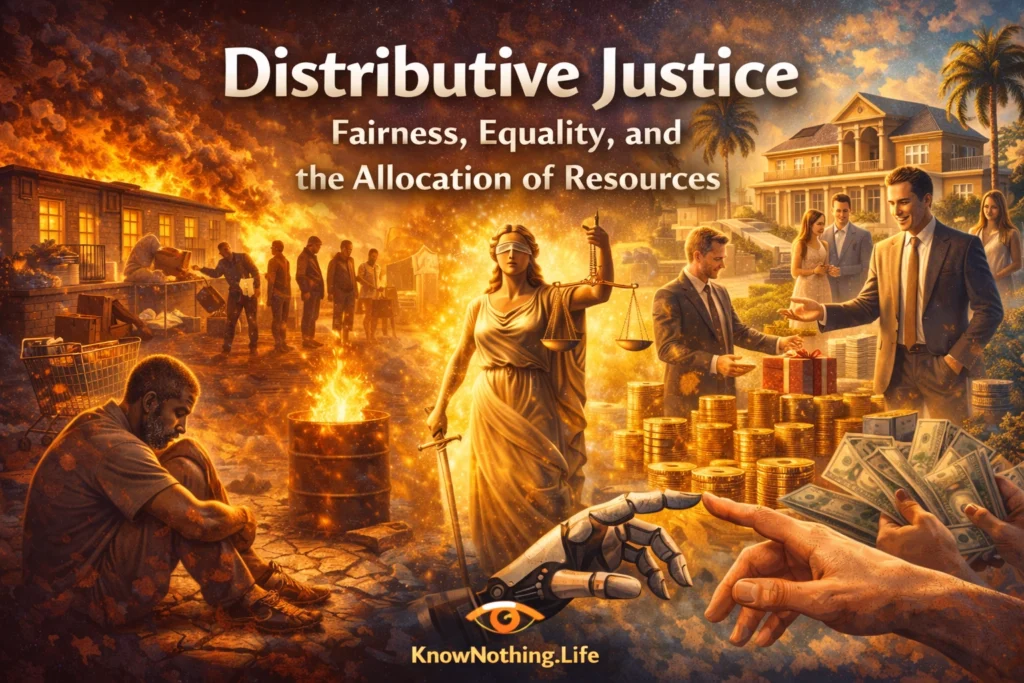
Distributive justice concerns how goods, opportunities, and burdens are shared within a society. It addresses one of the most persistent moral questions in human life: who gets what, and why? Whether the issue is wealth, healthcare, education, or political power, distributive justice seeks principles that can justify the ways resources are allocated among individuals and groups. At stake is not only material well-being but also dignity, fairness, and the legitimacy of social institutions.
The concept becomes especially important in complex societies where inequality is inevitable. Differences in talent, effort, inheritance, and social position create uneven outcomes, but not all inequalities are seen as unjust. Distributive justice attempts to distinguish between inequalities that are acceptable and those that demand correction. This requires a framework for evaluating competing claims—whether based on merit, need, equality, or entitlement—and determining how they should be balanced. As societies grow more interconnected and disparities more visible, the question of fair distribution becomes central to both ethical theory and public policy.
Classical Foundations of Distributive Justice
The roots of distributive justice can be traced to Aristotle, who offered one of the earliest systematic accounts in Nicomachean Ethics. Aristotle distinguishes distributive justice from corrective justice and emphasizes that distribution should be based on proportional equality rather than simple numerical equality. In his view, individuals should receive shares corresponding to their merit or contribution, though what counts as merit depends on the values of the political community. As he writes, “Equals should be treated equally, and unequals unequally, in proportion to their relevant differences.”
This emphasis on proportionality reflects a broader concern with balance and order. For Aristotle, justice is not achieved by giving everyone the same thing, but by aligning distribution with a rational standard. However, this raises immediate questions: what counts as a relevant difference? Is it virtue, wealth, effort, or social status? Aristotle’s framework leaves room for interpretation, which later thinkers would expand and contest. Nevertheless, his formulation establishes a lasting tension between equality and merit that continues to define debates about distributive justice.
Ancient discussions of justice also intersect with broader ideas about the good life and the purpose of the state. In Plato’s The Republic, distribution is tied to the proper functioning of a hierarchical society in which each class performs its designated role. While Plato does not develop a detailed theory of distributive justice, his emphasis on harmony and specialization suggests that fairness is linked to order rather than equality. These early perspectives frame distributive justice as part of a larger inquiry into moral and political organization.
Egalitarianism and Justice as Fairness
Modern discussions of distributive justice are often shaped by egalitarian ideals, particularly in the work of John Rawls. In A Theory of Justice, Rawls redefines distributive justice as “justice as fairness,” grounded in a hypothetical social contract. By imagining individuals choosing principles of justice behind a veil of ignorance—unaware of their own social position—Rawls seeks to ensure impartiality. This thought experiment leads to two key principles: equal basic liberties for all, and the difference principle, which allows inequalities only if they benefit the least advantaged members of society.
Rawls’s framework represents a powerful attempt to reconcile equality with efficiency. Rather than eliminating all inequalities, he argues that some disparities can be justified if they improve overall outcomes, particularly for those at the bottom. His approach shifts the focus from strict equality to fairness of opportunity and outcome. As he states, “Social and economic inequalities are to be arranged so that they are to the greatest benefit of the least advantaged.” This principle has had a profound influence on political philosophy and policy debates, shaping discussions about welfare, taxation, and social justice.
Critics of Rawls argue that his theory places too much emphasis on redistribution and not enough on individual freedom. Nonetheless, his work establishes a benchmark for evaluating distributive systems, providing a structured way to assess whether inequalities are morally defensible. By grounding justice in fairness rather than tradition or power, Rawls reorients the conversation toward the needs of those most affected by inequality.
Libertarian and Entitlement Theories
In contrast to egalitarian approaches, libertarian theories of distributive justice emphasize individual rights and voluntary exchange. The most prominent defender of this view is Robert Nozick, whose work Anarchy, State, and Utopia presents an entitlement theory of justice. According to Nozick, a distribution is just if it arises from legitimate acquisition and voluntary transfer. There is no need for a patterned or end-state distribution; what matters is the process by which holdings are acquired.
Nozick famously challenges redistributive theories with his “Wilt Chamberlain” example, arguing that even if a distribution begins as equal, voluntary exchanges can quickly create inequality. Interfering with these outcomes, he contends, violates individual liberty. As he puts it, “Taxation of earnings from labor is on a par with forced labor.” This stark claim underscores the libertarian commitment to property rights and minimal state intervention.
The tension between libertarian and egalitarian views reflects deeper disagreements about the nature of justice. While Rawls prioritizes fairness and the protection of the least advantaged, Nozick emphasizes freedom and the inviolability of individual rights. These competing frameworks continue to shape debates about economic policy, highlighting the difficulty of balancing liberty with equality in distributive systems.
Capabilities, Needs, and Human Development
Beyond the dichotomy of equality and entitlement, alternative approaches to distributive justice focus on human capabilities and basic needs. Amartya Sen and Martha Nussbaum develop the capabilities approach, which evaluates justice in terms of what individuals are actually able to do and be. Rather than measuring distribution solely by income or resources, this perspective considers whether people have the real freedom to live meaningful lives.
Sen’s work, particularly in Development as Freedom, emphasizes that poverty is not just a lack of income but a deprivation of capabilities. Justice, therefore, requires expanding people’s opportunities to achieve well-being. Nussbaum builds on this idea by proposing a list of central human capabilities—such as health, education, and political participation—that should be guaranteed to all individuals. She argues that “the central capabilities are not just instrumental to further pursuits: they are held to have value in themselves.”
This approach reframes distributive justice as a matter of enabling human flourishing rather than simply allocating goods. It highlights the importance of social conditions—such as education systems, healthcare access, and political inclusion—in shaping individual outcomes. By focusing on capabilities, this perspective offers a more holistic understanding of justice, one that integrates economic, social, and ethical dimensions.
Distributive Justice in Contemporary Society
In modern societies, distributive justice is at the heart of debates about inequality, globalization, and public policy. Issues such as income disparity, access to education, and healthcare availability raise pressing questions about fairness and responsibility. While some argue that market outcomes reflect merit and efficiency, others point to structural inequalities that limit opportunities for certain groups. These disagreements reflect underlying tensions between competing theories of distributive justice.
Globalization adds another layer of complexity, extending questions of distribution beyond national borders. Should wealthy nations have obligations to poorer ones? How should resources be allocated in addressing global challenges such as climate change? These questions challenge traditional frameworks that focus primarily on domestic justice, requiring new approaches that account for global interdependence.
Distributive justice also intersects with identity and historical context. Movements addressing racial inequality, gender disparities, and economic injustice highlight the ways in which distribution is shaped by social structures and historical legacies. These perspectives emphasize that achieving justice requires not only fair principles but also active efforts to address systemic disadvantages. As a result, distributive justice remains a dynamic and contested field, continually evolving in response to changing social realities.
The Ongoing Challenge of Fair Distribution
Distributive justice does not offer a single, universally accepted solution. Instead, it presents a framework for grappling with competing values—equality, freedom, merit, and need. Each theory provides insights while also revealing limitations, and real-world applications often involve compromises between these ideals. The challenge lies in developing systems that are both fair and sustainable, capable of adapting to new circumstances without losing their moral grounding.
Philosophical debates about distributive justice continue to inform practical decisions about taxation, welfare, and public investment. They shape the design of institutions and the expectations placed on individuals and governments. At the same time, they remind us that justice is not merely a technical problem but a moral endeavor, requiring ongoing reflection and dialogue.
As societies confront new challenges—from technological disruption to environmental crisis—the question of how to distribute resources fairly becomes ever more urgent. Distributive justice remains a central concern of political philosophy because it speaks directly to the conditions under which people live, work, and pursue their goals. It is, ultimately, a question about what we owe one another and how we can build systems that reflect that responsibility.