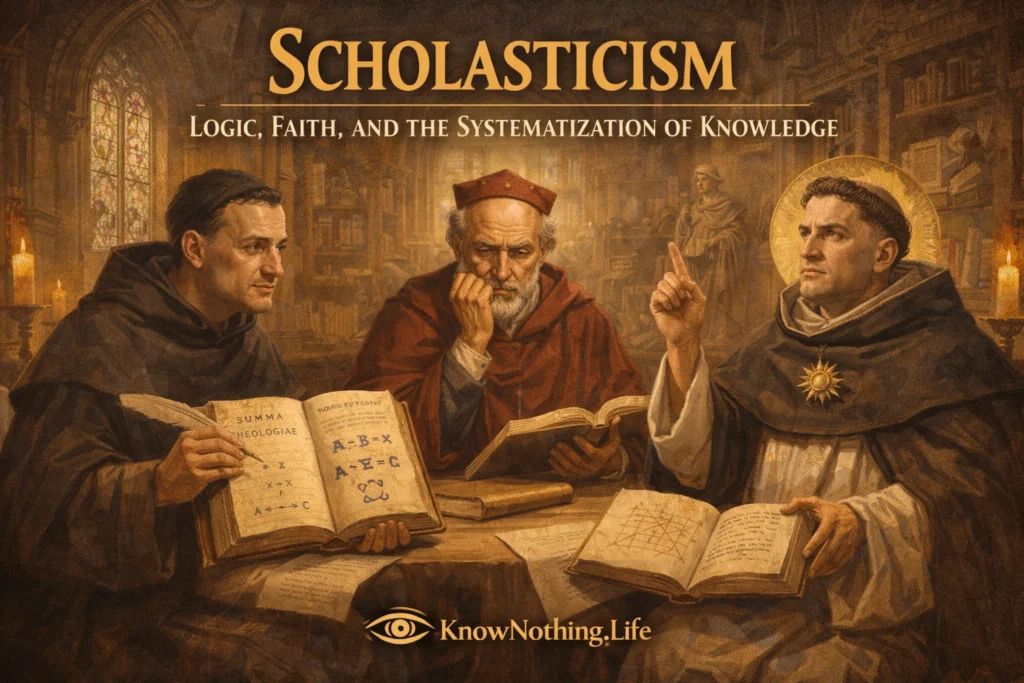
Scholasticism represents one of the most rigorous and influential intellectual movements of the medieval period, defined by its commitment to logical analysis, systematic reasoning, and the reconciliation of faith with reason. Emerging in the universities of medieval Europe between the 11th and 14th centuries, Scholasticism is less a single doctrine than a method—a disciplined approach to inquiry that seeks clarity through argument, definition, and structured debate. It becomes the dominant mode of philosophical and theological thinking, shaping the intellectual culture of the Middle Ages.
At its core, Scholasticism is driven by the conviction that truth is unified and accessible through both reason and revelation. Rather than viewing philosophy and theology as competing domains, scholastic thinkers aim to harmonize them, demonstrating that rational inquiry can support and illuminate religious belief. This effort results in a highly developed tradition of analysis, one that emphasizes precision, coherence, and the careful examination of opposing viewpoints. Scholasticism thus stands as a testament to the power of reasoned discourse in the pursuit of understanding.
The Origins of Scholastic Thought
The roots of Scholasticism can be traced to the revival of learning in medieval Europe, particularly the rediscovery of classical texts. The works of Aristotle, preserved and transmitted through Islamic scholars such as Averroes, play a central role in shaping scholastic thought. Aristotle’s emphasis on logic, categorization, and systematic inquiry provides the tools necessary for the development of scholastic method.
One of the earliest figures associated with Scholasticism is Anselm of Canterbury, whose work Proslogion introduces the famous ontological argument for the existence of God. Anselm’s approach reflects the scholastic commitment to using reason to explore theological questions. He famously articulates this relationship with the phrase “faith seeking understanding,” suggesting that belief and inquiry are mutually reinforcing.
The emergence of universities in cities such as Paris and Bologna provides an institutional context for Scholasticism, fostering environments in which scholars can engage in structured debate and study. These institutions become centers of intellectual activity, where the scholastic method is refined and applied across disciplines. The development of this academic culture marks a significant step in the evolution of Western intellectual life.
The Scholastic Method: Question, Argument, and Resolution
The defining feature of Scholasticism is its method, often characterized by a structured process of inquiry. This method typically begins with a question, followed by the presentation of arguments for and against a particular position. These arguments are then analyzed and resolved through careful reasoning, leading to a conclusion that seeks to reconcile conflicting views. This approach is exemplified in the works of Thomas Aquinas, particularly in Summa Theologica.
In Aquinas’s writings, each question is addressed through a series of objections, a counterargument, and a final resolution. This format not only clarifies the issue at hand but also demonstrates the importance of engaging with opposing perspectives. Aquinas writes, “It is necessary for the salvation of man that certain truths which exceed human reason should be made known to him by divine revelation,” acknowledging both the power and the limits of reason.
The scholastic method reflects a deep commitment to intellectual rigor and openness. By systematically examining different viewpoints, scholastic thinkers aim to arrive at a more comprehensive understanding of truth. This approach influences not only philosophy and theology but also the development of scientific and legal reasoning, establishing a model for disciplined inquiry that endures beyond the medieval period.
Thomas Aquinas and the Synthesis of Faith and Reason
Thomas Aquinas stands as the most influential figure in Scholasticism, achieving a synthesis of Aristotelian philosophy and Christian theology that defines the movement. In Summa Theologica, Aquinas addresses a wide range of topics, from the existence of God to the nature of human morality, using the scholastic method to organize and analyze complex questions.
Aquinas’s philosophy is grounded in the belief that reason and faith are complementary. He argues that certain truths, such as the existence of God, can be demonstrated through reason, while others require revelation. His “Five Ways” provide arguments for God’s existence based on observation of the natural world, illustrating the integration of empirical and logical reasoning.
One of Aquinas’s most enduring contributions is his theory of natural law, which posits that moral principles are rooted in human nature and accessible through reason. This idea has had a lasting impact on ethical and political thought, influencing discussions about rights, justice, and the role of law. Aquinas’s work exemplifies the scholastic ideal of unifying knowledge into a coherent system, demonstrating the potential of reasoned inquiry to illuminate fundamental questions.
Debates within Scholasticism
Despite its emphasis on synthesis, Scholasticism is characterized by vigorous internal debates. One of the most significant concerns the problem of universals—the question of whether general concepts have real existence or are merely names. Realists, influenced by Platonic thought, argue that universals exist independently of particular objects, while nominalists reject this view.
William of Ockham emerges as a leading figure in the nominalist camp, advocating for simplicity in explanation. His principle, known as Ockham’s Razor, suggests that unnecessary entities should not be posited without necessity. This emphasis on parsimony challenges more elaborate metaphysical systems, contributing to a shift in philosophical thinking.
Other debates address the nature of knowledge, the relationship between divine will and human freedom, and the limits of human understanding. These discussions highlight the dynamic nature of Scholasticism, demonstrating that it is not a static tradition but a vibrant intellectual movement. The diversity of perspectives within Scholasticism reflects its commitment to inquiry and its openness to revision.
The Role of Logic and Language
Logic plays a central role in Scholasticism, serving as the primary tool for analyzing and resolving philosophical questions. Scholastic thinkers develop sophisticated systems of logic, building on Aristotelian principles to refine methods of argumentation. This focus on logical structure ensures that arguments are coherent and systematically organized, enhancing the clarity of philosophical discourse.
Language is also a key concern, particularly in relation to the problem of universals and the interpretation of texts. Scholastics recognize that the meaning of words can influence understanding, leading to careful analysis of terms and concepts. This attention to language contributes to the precision and rigor of scholastic thought, laying the groundwork for later developments in linguistics and analytic philosophy.
The emphasis on logic and language reflects a broader commitment to intellectual discipline. By developing tools for clear and consistent reasoning, Scholasticism establishes standards for philosophical inquiry that continue to influence modern thought. Its methods demonstrate the importance of structure and clarity in the pursuit of knowledge.
The Legacy of Scholasticism
The influence of Scholasticism extends beyond the medieval period, shaping the development of Western philosophy and education. Its emphasis on systematic inquiry and logical analysis contributes to the emergence of modern science, particularly in its insistence on clarity and coherence. The scholastic method also influences legal and theological traditions, providing a framework for structured argumentation.
While the rise of Renaissance humanism and modern philosophy leads to a decline in the dominance of Scholasticism, its legacy remains significant. Many of its ideas and methods are incorporated into later traditions, demonstrating their enduring relevance. The integration of reason and faith, the emphasis on rigorous analysis, and the commitment to intellectual dialogue continue to inform contemporary discussions.
Ultimately, Scholasticism represents a remarkable achievement in the history of thought, embodying the belief that complex questions can be addressed through disciplined inquiry. Its legacy lies not only in its specific doctrines but in its method—a model of reasoning that continues to inspire and challenge those who seek to understand the world.