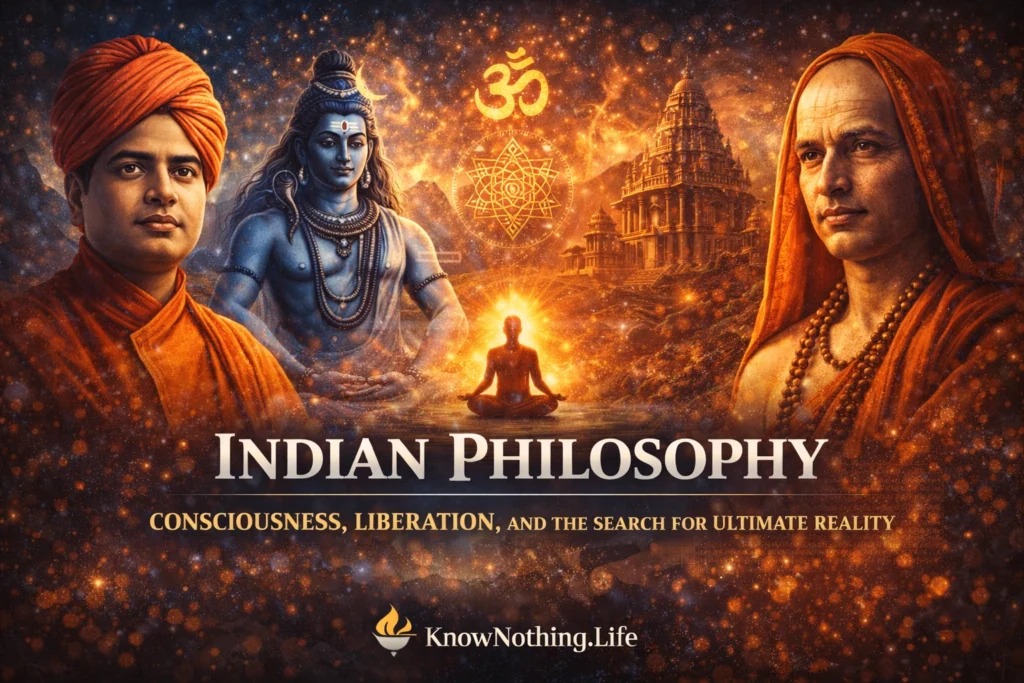
Indian philosophy is one of the oldest and most sophisticated philosophical traditions in human history, spanning thousands of years and encompassing a wide array of schools, texts, and intellectual movements. Rooted in the Indian subcontinent, it is deeply intertwined with spiritual inquiry, ethical practice, and the pursuit of liberation from suffering. Unlike many Western traditions that emphasize abstract reasoning alone, Indian philosophy integrates metaphysics, epistemology, ethics, and spirituality into a unified quest for self-realization and ultimate truth.
At its core, Indian philosophy seeks to answer fundamental questions about existence, consciousness, and the nature of reality. It explores the relationship between the individual self and the cosmos, the causes of suffering, and the means by which liberation (moksha) can be attained. Across its many schools, a recurring concern is the idea that ordinary human experience is shaped by ignorance or illusion, and that true knowledge has the power to transform both understanding and being. This emphasis on experiential insight and inner transformation gives Indian philosophy its distinctive character and enduring influence.
The Vedic Foundations and the Upanishadic Vision
The earliest foundations of Indian philosophy are found in the Vedas, a collection of ancient sacred texts composed over several centuries. These texts, particularly the Upanishads, mark a transition from ritualistic practices to philosophical reflection on the nature of reality and the self. The Upanishads introduce some of the most profound ideas in Indian thought, including the identity of Atman (the individual self) and Brahman (the ultimate reality). This insight is famously expressed in the phrase “Tat Tvam Asi” (“That Thou Art”), which suggests that the essence of the individual is fundamentally identical with the essence of the universe.
The Upanishadic sages sought to move beyond external rituals and toward an inward understanding of existence. They emphasized that true knowledge is not merely intellectual but experiential, achieved through meditation, contemplation, and self-inquiry. One of the central teachings of the Upanishads is that ignorance (avidya) binds individuals to the cycle of birth and rebirth (samsara), while knowledge (vidya) leads to liberation. This framework establishes a philosophical orientation that prioritizes inner transformation as the path to ultimate truth.
Among the key figures associated with this tradition is Yajnavalkya, who appears in the Brihadaranyaka Upanishad. In his dialogues, Yajnavalkya explores the nature of the self and ultimate reality, asserting that the true self is beyond all attributes and cannot be grasped through ordinary perception. His teachings exemplify the depth and subtlety of early Indian philosophy, which seeks to uncover the hidden dimensions of consciousness and existence.
Classical Schools and Systems of Thought
Indian philosophy developed into a rich landscape of classical schools, traditionally divided into orthodox (astika) and heterodox (nastika) systems. The orthodox schools, which accept the authority of the Vedas, include Vedanta, Samkhya, Yoga, Nyaya, Vaisheshika, and Mimamsa. Each of these schools offers a distinct approach to understanding reality, knowledge, and liberation, yet they share a common commitment to rigorous philosophical inquiry.
One of the most influential of these schools is Vedanta, particularly in its non-dualistic form as articulated by Adi Shankaracharya. In his commentaries on texts such as the Brahma Sutras and the Upanishads, Shankaracharya argued that the apparent multiplicity of the world is an illusion (maya), and that only Brahman is ultimately real. He wrote, “Brahman is real, the world is illusory, the individual self is not different from Brahman,” encapsulating the core insight of Advaita Vedanta. This perspective emphasizes the unity of all existence and the transformative power of self-knowledge.
Another important school is Samkhya, which presents a dualistic framework distinguishing between consciousness (purusha) and matter (prakriti). This system provides a detailed analysis of the components of reality and the processes that give rise to experience. Closely related to Samkhya is the Yoga school, systematized by Patanjali in the Yoga Sutras. Patanjali outlines an eightfold path of practice aimed at achieving mental discipline and spiritual liberation, emphasizing the role of meditation in attaining higher states of awareness.
Buddhism and the Critique of the Self
One of the most significant developments in Indian philosophy is the emergence of Buddhism, founded by Siddhartha Gautama in the 6th century BCE. Rejecting the authority of the Vedas, the Buddha offered a radically different perspective on the nature of existence. Central to his teaching is the concept of anatta, or non-self, which denies the existence of a permanent, unchanging self. Instead, the individual is understood as a collection of ever-changing processes, shaped by causes and conditions.
The Buddha’s teachings are encapsulated in the Four Noble Truths, which diagnose the problem of suffering and prescribe a path to its cessation. In texts such as the Dhammapada, he emphasizes the impermanence of all conditioned phenomena, stating, “All conditioned things are impermanent—when one sees this with wisdom, one turns away from suffering.” This insight challenges the notion of a stable identity and invites a deeper understanding of the transient nature of existence.
Buddhist philosophy also developed sophisticated systems of thought, including the Madhyamaka school founded by Nagarjuna. In his work Mulamadhyamakakarika, Nagarjuna introduced the concept of emptiness (shunyata), arguing that all phenomena are devoid of inherent existence and arise only in dependence on other factors. This radical critique of essentialism has had a profound influence on both Eastern and Western philosophy, offering a nuanced understanding of reality as relational and dynamic.
Jainism and the Ethics of Nonviolence
Another important heterodox tradition in Indian philosophy is Jainism, which emphasizes nonviolence (ahimsa), truth, and self-discipline as the path to liberation. Founded by Mahavira, Jain philosophy presents a pluralistic view of reality, recognizing the complexity and multiplicity of perspectives. This approach is encapsulated in the doctrine of anekantavada, which holds that truth can be understood from multiple viewpoints and that no single perspective is complete.
Jain ethics places a strong emphasis on the consequences of actions, particularly in relation to the accumulation of karma. Unlike other traditions that focus primarily on knowledge or meditation, Jainism stresses the importance of ethical conduct in achieving liberation. The practice of nonviolence extends not only to human beings but to all living creatures, reflecting a deep respect for life and interconnectedness.
Mahavira’s teachings highlight the importance of self-control and compassion, as well as the need to overcome attachment and desire. His philosophy offers a distinctive contribution to Indian thought, emphasizing the ethical dimensions of liberation and the role of personal responsibility in shaping one’s destiny.
Key Themes and Philosophical Contributions
Indian philosophy is characterized by several recurring themes that cut across its diverse traditions. One of the most prominent is the concept of liberation (moksha or nirvana), which represents the ultimate goal of philosophical and spiritual practice. Whether understood as union with Brahman, the cessation of suffering, or the release from karmic bondage, liberation involves a profound transformation of consciousness and being.
Another key theme is the emphasis on knowledge as a means of liberation. In many Indian traditions, ignorance is seen as the root cause of suffering, and true knowledge is understood as a direct realization of reality rather than mere intellectual understanding. This perspective places a strong emphasis on experiential insight, achieved through practices such as meditation, ethical discipline, and self-inquiry.
Indian philosophy also contributes significantly to the study of logic and epistemology, particularly in schools such as Nyaya, which developed detailed theories of inference, perception, and valid knowledge. These contributions demonstrate that Indian philosophy is not only concerned with spiritual matters but also with rigorous analysis and critical thinking.
Contemporary Relevance and Global Influence
In the modern world, Indian philosophy continues to exert a profound influence on global thought and culture. Its teachings have inspired movements in psychology, spirituality, and self-development, particularly through practices such as yoga and meditation. The emphasis on mindfulness and self-awareness has found resonance in contemporary approaches to mental health and well-being, highlighting the enduring relevance of ancient insights.
Indian philosophy has also contributed to cross-cultural dialogue, offering alternative perspectives on issues such as identity, consciousness, and the nature of reality. Its emphasis on interconnectedness and the illusion of separateness challenges dominant paradigms in Western thought, encouraging a more holistic and integrative approach to understanding the world.
As globalization brings different philosophical traditions into closer contact, the insights of Indian philosophy continue to inspire new forms of inquiry and synthesis. Its rich intellectual heritage provides a valuable resource for addressing contemporary challenges, from environmental sustainability to ethical responsibility in an interconnected world.
Final Reflections on Indian Philosophy
Indian philosophy stands as a testament to the depth and diversity of human thought, offering a comprehensive exploration of the nature of existence, consciousness, and liberation. Its integration of metaphysical inquiry, ethical practice, and spiritual insight creates a holistic approach to philosophy that is both intellectually rigorous and deeply transformative.
As Siddhartha Gautama taught, “Peace comes from within. Do not seek it without.” This insight captures the essence of Indian philosophy, which emphasizes the importance of inner transformation as the key to understanding and overcoming the challenges of life. By turning inward and cultivating awareness, individuals can discover a deeper sense of harmony and connection with the world.
In the end, Indian philosophy offers not only answers to philosophical questions but a way of life—a path toward greater understanding, compassion, and freedom. Its enduring legacy lies in its ability to illuminate the complexities of existence while guiding individuals toward a more profound realization of their true nature.