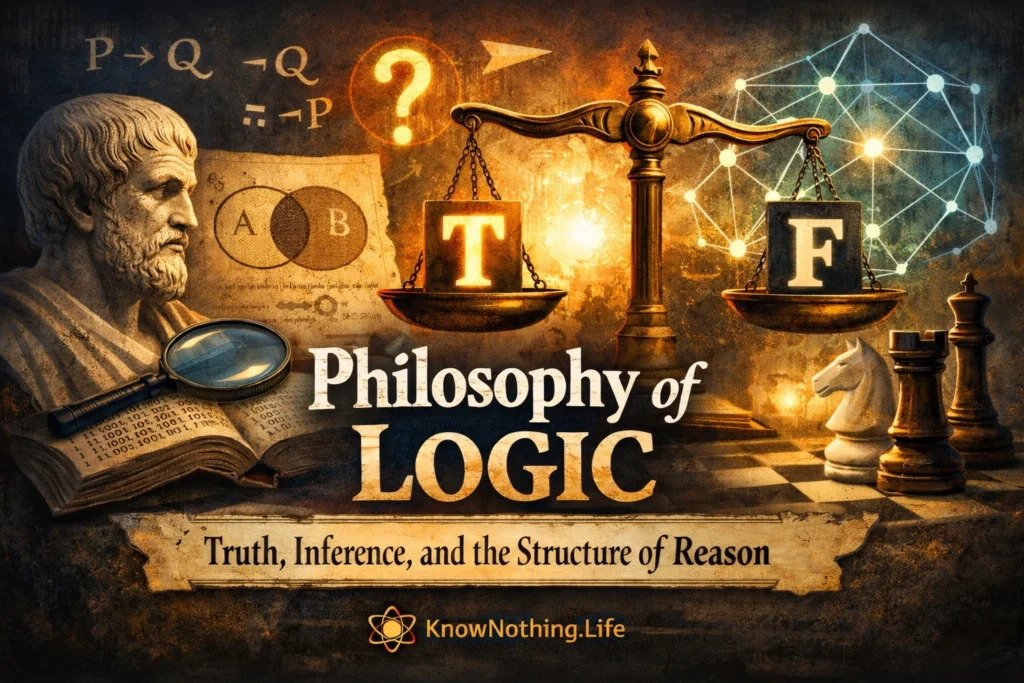
The philosophy of logic investigates the nature, scope, and foundations of logic itself. While logic is often understood as a formal system of rules governing valid reasoning, the philosophical inquiry goes deeper, asking what those rules mean, why they work, and whether they capture something fundamental about reality or merely reflect human conventions. At its core, the philosophy of logic addresses questions about truth, inference, necessity, and the limits of formal systems—questions that sit at the very foundation of rational thought.
Historically, logic has been regarded as the backbone of philosophy. From classical syllogisms to modern symbolic systems, it has provided a framework for distinguishing valid arguments from invalid ones. Yet philosophers have long debated whether logic is discovered or invented, whether its principles are universal or context-dependent, and whether alternative logical systems might be equally legitimate. These debates reveal that logic is not just a technical discipline but a deeply philosophical one, intertwined with metaphysics, epistemology, and language.
The Nature of Logical Truth
One of the central concerns in the philosophy of logic is the nature of logical truth. Logical truths are often characterized as statements that are true in virtue of their form rather than their content. For example, a statement like “Either it is raining or it is not raining” is true regardless of the actual weather conditions. Such truths appear necessary and universal, raising the question of what grounds their validity.
Philosophers such as Gottlob Frege argued that logical truths are objective and independent of human thought, forming the foundation of all rational inquiry. Frege viewed logic as a system that reveals the structure of reality itself, not merely a tool for organizing language. In contrast, others have taken a more conventionalist approach, suggesting that logical truths are true because of the rules we adopt for using symbols and language.
This debate extends into questions about analyticity—the idea that some statements are true by definition. If logical truths are analytic, then their necessity arises from linguistic conventions. However, critics such as Willard Van Orman Quine challenged the distinction between analytic and synthetic truths, arguing that our beliefs form an interconnected web in which even logical principles can, in principle, be revised. This perspective suggests that logic may be less fixed and more flexible than traditionally assumed.
Validity and Inference
Another fundamental issue in the philosophy of logic is the nature of validity and inference. An argument is considered valid if its conclusion follows necessarily from its premises. But what does it mean for one statement to follow from another? This question leads to deeper inquiries about the nature of consequence and the criteria for correct reasoning.
Formal logic provides precise tools for evaluating validity, using symbolic representations to capture the structure of arguments. Philosophers like Bertrand Russell and Alfred North Whitehead sought to reduce mathematics and reasoning to logical principles, culminating in their monumental work Principia Mathematica. Their project aimed to show that all mathematical truths could be derived from a small set of logical axioms, illustrating the power of formal systems to capture complex patterns of inference.
However, the reliance on formal systems raises further philosophical questions. Does validity depend solely on syntactic rules, or does it require a semantic notion of truth? Some philosophers argue that inference is fundamentally about preserving truth from premises to conclusion, while others emphasize the role of proof and derivation within formal systems. These differing perspectives highlight the tension between logic as a formal discipline and logic as a theory of reasoning.
Logical Systems and Pluralism
The development of modern logic has revealed that there is not just one logical system, but many. Classical logic, with its principles of bivalence and the law of excluded middle, has long been considered the standard framework. However, alternative systems—such as intuitionistic logic, modal logic, and paraconsistent logic—challenge some of its core assumptions.
For example, intuitionistic logic rejects the idea that every statement is either true or false, emphasizing instead the role of proof in establishing truth. This approach, influenced by mathematicians like L. E. J. Brouwer, has significant implications for the philosophy of mathematics and the nature of knowledge. Similarly, modal logic introduces concepts of necessity and possibility, expanding the scope of logical analysis beyond simple truth values.
The existence of multiple logical systems has led to the idea of logical pluralism—the view that more than one logic may be correct, depending on the context. Philosophers such as Graham Priest have argued that different logics capture different aspects of reasoning, and that no single system can claim absolute authority. This perspective challenges the traditional notion of logic as a universal and unchanging framework, suggesting instead a more flexible and context-sensitive understanding.
Paradoxes and the Limits of Logic
Paradoxes have played a crucial role in shaping the philosophy of logic by exposing the limitations of formal systems. One of the most famous examples is the liar paradox, which arises from a sentence that asserts its own falsehood. Such paradoxes reveal tensions within our concepts of truth and reference, forcing philosophers to reconsider the foundations of logic.
The discovery of logical paradoxes in the early twentieth century led to significant developments in formal logic and set theory. Kurt Gödel demonstrated that any sufficiently powerful formal system is incomplete: there are true statements that cannot be proven within the system. Gödel’s incompleteness theorems had profound implications, showing that the dream of a complete and self-contained logical foundation for mathematics is unattainable.
These results highlight the inherent limitations of logic as a formal enterprise. While logic provides powerful tools for reasoning, it cannot capture all truths or resolve all contradictions. This realization has led to ongoing debates about the nature of mathematical truth, the role of intuition, and the boundaries of formal reasoning.
Logic, Language, and Meaning
Logic is closely connected to language, as it provides a framework for analyzing the structure of statements and arguments. Philosophers of logic often draw on insights from the philosophy of language to understand how logical systems relate to meaning and interpretation. The relationship between syntax (formal structure) and semantics (meaning) is particularly central to this inquiry.
Alfred Tarski made significant contributions to this area by developing a formal theory of truth for logical languages. His work showed how truth can be defined in a precise and systematic way, linking logical expressions to the world they describe. This approach has become a cornerstone of modern logic, providing a bridge between formal systems and their interpretations.
At the same time, philosophers such as Ludwig Wittgenstein emphasized the limits of formal analysis. In his later work, Wittgenstein argued that meaning arises from use within specific contexts, suggesting that logical structure alone cannot fully capture the richness of language. This perspective challenges the idea that logic can provide a complete account of meaning, pointing instead to the importance of context, practice, and human activity.
Logic and Rationality
The philosophy of logic also intersects with questions about rationality and human reasoning. Logic is often seen as the ideal standard of rational thought, providing rules that guide correct inference. However, actual human reasoning frequently deviates from these ideals, raising questions about the relationship between logic and cognition.
Some philosophers argue that logic should be normative, prescribing how we ought to reason, regardless of how we actually do. Others suggest that logic should be informed by empirical studies of human cognition, taking into account the ways in which people naturally think and reason. This debate reflects broader tensions between normative and descriptive approaches in philosophy.
In recent years, the rise of artificial intelligence has added a new dimension to these discussions. Machines can perform logical operations with great precision, but whether they truly “understand” logic remains an open question. This issue echoes earlier philosophical debates about the nature of reasoning and the role of formal systems in capturing human thought.
Conclusion
The philosophy of logic explores the foundations of reasoning, examining the nature of truth, validity, and inference. It reveals that logic is not merely a set of formal rules, but a complex and multifaceted discipline with deep philosophical implications. From the work of Gottlob Frege and Bertrand Russell to the groundbreaking insights of Kurt Gödel, the field has continually evolved, challenging our assumptions about knowledge and rationality.
Ultimately, the philosophy of logic invites us to reflect on the very nature of thought itself. By examining the principles that govern reasoning, it deepens our understanding of what it means to think clearly, argue effectively, and seek truth. In doing so, it remains an essential and enduring part of philosophical inquiry.