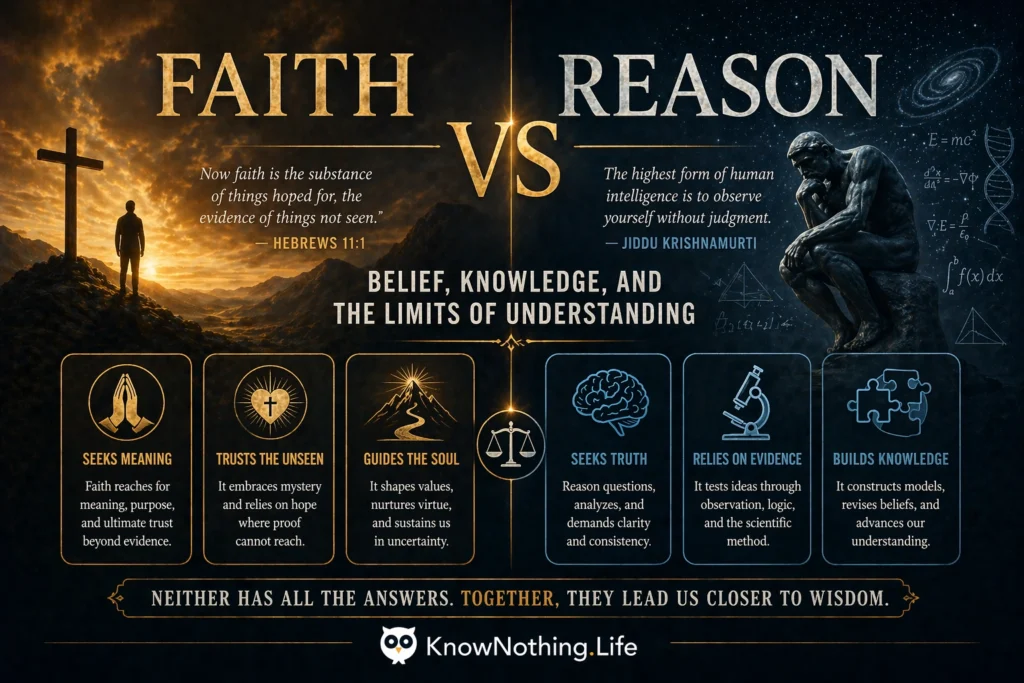
The relationship between faith and reason has been one of the most enduring debates in philosophy and theology. At its core lies a fundamental question: should beliefs about ultimate reality, God, and morality be grounded in rational evidence, or can they be justified through faith alone? This tension reflects broader concerns about the nature of knowledge, the limits of human understanding, and the role of belief in shaping our view of the world.
Faith is often associated with trust, commitment, or belief without sufficient empirical evidence, while reason emphasizes logic, argument, and evidence-based justification. Yet the opposition between them is not always clear-cut. Many philosophers and theologians have sought to reconcile faith and reason, arguing that they serve complementary roles rather than being mutually exclusive. The debate continues to shape discussions about religion, science, and the foundations of knowledge.
Classical and Medieval Perspectives
In ancient philosophy, reason was often seen as the primary path to knowledge, but religious traditions introduced the concept of faith as a means of accessing truths beyond human understanding. Early Christian thinkers grappled with how these two sources of knowledge relate to one another, seeking to integrate philosophical reasoning with theological doctrine.
Augustine of Hippo famously argued that faith precedes understanding. For Augustine, belief in God provides the foundation for rational inquiry, guiding the mind toward truth. He maintained that faith and reason are not opposed but intertwined, with faith illuminating what reason alone cannot fully grasp.
Later, Thomas Aquinas developed a more systematic account, distinguishing between truths accessible to reason and those revealed through faith. Aquinas argued that reason can demonstrate certain aspects of God’s existence, while faith is necessary for understanding divine mysteries. His synthesis of Aristotelian philosophy and Christian theology became a cornerstone of medieval thought.
The Rise of Rationalism and Skepticism
The early modern period saw a shift toward greater emphasis on reason as the foundation of knowledge. Philosophers sought to establish secure foundations for belief through rational inquiry, often questioning the authority of tradition and revelation. This shift led to new challenges for the role of faith.
René Descartes exemplified this approach by seeking certainty through methodical doubt. While he ultimately affirmed the existence of God, his method placed reason at the center of philosophical inquiry. Similarly, David Hume raised skeptical doubts about religious belief, arguing that claims about miracles and divine intervention lack sufficient empirical support.
These developments contributed to a growing divide between faith and reason. As scientific and philosophical methods advanced, many began to question whether faith-based beliefs could be justified in the same way as empirical knowledge. This tension set the stage for modern debates about the compatibility of religion and rational inquiry.
Faith as Commitment and Existential Choice
In response to the challenges posed by rationalism and skepticism, some philosophers reinterpreted faith as a form of commitment rather than a set of propositions to be proven. Søren Kierkegaard argued that faith involves a “leap” beyond reason, a personal decision that cannot be justified through objective evidence alone.
Kierkegaard emphasized the subjective nature of faith, viewing it as an existential commitment that defines one’s relationship to the divine. For him, the attempt to prove God’s existence through reason misses the point of faith, which is rooted in personal experience and inward reflection. This perspective highlights the limits of reason in addressing questions of ultimate meaning.
This approach has influenced existentialist and contemporary discussions of faith, suggesting that belief is not merely a matter of evidence but of personal engagement. It challenges the assumption that all beliefs must be justified in purely rational terms, opening space for alternative forms of understanding.
Reason as a Foundation for Belief
While some emphasize the limits of reason, others argue that rational inquiry can support religious belief. Philosophers in the analytic tradition have developed arguments aimed at showing that belief in God can be reasonable, even if it is not conclusively proven.
Alvin Plantinga introduced the concept of “reformed epistemology,” which holds that belief in God can be properly basic—justified without requiring evidence or argument. According to this view, faith is not irrational but grounded in cognitive faculties that are reliable under appropriate conditions.
Other philosophers have sought to provide rational arguments for religious belief, such as the cosmological and teleological arguments. These approaches aim to bridge the gap between faith and reason, showing that belief in God can be supported by philosophical reasoning. However, the success of these arguments remains a matter of debate.
Conflict and Compatibility
The relationship between faith and reason is often framed in terms of conflict or compatibility. Some argue that the two are fundamentally opposed, with faith requiring belief without evidence and reason demanding justification through evidence. This view is often associated with critiques of religion that emphasize scientific and rational explanations.
Others argue that faith and reason are compatible or even mutually supportive. According to this perspective, reason can clarify and defend faith, while faith can provide a broader context for understanding. This view is reflected in the work of thinkers who see no contradiction between scientific inquiry and religious belief.
The debate over conflict versus compatibility reflects deeper questions about the nature of knowledge and the role of belief. It raises issues about the limits of reason, the scope of science, and the possibility of integrating different forms of understanding.
Faith, Reason, and Science
The relationship between faith and reason is closely linked to the relationship between religion and science. Scientific inquiry relies on empirical evidence and rational analysis, while religious belief often involves faith in unseen realities. This difference has led to debates about whether science and religion are in conflict or address different domains.
Some philosophers argue that science and religion operate in separate spheres, with science addressing questions of how the world works and religion addressing questions of meaning and purpose. Others contend that there is overlap, particularly in areas such as cosmology and the origin of the universe.
The interaction between faith, reason, and science continues to shape contemporary discussions. It highlights the complexity of integrating different approaches to knowledge and the challenges of addressing questions that lie at the boundaries of human understanding.
Conclusion
The debate between faith and reason is a central issue in philosophy, reflecting broader questions about belief, knowledge, and the limits of human understanding. From the synthesis of Thomas Aquinas to the existential insights of Søren Kierkegaard and the analytic approaches of Alvin Plantinga, it has taken many forms.
While no single resolution has emerged, the ongoing dialogue between faith and reason continues to enrich philosophical inquiry. By exploring their relationship, we gain a deeper appreciation of the diverse ways in which humans seek to understand the world and their place within it.