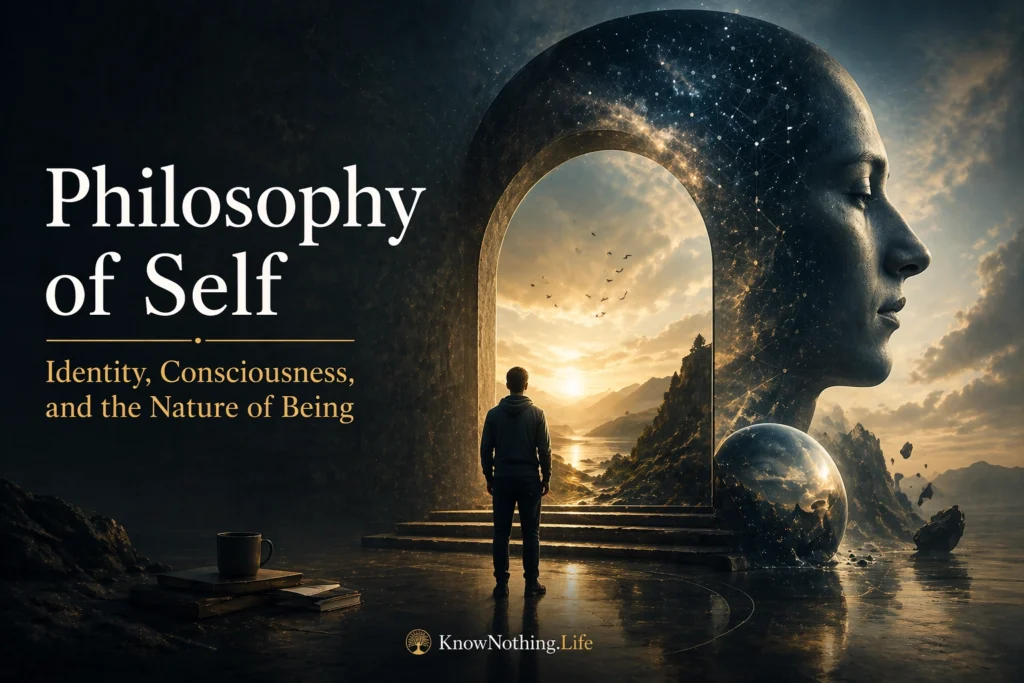
The question of the self sits at the center of philosophy, quietly shaping how we understand consciousness, responsibility, meaning, and even reality itself. To ask “Who am I?” is not merely a personal inquiry—it is a philosophical problem that has challenged thinkers across cultures and centuries. The self appears obvious at first glance: a stable identity that persists over time. Yet the deeper we look, the more elusive it becomes. Is the self a unified entity, or a constantly shifting process? Does it reside in the mind, the body, or somewhere beyond both?
Philosophy of self explores these tensions by examining identity, awareness, and continuity. It brings together metaphysics, psychology, and ethics, probing whether the “I” we experience is real, constructed, or illusory. From ancient reflections on the soul to modern debates about cognitive science and personal identity, the self has remained one of philosophy’s most enduring and controversial subjects. Understanding it is not just an abstract exercise—it shapes how we live, how we relate to others, and how we interpret our place in the world.
Historical Foundations of the Self
The philosophical investigation of the self begins in antiquity, where early thinkers sought to locate the essence of human identity. In ancient Greece, Socrates emphasized self-knowledge as the foundation of wisdom, urging individuals to “know thyself.” This directive was not about cataloging personal traits, but about uncovering a deeper moral and rational core. His student Plato expanded this view, proposing that the self is fundamentally tied to the soul—a non-material, rational essence that transcends the physical body.
Aristotle, in contrast, grounded the self more firmly in the natural world. For Aristotle, the self was not separate from the body but expressed through it, as part of a unified organism. This perspective marked an early attempt to reconcile mental and physical dimensions of identity.
Outside the Western tradition, Buddhist philosophy offered a radically different view, arguing that the self is not a fixed entity at all. The doctrine of anatta, or “no-self,” suggests that what we call the self is merely a collection of changing processes—thoughts, sensations, and perceptions—with no permanent core.
These early frameworks established the central tension that continues to define the philosophy of self: whether identity is something enduring and essential, or something fluid and constructed. The contrast between soul-based theories and process-based views still echoes in contemporary debates.
The Self and Consciousness
At the heart of the philosophy of self lies the relationship between identity and consciousness. One of the most influential modern perspectives comes from René Descartes, who famously declared, “I think, therefore I am.” This statement positioned the self as fundamentally tied to the act of thinking. For Descartes, the certainty of one’s own consciousness provided an unshakable foundation for knowledge. Even if everything else could be doubted, the existence of the thinking self could not.
However, later philosophers challenged this seemingly solid foundation. David Hume argued that introspection reveals no stable self—only a bundle of perceptions constantly in flux. According to Hume, what we call the self is simply a convenient label for this ever-changing stream. There is no underlying substance holding it all together, only the illusion of continuity created by memory and habit.
In the 20th century, phenomenologists like Edmund Husserl and existentialists such as Jean-Paul Sartre further explored the structure of consciousness. Sartre, in particular, rejected the idea of a fixed self, arguing that existence precedes essence. The self is not something we discover but something we create through our choices and actions. Consciousness, in this view, is not a container of identity but an active process that continually shapes it.
Personal Identity and Continuity
A central question in the philosophy of self is what makes a person the same over time. Despite physical changes, shifting beliefs, and evolving experiences, we tend to think of ourselves as continuous beings. But what accounts for this continuity? Is it memory, the body, or something deeper?
John Locke offered one of the most influential answers, proposing that personal identity is grounded in memory. According to Locke, a person is the same over time insofar as they can remember past experiences. This psychological continuity creates a sense of unity, linking the present self to past actions and thoughts. However, this theory raises difficult questions: What happens when memory fails? Are we no longer the same person if we forget our past?
Modern thought experiments have pushed these questions further. Consider scenarios involving brain transplants or digital consciousness—if your memories were transferred to another body or machine, would that still be you? Philosophers continue to debate whether identity depends on psychological continuity, physical continuity, or some combination of both. These questions are no longer purely theoretical, as advances in neuroscience and artificial intelligence bring them closer to practical relevance.
Ultimately, the problem of personal identity reveals how fragile and complex the notion of the self truly is. What feels like a stable core may, upon closer inspection, depend on factors that are constantly changing or even unreliable.
The Self as Narrative
An increasingly influential perspective views the self not as a fixed entity, but as a story we tell about ourselves. This narrative theory suggests that identity is constructed through the integration of experiences into a coherent account. Rather than existing as a static object, the self emerges through interpretation and meaning-making.
Philosophers like Paul Ricoeur have argued that narrative provides the structure through which we understand our lives. By organizing events into a story, we create a sense of continuity and purpose. This narrative is not purely subjective—it is shaped by cultural norms, language, and social interactions. The self, in this sense, is both personal and collective, formed through dialogue with the world around us.
This perspective also highlights the role of memory and imagination in shaping identity. We do not simply recall the past; we reinterpret it, often unconsciously, to fit our current understanding of ourselves. The future, too, plays a role, as our goals and aspirations influence how we define who we are. The self becomes a dynamic, evolving narrative rather than a fixed essence.
However, critics argue that the narrative view risks reducing identity to fiction. If the self is merely a story, what grounds its reality? The challenge lies in balancing the constructed nature of identity with the lived experience of being a continuous, embodied subject.
The Embodied and Social Self
While many philosophical theories focus on the mind, recent approaches emphasize the importance of the body and social context in shaping the self. The embodied view argues that identity cannot be separated from physical experience. Our perceptions, emotions, and actions are deeply rooted in the body, influencing how we understand ourselves and interact with the world.
Thinkers like Maurice Merleau-Ponty have argued that the body is not merely an object we possess but a fundamental aspect of our being. We do not simply have bodies—we are our bodies, experiencing the world through them. This perspective challenges the traditional mind-body dualism and suggests that the self is inherently situated in physical space.
At the same time, the social dimension of the self cannot be ignored. Identity is shaped through relationships, language, and cultural norms. From early childhood, we develop a sense of self through interaction with others, internalizing expectations and roles. Sociological and philosophical perspectives converge here, emphasizing that the self is not isolated but relational.
This social aspect raises important ethical and political questions. If the self is shaped by society, to what extent are we responsible for who we are? And how do power structures influence identity formation? The philosophy of self thus intersects with broader concerns about freedom, agency, and justice.
The Illusion or Reality of the Self
One of the most radical questions in the philosophy of self is whether the self exists at all. Some philosophical and scientific perspectives suggest that the self is an illusion—a byproduct of cognitive processes rather than a real entity. This view echoes ancient Buddhist thought while finding support in modern neuroscience, which shows how the brain constructs a sense of unity from distributed processes.
Yet even if the self is constructed, it does not necessarily follow that it is unreal in any meaningful sense. Illusions can have real effects, shaping behavior, relationships, and experience. The sense of self may be a useful fiction—an organizing principle that allows us to navigate the world effectively.
Other philosophers maintain that the self is real, but not in the way we traditionally conceive it. Instead of being a fixed substance, it may be better understood as a process—an ongoing pattern of activity that persists through change. This process view attempts to reconcile the stability of identity with the fluidity of experience.
The debate over the reality of the self remains unresolved, reflecting deeper questions about the nature of existence and knowledge. Whether illusion or reality, the self continues to play a central role in human life, shaping how we think, feel, and act.
Conclusion
The philosophy of self reveals that what seems most familiar is also among the most mysterious. From ancient theories of the soul to modern accounts of narrative and embodiment, the self has been understood in radically different ways. Some see it as a stable essence, others as a shifting process, and still others as an illusion altogether.
What unites these perspectives is the recognition that the self is not a simple, given fact. It is something to be examined, questioned, and perhaps even reimagined. As science and philosophy continue to evolve, our understanding of the self will likely change as well, challenging assumptions that once seemed unquestionable.
In the end, the philosophy of self does not offer a single definitive answer. Instead, it opens a space for reflection, inviting us to explore what it means to exist as a conscious, embodied, and social being. The question “Who am I?” remains unanswered—not because it cannot be answered, but because it is a question that must be continually asked.