Critical thinking is the disciplined process of actively analyzing, evaluating, and synthesizing information to guide belief and action. It is not merely about thinking more, but about thinking better—more clearly, more logically, and more reflectively. In a world saturated with information, opinions, and competing claims, critical thinking provides the tools necessary to distinguish between what is credible and what is misleading. It enables individuals to move beyond surface impressions, examining underlying assumptions and evidence.
At its core, critical thinking is both a skill set and a mindset. It involves cognitive abilities such as reasoning, interpretation, and problem solving, as well as dispositions such as open-mindedness, intellectual humility, and skepticism. These elements work together to create a form of thinking that is both rigorous and flexible. Rather than accepting information at face value, critical thinkers engage with it, question it, and refine their understanding through careful analysis.
Historical Foundations and Philosophical Roots
The origins of critical thinking can be traced to ancient philosophy, particularly the method of systematic questioning associated with Socrates. The Socratic method emphasized dialogue, inquiry, and the examination of beliefs, encouraging individuals to question assumptions and seek deeper understanding. This approach laid the foundation for critical thinking as a practice of reflective inquiry.
In the modern era, philosophers such as John Dewey advanced the concept of reflective thinking, emphasizing the importance of active, persistent, and careful consideration of beliefs in light of evidence. Dewey argued that critical thinking is essential for democratic participation, as it enables individuals to evaluate information and make informed decisions.
These philosophical roots highlight the enduring importance of critical thinking as both an intellectual and practical endeavor. Over time, the concept has been integrated into psychology and education, where it is studied as a cognitive process and taught as a fundamental skill. This interdisciplinary development reflects the broad relevance of critical thinking across domains.
Core Components of Critical Thinking
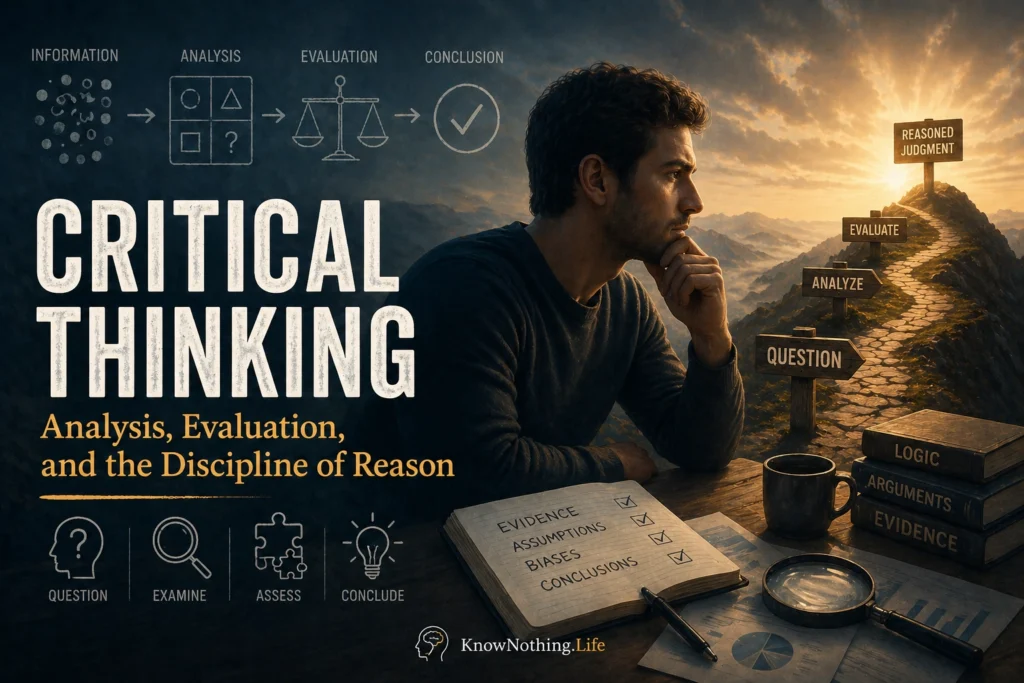
Critical thinking involves several interrelated components that together support effective reasoning. Analysis is the process of breaking down complex information into its constituent parts, identifying relationships and structures. This allows individuals to understand the components of an argument or problem and how they fit together.
Evaluation involves assessing the credibility and relevance of information. This includes examining the quality of evidence, the validity of reasoning, and the reliability of sources. Critical thinkers consider multiple perspectives, weighing strengths and weaknesses before forming conclusions. This process requires both skepticism and fairness, ensuring that judgments are grounded in evidence rather than bias.
Inference and interpretation are also central to critical thinking. Inference involves drawing conclusions based on available information, while interpretation involves understanding the meaning and implications of that information. These processes require the integration of knowledge and reasoning, enabling individuals to move from data to insight. Together, these components form the foundation of critical thinking as a systematic approach to understanding and decision-making.
Logic, Reasoning, and Argumentation
Logic is a fundamental aspect of critical thinking, providing the structure for evaluating arguments and reasoning. Deductive reasoning involves drawing conclusions that necessarily follow from premises, ensuring logical consistency. Inductive reasoning, in contrast, involves generalizing from specific observations, allowing for probabilistic conclusions. Both forms of reasoning are essential for critical thinking, each serving different purposes.
Argumentation is the practical application of logic, involving the construction and evaluation of arguments. A strong argument is supported by evidence and follows a coherent structure, while a weak argument may rely on unsupported claims or flawed reasoning. Critical thinkers analyze arguments by identifying premises, conclusions, and the connections between them.
Understanding common logical fallacies is an important part of this process. Fallacies are errors in reasoning that undermine the validity of an argument, such as appeals to emotion, false dilemmas, or ad hominem attacks. Recognizing these patterns helps individuals avoid being misled and strengthens their ability to construct sound arguments. Logic and argumentation thus provide the tools for rigorous and effective thinking.
Cognitive Biases and Barriers to Critical Thinking
Despite the importance of critical thinking, individuals often encounter cognitive biases that hinder objective reasoning. These biases are systematic patterns of thought that deviate from rationality, influencing how information is interpreted and decisions are made. For example, confirmation bias leads individuals to favor information that supports their existing beliefs while ignoring contradictory evidence.
Other biases, such as the availability heuristic or anchoring effect, can distort judgment by emphasizing certain information over others. These biases are often automatic and unconscious, making them difficult to detect and correct. They reflect the mind’s reliance on shortcuts, which can be efficient but also prone to error.
Overcoming these barriers requires awareness and deliberate effort. Critical thinking involves recognizing the influence of biases and actively working to counteract them. This may include seeking diverse perspectives, questioning assumptions, and engaging in reflective thinking. By addressing these challenges, individuals can improve the quality of their reasoning and decision-making.
Critical Thinking in Decision-Making
Critical thinking plays a vital role in decision-making, where individuals must evaluate options and choose among alternatives. Effective decision-making requires the ability to analyze information, assess risks and benefits, and consider long-term consequences. Critical thinking provides the framework for this process, enabling informed and rational choices.
In complex situations, decision-making often involves uncertainty and incomplete information. Critical thinkers navigate this uncertainty by evaluating probabilities, considering multiple scenarios, and avoiding overconfidence. They are also able to adapt their decisions as new information becomes available, reflecting the dynamic nature of critical thinking.
The integration of critical thinking and decision-making highlights the practical importance of these skills. Whether in personal, professional, or societal contexts, the ability to think critically supports better outcomes and more effective problem solving. It underscores the value of reasoning as a tool for navigating complexity.
Critical Thinking in Education and Society
Education plays a central role in developing critical thinking skills, as it provides opportunities for practice and refinement. Effective teaching strategies emphasize active learning, where students engage with material through discussion, analysis, and problem solving. These approaches encourage deeper understanding and the development of independent thinking.
In society, critical thinking is essential for informed citizenship and participation in public discourse. It enables individuals to evaluate information, assess the credibility of sources, and make reasoned judgments about important issues. In an era of misinformation and rapid information exchange, these skills are more important than ever.
The application of critical thinking extends to various fields, including science, business, and media. In each context, the ability to analyze and evaluate information supports innovation, ethical decision-making, and effective communication. This broad relevance highlights the importance of fostering critical thinking at both individual and societal levels.
Neural Basis of Critical Thinking
The neural mechanisms underlying critical thinking involve brain regions associated with executive function, reasoning, and cognitive control. The prefrontal cortex plays a central role, supporting processes such as planning, decision-making, and the regulation of thought. This region enables individuals to maintain focus, evaluate information, and inhibit impulsive responses.
Other areas, such as the parietal cortex and temporal lobes, contribute to the integration of information and the retrieval of knowledge. These regions work together within a network that supports complex cognitive processes, allowing for the coordination of analysis, evaluation, and inference.
Neuroscientific research has also explored the role of neural connectivity and dynamics in critical thinking, highlighting how different brain regions interact to support reasoning. These findings provide a biological basis for cognitive processes, linking mental activity to underlying neural mechanisms and deepening our understanding of how critical thinking operates.
Developing and Enhancing Critical Thinking
Critical thinking is not a fixed ability but a skill that can be developed and refined through practice. Strategies for enhancing critical thinking include engaging in reflective thinking, questioning assumptions, and seeking diverse perspectives. These practices encourage deeper analysis and reduce the influence of biases.
Metacognition, or thinking about one’s own thinking, is also important for critical thinking. By monitoring and evaluating their cognitive processes, individuals can identify errors and improve their reasoning. This self-awareness supports continuous learning and the development of more effective thinking strategies.
Educational and professional environments can foster critical thinking by promoting inquiry, discussion, and problem solving. Providing opportunities for active engagement and feedback helps individuals build and refine their skills. As critical thinking becomes increasingly important in a complex world, its development is essential for personal and collective success.
Conclusion: The Discipline of Thought
Critical thinking represents the disciplined use of reason to analyze, evaluate, and synthesize information. It is both a cognitive process and a practical skill, enabling individuals to navigate complexity, make informed decisions, and engage with the world in a thoughtful and reflective manner. By integrating logic, evidence, and awareness of bias, critical thinking provides a framework for understanding and action.
As the demands on cognition continue to grow, the importance of critical thinking becomes increasingly evident. It offers a means of managing information, addressing challenges, and fostering innovation. Through continued study and practice, critical thinking remains a cornerstone of human intelligence, shaping how individuals understand and interact with the world.