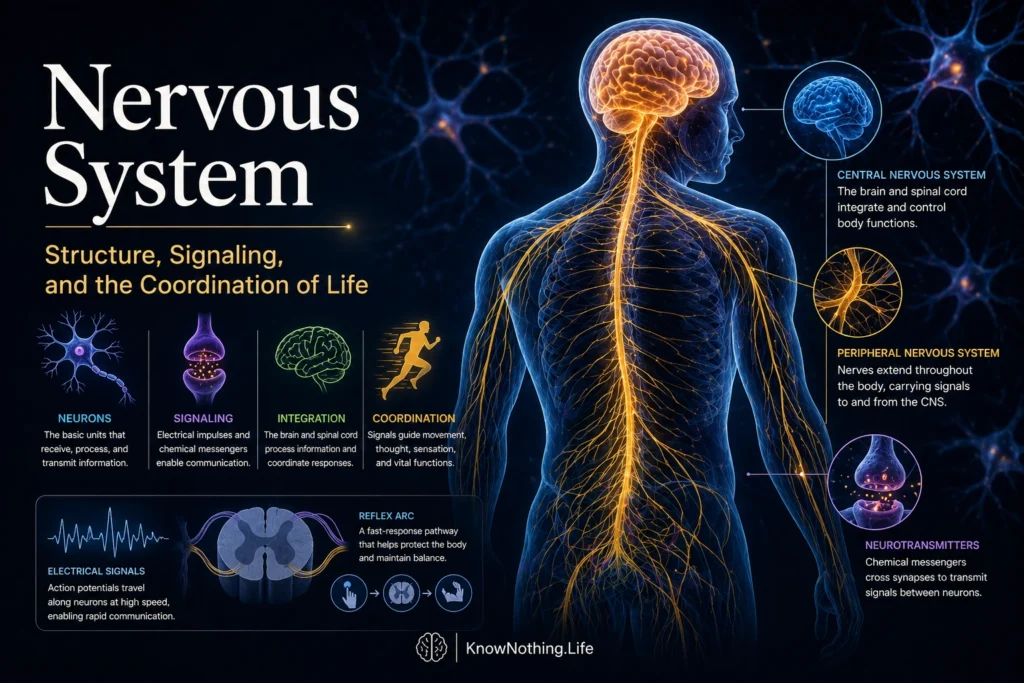
The nervous system is the body’s central communication network, integrating sensory input, coordinating responses, and enabling the full range of human experience—from reflexive movements to abstract thought. It links the brain, spinal cord, and peripheral pathways into a unified system that allows organisms to perceive their environment, process information, and act with precision and adaptability. Without the nervous system, there would be no perception, no movement, and no consciousness.
The scientific understanding of the nervous system has developed over centuries, moving from philosophical speculation to detailed biological analysis. Early thinkers such as René Descartes proposed mechanical models of reflexes, suggesting that the body could operate like a machine. Modern neuroscience has expanded this view, revealing a system of immense complexity. As neuroscientist Eric R. Kandel wrote in Principles of Neural Science, “The brain is the organ of the mind,” emphasizing that mental processes are inseparable from neural activity.
Major Divisions of the Nervous System
The nervous system is broadly divided into two main components: the central nervous system (CNS) and the peripheral nervous system (PNS). The CNS consists of the brain and spinal cord, serving as the primary site for processing and integrating information. The brain interprets sensory input, generates thoughts, and initiates responses, while the spinal cord acts as a conduit for signals traveling between the brain and the rest of the body.
The peripheral nervous system connects the CNS to the body’s organs, muscles, and sensory receptors. It is further divided into the somatic nervous system, which controls voluntary movements, and the autonomic nervous system, which regulates involuntary functions such as heart rate and digestion. The autonomic system itself includes the sympathetic and parasympathetic divisions, which have opposing effects that maintain physiological balance.
These divisions illustrate the hierarchical organization of the nervous system, but they also highlight its integration. Signals flow continuously between central and peripheral components, allowing for coordinated responses. As Charles Sherrington described in The Integrative Action of the Nervous System, the nervous system functions as a unified whole, integrating diverse inputs into coherent actions.
Neurons and Neural Signaling
At the cellular level, the nervous system is composed of neurons and supporting glial cells. Neurons are specialized for communication, transmitting signals through electrical impulses and chemical messengers. Each neuron consists of a cell body, dendrites that receive information, and an axon that sends signals to other cells.
Neural signaling begins with an action potential, an electrical impulse that travels along the axon. When this impulse reaches the synapse, it triggers the release of neurotransmitters, which cross the synaptic cleft and bind to receptors on the next neuron. This process allows information to be transmitted across complex networks, enabling rapid and coordinated responses.
The efficiency and adaptability of neural signaling are central to the functioning of the nervous system. Connections between neurons can be strengthened or weakened based on experience, a process known as synaptic plasticity. Psychologist Donald Hebb famously summarized this principle with the phrase “neurons that fire together wire together,” highlighting how learning and memory are rooted in changes at the synaptic level.
Sensory and Motor Systems
The nervous system is responsible for both receiving information from the environment and generating appropriate responses. Sensory systems detect stimuli such as light, sound, temperature, and touch, converting them into neural signals that can be processed by the brain. Specialized receptors in the eyes, ears, skin, and other organs play a key role in this process, allowing individuals to perceive their surroundings.
Once sensory information is processed, the nervous system generates motor responses through the activation of muscles and glands. The somatic nervous system controls voluntary movements, enabling actions such as walking, speaking, and manipulating objects. In contrast, the autonomic nervous system regulates involuntary functions, maintaining internal stability without conscious effort.
The coordination between sensory input and motor output is essential for adaptive behavior. For example, reflexes—automatic responses to stimuli—demonstrate the efficiency of this system. Reflex arcs can operate at the level of the spinal cord, allowing for rapid responses without direct involvement of the brain. This integration of sensory and motor systems illustrates the nervous system’s ability to balance speed and complexity.
The Autonomic Nervous System
The autonomic nervous system (ANS) regulates the body’s internal environment, controlling functions that are essential for survival but do not require conscious awareness. It is divided into the sympathetic and parasympathetic systems, which have complementary roles in maintaining homeostasis.
The sympathetic system prepares the body for action, often described as the “fight or flight” response. It increases heart rate, dilates pupils, and redirects blood flow to muscles, enabling rapid responses to perceived threats. In contrast, the parasympathetic system promotes relaxation and recovery, slowing the heart rate and supporting processes such as digestion and energy conservation.
This dynamic balance between activation and restoration is crucial for health and well-being. Chronic activation of the sympathetic system, for example, can contribute to stress-related disorders, while proper regulation of the ANS supports resilience and stability. As physiologist Walter Cannon introduced the concept of homeostasis, he emphasized the importance of maintaining internal balance despite external changes.
Integration and Higher Functions
Beyond basic sensory and motor functions, the nervous system supports higher cognitive processes such as reasoning, memory, and emotion. These functions are primarily associated with the brain, particularly the cerebral cortex, which is responsible for complex thought and decision-making.
Integration is a key feature of these higher functions. The brain combines information from multiple sources, allowing individuals to interpret experiences, plan actions, and adapt to new situations. Emotional processing, for example, involves interactions between the limbic system and cortical regions, illustrating the interconnected nature of cognition and emotion.
Neuroscientist Antonio Damasio has argued that emotion plays a fundamental role in decision-making, challenging the idea that rational thought operates independently. In Descartes’ Error, he wrote, “We are not thinking machines that feel; rather, we are feeling machines that think,” highlighting the integration of emotional and cognitive processes within the nervous system.
Plasticity and Adaptation
One of the most remarkable properties of the nervous system is its capacity for plasticity—the ability to change in response to experience. This adaptability allows the system to learn, recover from injury, and adjust to new environments. Neural connections can be strengthened through repeated use or weakened when they are no longer needed, reflecting the dynamic nature of the brain.
Plasticity is particularly evident during development, when the nervous system is highly responsive to environmental input. However, it continues throughout life, enabling individuals to acquire new skills and adapt to changing circumstances. This capacity for change is central to learning and memory, as well as to rehabilitation following injury.
The concept of plasticity also has important implications for mental health. Therapeutic interventions, whether behavioral or pharmacological, can influence neural pathways, supporting recovery and growth. This highlights the potential for change within the nervous system, even in the face of significant challenges.
Conclusion
The nervous system is a complex and dynamic network that underlies all aspects of human experience. From the transmission of neural signals to the integration of sensory input and the generation of behavior, it serves as the foundation for both physical and mental processes. Its organization into interconnected systems allows for both specialization and flexibility, enabling the body to respond effectively to a changing environment.
As research continues to advance, the study of the nervous system offers deeper insights into the nature of the mind and behavior. By understanding its structure and function, scientists and clinicians can develop more effective approaches to treating disorders, enhancing performance, and improving quality of life. Ultimately, the nervous system represents the biological basis of what it means to perceive, think, and act in the world.