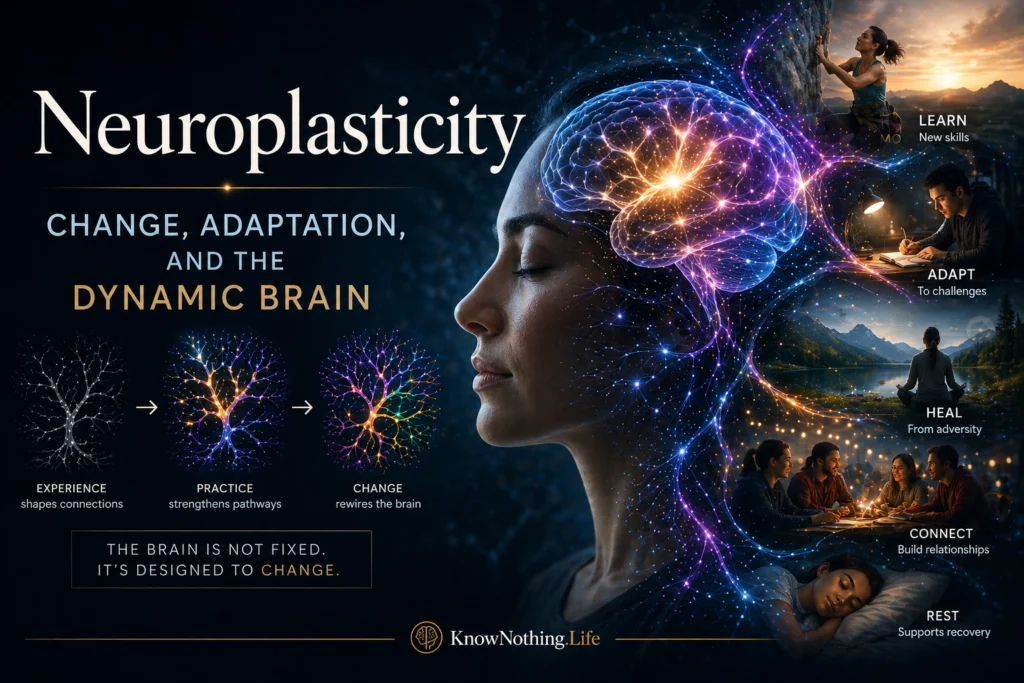
Neuroplasticity refers to the brain’s ability to change its structure and function in response to experience, learning, and environmental demands. Once thought to be largely fixed after early development, the brain is now understood as a dynamic and adaptive system, capable of reorganizing itself throughout the lifespan. This capacity for change underlies learning, memory, recovery from injury, and even the formation of identity.
The concept of neuroplasticity has transformed neuroscience and psychology, challenging earlier assumptions about the limits of the adult brain. Neuroscientist Eric R. Kandel emphasized the centrality of plasticity in understanding behavior, writing in Principles of Neural Science that “learning produces changes in the strength of synaptic connections.” This insight highlights that experience is not merely recorded by the brain but actively reshapes its architecture, making plasticity a foundational principle of mind and behavior.
Historical Development
The idea that the brain can change is relatively recent in scientific history. Early neuroscientists believed that the adult brain was largely immutable, with neurons fixed in number and function. This view was challenged in the mid-20th century by experimental findings showing that neural connections could be modified through experience.
Psychologist Donald Hebb played a pivotal role in this shift with his theory of synaptic plasticity. In The Organization of Behavior, Hebb proposed that repeated activation of neural pathways strengthens the connections between neurons, a principle summarized as “cells that fire together wire together.” This idea provided a mechanism for learning and memory, linking experience directly to changes in brain structure.
Later research expanded on Hebb’s insights, demonstrating that plasticity occurs at multiple levels, from synaptic changes to the growth of new neurons. The discovery of neurogenesis in the adult hippocampus further challenged the notion of a fixed brain, showing that new neurons can be generated even in adulthood. These findings have reshaped our understanding of development, learning, and recovery.
Mechanisms of Neuroplasticity
Neuroplasticity operates through a variety of mechanisms that alter the strength and organization of neural connections. One of the most well-studied processes is long-term potentiation (LTP), in which repeated stimulation of a synapse enhances its ability to transmit signals. This strengthening of synaptic connections is believed to be a key mechanism underlying learning and memory.
Conversely, long-term depression (LTD) weakens synaptic connections, allowing the brain to eliminate unnecessary or redundant pathways. This balance between strengthening and weakening connections enables the brain to adapt efficiently, maintaining flexibility while preserving important information. Structural changes, such as the growth of new dendritic branches or the formation of new synapses, also contribute to plasticity.
Neuroscientist Michael Merzenich has been a leading figure in the study of cortical plasticity, demonstrating that sensory and motor maps in the brain can be reorganized through training and experience. His work shows that the brain is not only capable of change but is constantly being reshaped by the demands placed upon it, reinforcing the idea that use and experience drive neural organization.
Learning and Memory
Neuroplasticity is fundamental to learning and memory, providing the biological basis for the acquisition and retention of information. When individuals learn new skills or knowledge, changes occur in the brain’s neural networks, strengthening connections that are repeatedly used. These changes allow information to be encoded, stored, and retrieved, forming the basis of memory.
Different types of memory involve different forms of plasticity. For example, procedural memory, which underlies skills such as riding a bicycle, involves changes in motor pathways, while declarative memory, which includes facts and events, relies on the hippocampus and related structures. The interaction between these systems allows for the integration of different forms of knowledge.
Kandel’s research on simple organisms, such as the sea slug Aplysia, demonstrated that even basic forms of learning involve changes in synaptic strength. By studying these processes at a cellular level, he showed how experience can lead to lasting changes in neural function, providing a bridge between molecular biology and psychology.
Development and Critical Periods
Neuroplasticity is particularly pronounced during early development, when the brain is highly responsive to environmental input. During this period, known as a critical or sensitive period, neural circuits are shaped by experience, allowing for the rapid acquisition of skills such as language and sensory processing.
During development, the brain undergoes a process of synaptic overproduction followed by pruning, in which unused connections are eliminated. This process increases the efficiency of neural networks, ensuring that frequently used pathways are strengthened while others are removed. The result is a system that is both adaptable and optimized for the individual’s environment.
Developmental psychologist Jean Piaget emphasized the role of interaction with the environment in cognitive development, suggesting that knowledge is constructed through experience. Neuroplasticity provides the biological basis for this process, illustrating how environmental input shapes the structure and function of the brain.
Recovery and Rehabilitation
One of the most significant implications of neuroplasticity is its role in recovery from brain injury. When damage occurs, such as from a stroke or traumatic brain injury, the brain can reorganize itself to compensate for lost functions. This may involve the strengthening of existing pathways or the recruitment of new regions to take over functions previously performed by damaged areas.
Rehabilitation therapies often aim to harness this capacity for change, using targeted exercises to promote recovery. For example, constraint-induced movement therapy encourages the use of an affected limb, stimulating neural pathways and improving function. These approaches demonstrate that recovery is not solely dependent on the extent of damage but also on the brain’s ability to adapt.
Neurologist Oliver Sacks documented numerous cases of recovery and adaptation in his clinical work, highlighting the resilience of the brain. He observed that “the brain is remarkably resilient and adaptable,” emphasizing that even severe impairments can be mitigated through plasticity and rehabilitation.
Neuroplasticity and Mental Health
Neuroplasticity also plays a crucial role in mental health, influencing how individuals respond to stress, trauma, and therapeutic interventions. Chronic stress, for example, can lead to changes in neural circuits associated with emotion and memory, contributing to conditions such as anxiety and depression. These changes illustrate how negative experiences can shape the brain in maladaptive ways.
At the same time, plasticity provides a basis for treatment and recovery. Psychotherapy, pharmacological interventions, and lifestyle changes can all promote positive changes in neural pathways. Cognitive-behavioral therapy (CBT), for instance, has been shown to alter patterns of brain activity associated with negative thinking, demonstrating that psychological interventions can produce measurable biological effects.
Neuroscientist Norman Doidge, in The Brain That Changes Itself, popularized the concept of neuroplasticity, highlighting its implications for both recovery and personal growth. He argued that understanding plasticity can empower individuals to actively shape their own brains through experience and practice.
Conclusion
Neuroplasticity reveals the brain as a dynamic and adaptive system, capable of change throughout life. From the strengthening of synaptic connections to the reorganization of entire neural networks, plasticity underlies learning, memory, and recovery. It challenges the notion of a fixed brain, demonstrating instead that experience plays a central role in shaping neural structure and function.
As research continues to advance, the study of neuroplasticity offers new possibilities for education, rehabilitation, and mental health treatment. By understanding how the brain changes, we gain insight into the processes that shape behavior and identity, highlighting both the constraints and the potential of the human mind.