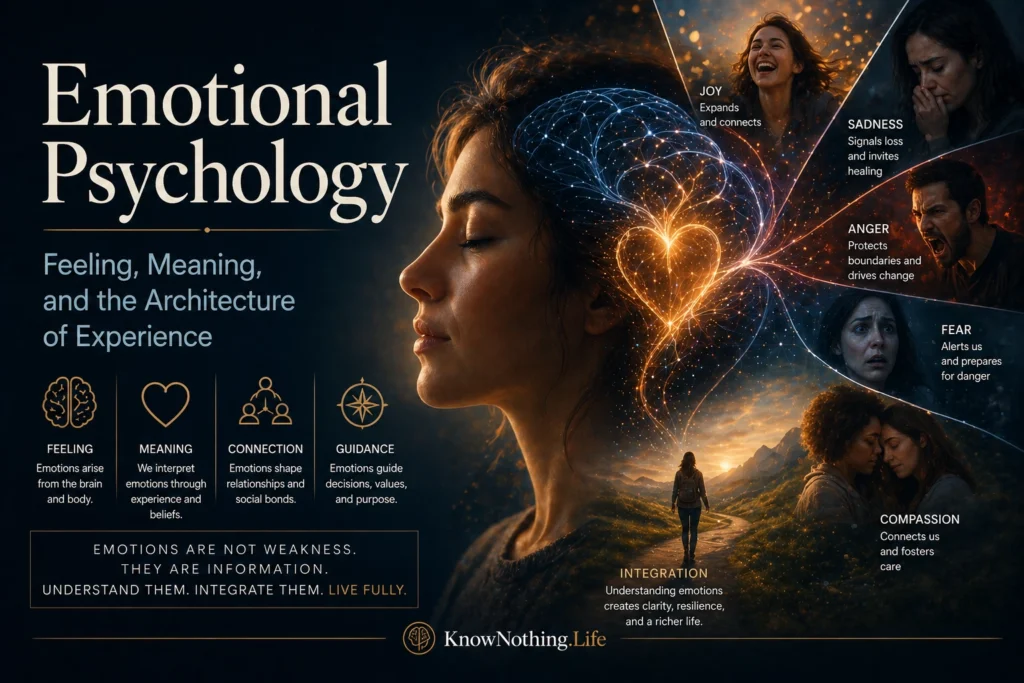
Emotion is central to human life, shaping perception, decision-making, relationships, and identity. Emotional psychology seeks to understand how feelings arise, how they are expressed, and how they influence behavior. Far from being irrational or secondary to cognition, emotions are now recognized as fundamental components of psychological functioning, providing essential information about the environment and guiding adaptive responses.
Historically, emotions were often viewed with suspicion, seen as forces that disrupt reason. However, contemporary research has reframed this perspective, emphasizing the integration of emotion and cognition. Philosopher and psychologist William James proposed one of the earliest scientific theories of emotion, suggesting in The Principles of Psychology that “we feel sorry because we cry, angry because we strike, afraid because we tremble.” This idea—that emotions arise from bodily responses—marked the beginning of a long effort to understand the complex interplay between body, mind, and experience.
Theories of Emotion
Emotional psychology has been shaped by a range of theoretical perspectives, each offering a different account of how emotions are generated. The James-Lange theory, associated with William James and Carl Lange, posits that emotions result from physiological changes in the body. According to this view, the perception of bodily states—such as increased heart rate or muscle tension—gives rise to the subjective experience of emotion.
In contrast, the Cannon-Bard theory, developed by Walter Cannon and Philip Bard, argues that emotional experience and physiological responses occur simultaneously but independently. This model emphasizes the role of the brain, particularly the thalamus, in generating emotional responses, challenging the idea that bodily changes are the primary cause of emotion.
More recent theories, such as the cognitive appraisal model proposed by Richard Lazarus, emphasize the role of interpretation in emotion. According to Lazarus, emotions arise from the evaluation of events in relation to one’s goals and well-being. This perspective highlights that the same situation can evoke different emotions depending on how it is perceived, underscoring the importance of cognition in emotional experience.
Biological Foundations of Emotion
Emotions are rooted in the brain and body, involving complex interactions between neural circuits, hormones, and physiological systems. The limbic system, which includes structures such as the amygdala, hippocampus, and hypothalamus, plays a central role in emotional processing. The amygdala, in particular, is associated with the detection of threat and the generation of fear responses.
Neuroscientist Joseph LeDoux has demonstrated that the brain can process emotional stimuli through both fast and slow pathways. The “low road” allows for rapid, automatic responses to potential threats, while the “high road” involves more detailed processing and conscious awareness. This dual-pathway model explains how emotions can be both immediate and reflective, depending on the context.
Hormonal systems also contribute to emotional regulation. Stress hormones such as cortisol influence responses to threat, while neurotransmitters like serotonin and dopamine play roles in mood and reward. These biological processes are deeply interconnected, creating a network that supports the complexity of emotional experience.
Emotional Expression and Communication
Emotions are not only internal experiences but also social signals that communicate information to others. Facial expressions, vocal tone, and body language convey emotional states, facilitating social interaction and coordination. Psychologist Paul Ekman identified a set of basic emotions—such as happiness, sadness, anger, fear, surprise, and disgust—that are associated with universal facial expressions.
Ekman’s research suggests that certain emotional expressions are biologically innate, shared across cultures, and recognized universally. However, cultural norms also shape how emotions are expressed and interpreted. Display rules, for example, determine when and how it is appropriate to show certain emotions, reflecting the influence of social context on emotional behavior.
Emotional communication plays a crucial role in relationships, enabling individuals to convey needs, intentions, and reactions. It also contributes to empathy, the ability to understand and share the feelings of others. This social dimension of emotion highlights its role in maintaining connections and facilitating cooperation.
Emotion and Cognition
The relationship between emotion and cognition is complex and reciprocal. Emotions influence attention, memory, and decision-making, often shaping how information is processed and interpreted. For example, emotionally charged events are more likely to be remembered, reflecting the interaction between emotional and memory systems in the brain.
At the same time, cognitive processes can regulate emotions. Strategies such as reappraisal—changing the interpretation of a situation—can alter emotional responses, demonstrating the capacity for cognitive control. This interplay between emotion and cognition is central to adaptive functioning, allowing individuals to respond flexibly to changing circumstances.
Neuroscientist Antonio Damasio has argued that emotion is essential for rational decision-making. In Descartes’ Error, he wrote, “We are not thinking machines that feel; rather, we are feeling machines that think,” emphasizing that emotions provide critical information that guides choices. Without emotion, decision-making becomes impaired, as seen in individuals with damage to emotion-related brain regions.
Development and Regulation of Emotion
Emotional development begins early in life and is shaped by both biological and environmental factors. Infants display basic emotional responses, which become more differentiated and complex over time. Caregiver interactions play a crucial role in this process, influencing the development of emotional regulation and attachment.
Psychologist John Bowlby emphasized the importance of early relationships in emotional development, arguing that secure attachment provides a foundation for healthy emotional functioning. Through interactions with caregivers, children learn to identify, express, and regulate their emotions, developing skills that are essential for social and psychological well-being.
Emotional regulation involves the ability to manage and respond to emotional experiences in adaptive ways. This includes strategies such as suppression, reappraisal, and problem-solving. Effective regulation is associated with better mental health and social functioning, while difficulties in regulation are linked to disorders such as anxiety and depression.
Emotional Disorders
Disruptions in emotional processes can lead to a range of psychological disorders. Depression, for example, involves persistent sadness and loss of interest, often accompanied by changes in cognition and behavior. Anxiety disorders are characterized by excessive fear and worry, reflecting dysregulation in threat-related systems.
Understanding emotional disorders requires an integrated approach that considers biological, cognitive, and social factors. Treatments often involve a combination of psychotherapy and medication, targeting both the underlying mechanisms and the subjective experience of emotion. Cognitive-behavioral therapy, for instance, focuses on modifying thought patterns that contribute to emotional distress.
Research on emotional disorders has also highlighted the role of resilience—the ability to adapt to adversity. Factors such as social support, coping strategies, and positive emotions can buffer against the impact of stress, promoting recovery and well-being.
Conclusion
Emotional psychology provides a comprehensive framework for understanding the role of feelings in human life. By integrating insights from biology, cognition, and social interaction, it reveals the complexity of emotional processes and their influence on behavior. Emotions are not merely reactions but integral components of perception, decision-making, and relationships.
As research continues to evolve, the study of emotion offers deeper insights into the nature of the mind and the factors that contribute to well-being. By understanding how emotions arise and how they can be regulated, individuals and clinicians can develop more effective strategies for enhancing mental health and navigating the challenges of life.