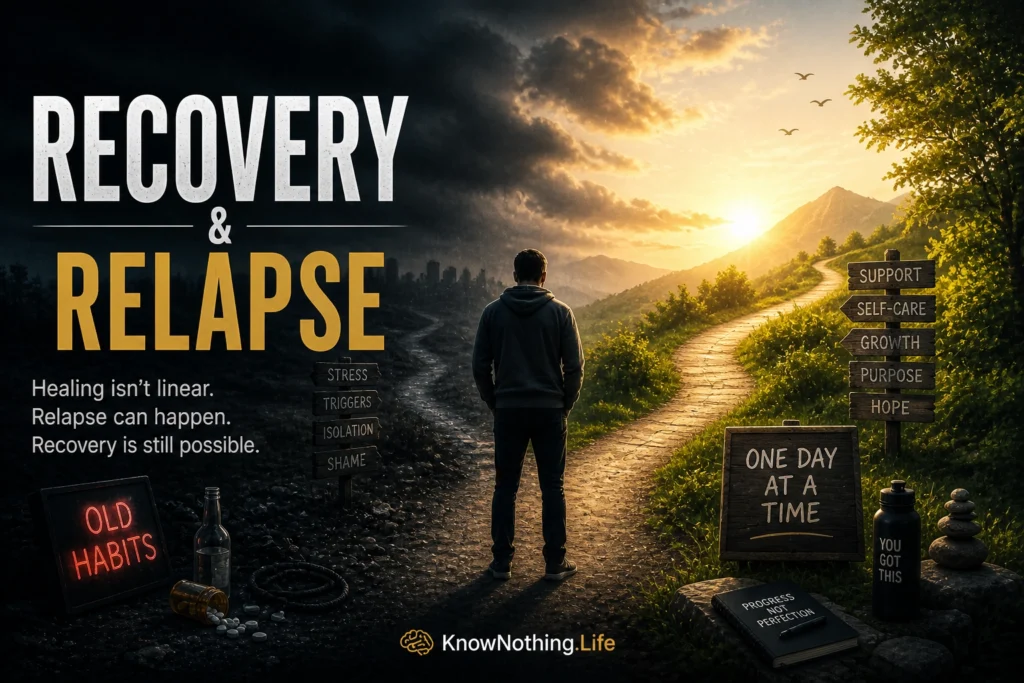
Recovery and relapse are central concepts in addiction psychology because addiction is rarely overcome through a single decision. Recovery is the long-term process of changing the relationship between a person, a substance or behavior, and the emotional, social, and environmental conditions that sustain addictive patterns. It may involve abstinence, reduced harm, medical treatment, therapy, support groups, spiritual practice, lifestyle change, restored relationships, or the rebuilding of identity. Relapse, meanwhile, is the return to substance use or compulsive behavior after a period of improvement. It can be painful and dangerous, but psychologically it is best understood as part of a process rather than as proof that recovery has failed.
Modern addiction research has moved away from viewing relapse as a simple collapse of willpower. Scholars such as Alan Marlatt, William R. Miller, Stephen Rollnick, Carlo DiClemente, James Prochaska, Nora Volkow, George Koob, and Judith Herman have helped reshape recovery as a dynamic process involving motivation, learning, stress, trauma, social support, and self-regulation. Marlatt’s relapse prevention model was especially important because it framed relapse as predictable and preventable, not mysterious or purely moral. Recovery is not only the absence of addictive behavior. It is the construction of a life in which old patterns lose power because new sources of meaning, connection, and coping become stronger.
Recovery as a Process of Change
Recovery begins with change, but change itself rarely happens all at once. James Prochaska and Carlo DiClemente’s transtheoretical model describes behavior change through stages such as precontemplation, contemplation, preparation, action, and maintenance. This model is useful because it recognizes that people often move gradually from denial or ambivalence toward commitment. A person may first resist the idea that there is a problem, then begin questioning their behavior, then experiment with limits, then seek help, and finally build a stable recovery practice. Movement through these stages is not always linear. People may move forward, backward, or cycle through stages multiple times.
This framework helps reduce shame because it shows that ambivalence is normal. Many people with addiction both want and do not want to change. They may hate the consequences of addiction while still relying on the substance or behavior for relief, identity, pleasure, or escape. William R. Miller and Stephen Rollnick developed motivational interviewing to work with this ambivalence rather than attack it. Their approach emphasizes empathy, autonomy, and the person’s own reasons for change. In Motivational Interviewing, they describe change as more likely when people hear themselves argue for it. Recovery becomes stronger when it is connected to personal values rather than imposed through fear alone.
The Psychology of Relapse
Relapse is often misunderstood as a single event: the drink, the drug use, the bet, the binge, the click, the return to the behavior. In addiction psychology, relapse is better understood as a chain of events. It may begin with stress, isolation, overconfidence, exposure to triggers, emotional distress, disrupted sleep, resentment, shame, or gradual neglect of recovery practices. By the time the behavior occurs, the relapse process may have been unfolding for days, weeks, or months. The final act is visible, but the earlier psychological drift is often more important.
Alan Marlatt’s relapse prevention model identifies high-risk situations, coping responses, self-efficacy, and the “abstinence violation effect” as central factors. The abstinence violation effect occurs when a lapse is interpreted as total failure: “I ruined everything, so I might as well keep going.” This all-or-nothing thinking can turn a brief slip into a full relapse. Marlatt’s approach reframes relapse as information. The question becomes not “What is wrong with me?” but “What happened, what was missing, and what needs to change?” This shift is crucial because shame often fuels the very cycle recovery is trying to break.
Triggers, Craving, and High-Risk Situations
Triggers are internal or external cues that activate craving or old behavioral patterns. External triggers may include people, places, objects, smells, sounds, social settings, money, celebrations, conflict, bars, casinos, phones, apps, or familiar routes. Internal triggers may include anxiety, boredom, loneliness, anger, shame, grief, excitement, fatigue, or physical pain. Ivan Pavlov’s work on conditioning helps explain why these cues are powerful. When a cue has repeatedly been paired with substance use or addictive behavior, it can begin to evoke craving automatically.
Recovery requires learning to recognize high-risk situations before they become overwhelming. A person recovering from alcohol addiction may be vulnerable at parties, after work, or during family conflict. Someone recovering from gambling addiction may be vulnerable after receiving a paycheck or watching sports. A person recovering from compulsive digital behavior may be vulnerable when alone at night with a phone nearby. Triggers do not remove responsibility, but they explain why willpower alone is often insufficient. Effective recovery plans reduce exposure where possible, increase coping skills where exposure is unavoidable, and build routines that make healthier choices easier.
Coping Skills and Emotional Regulation
Many addictive behaviors function as emotional regulation strategies. They change how a person feels quickly, even if the long-term consequences are harmful. Recovery therefore requires more than stopping the behavior. It requires developing new ways to tolerate distress, calm the body, process emotion, and seek support. Without replacement coping skills, the person may feel emotionally exposed and return to the addictive behavior when stress rises. Recovery asks the individual to learn what addiction once seemed to provide: relief, comfort, stimulation, escape, connection, or control.
Cognitive behavioral therapy is widely used in addiction treatment because it helps people identify thoughts, emotions, and situations that lead to relapse. It also teaches skills such as urge surfing, cognitive restructuring, refusal skills, problem-solving, and planning for high-risk moments. Marsha Linehan’s work in dialectical behavior therapy is also relevant, especially for people whose addictive behavior is tied to intense emotions. DBT emphasizes distress tolerance, emotional regulation, mindfulness, and interpersonal effectiveness. These skills matter because relapse often happens when emotion becomes stronger than reflection.
The Role of the Brain in Recovery
Neuroscience helps explain why recovery takes time. Addiction changes reward, stress, learning, and self-control systems. Nora Volkow’s research has shown that addiction affects brain circuits involved in reward, motivation, memory, and executive control. George Koob’s work on addiction’s “dark side” describes how repeated substance use can shift the brain toward stress and withdrawal states, making the person seek relief rather than pleasure. These changes do not make recovery impossible, but they show why early recovery can feel unstable. The brain is adjusting to life without the addictive pattern.
Neuroplasticity is the hopeful side of this story. The brain changes through repeated experience, which means recovery practices can gradually reshape motivation and habit. New routines, therapy, exercise, sleep, social connection, medication-assisted treatment when appropriate, and meaningful goals can help restore balance. Marc Lewis, in The Biology of Desire, emphasizes that addiction reflects learning and brain change, but learning can move in new directions. Recovery is the repeated practice of strengthening new pathways until old cues lose some of their force.
Social Support and Community
Recovery is strongly influenced by social environment. Addiction often thrives in secrecy, isolation, shame, and unstable relationships. Recovery becomes more sustainable when people have support, accountability, and belonging. This support may come from family, friends, therapists, recovery groups, sponsors, peer communities, faith communities, or medical professionals. The key is not only that people are present, but that they support recovery rather than enable the addictive pattern. Social support helps regulate emotion, reinforce new identity, and provide practical protection during high-risk moments.
Mutual-help groups such as Alcoholics Anonymous, Narcotics Anonymous, SMART Recovery, and other peer-based communities offer different philosophies, but they share a recognition that recovery is easier when people do not have to do it alone. The phrase often associated with recovery culture, “one day at a time,” captures an important psychological principle: overwhelming long-term change becomes more manageable when reduced to present action. Community also counters stigma. When people hear others speak honestly about relapse, craving, shame, and progress, their own struggle becomes less isolating and less hopeless.
Identity, Meaning, and the Rebuilding of Self
Addiction can become part of identity. A person may see themselves as broken, weak, hopeless, or permanently defined by the addictive behavior. Recovery requires a new identity that is honest about the past without being imprisoned by it. This may involve becoming a person who can be trusted again, a parent who is present, a partner who is honest, a worker who is dependable, or simply someone who can live without hiding. Identity change is not cosmetic. It gives recovery emotional direction.
Viktor Frankl’s Man’s Search for Meaning is often cited in recovery contexts because it emphasizes the human need for purpose. Frankl wrote, “Those who have a ‘why’ to live, can bear with almost any ‘how,’” quoting Nietzsche to express the importance of meaning in suffering. Recovery is more durable when it is tied to a compelling “why.” Avoiding consequences may start the process, but meaning sustains it. People need reasons to endure discomfort, repair damage, and continue when craving returns. A life organized around values becomes stronger than a life organized only around avoidance.
Trauma, Shame, and Relapse Risk
Trauma can increase relapse risk because unresolved pain often seeks relief. Judith Herman’s Trauma and Recovery describes recovery from trauma as involving safety, remembrance, mourning, and reconnection. These stages are relevant to addiction because many people use substances or behaviors to manage traumatic memories, bodily distress, or emotional fragmentation. If trauma remains untreated, abstinence may remove the coping mechanism without addressing the wound beneath it. This can leave the person vulnerable to relapse during emotional flashbacks, conflict, or periods of isolation.
Shame is another major relapse factor. Shame says not merely “I did something harmful,” but “I am harmful, defective, or unworthy.” This distinction matters. Guilt can motivate repair; shame often motivates hiding. Brené Brown’s research on shame and vulnerability, including Daring Greatly, emphasizes that shame grows in secrecy and silence. In addiction recovery, shame can create a destructive loop: the person feels ashamed, seeks relief through the addictive behavior, then feels more ashamed afterward. Recovery requires accountability without humiliation. People must face harm clearly while still believing they are capable of change.
Relapse Prevention Planning
Relapse prevention is the practical side of recovery psychology. A strong plan identifies triggers, warning signs, coping strategies, support contacts, emergency steps, and lifestyle risks. Warning signs may include romanticizing past use, skipping meetings or therapy, isolating, lying, neglecting sleep, increasing stress, contacting old using friends, or believing one is “cured” and no longer needs support. These signs do not guarantee relapse, but they indicate that recovery structure may be weakening.
A relapse prevention plan should be specific rather than vague. Instead of “I will be strong,” it might include: leave high-risk situations early, call a support person when craving reaches a certain level, remove access to money or apps, avoid certain locations, attend therapy, use medication as prescribed, exercise, practice urge surfing, and create a plan for weekends or lonely evenings. The goal is to make the healthy response available before the crisis arrives. Recovery works best when the person does not have to invent wisdom at the exact moment craving is strongest.
Lapse, Relapse, and Returning to Recovery
A lapse is a brief return to the substance or behavior; a relapse is a more sustained return to the old pattern. The distinction matters because a lapse does not have to become a full relapse. What happens immediately afterward is critical. If the person responds with honesty, support, analysis, and renewed structure, the lapse can become a learning event. If the person responds with secrecy, shame, and all-or-nothing thinking, the lapse may expand into relapse.
Returning to recovery quickly is one of the most important skills a person can develop. This means telling someone, removing immediate access, identifying what led to the lapse, recommitting to treatment, and strengthening the weak points in the plan. The goal is not to pretend the lapse does not matter. It matters deeply. But it does not erase previous progress. Recovery is measured not only by never falling, but by how quickly and honestly a person returns to the path after falling.
Long-Term Recovery and Growth
Long-term recovery is about more than avoiding relapse. It involves building a life that is emotionally, socially, and spiritually livable. This may include repairing relationships, developing healthier routines, finding meaningful work, rebuilding physical health, managing mental illness, creating sober friendships, serving others, and learning to experience ordinary pleasure again. The addictive behavior often offered intensity, escape, or relief. Recovery must offer depth, stability, and meaning.
Over time, many people describe recovery not simply as loss, but as growth. They gain emotional honesty, humility, discipline, empathy, and self-knowledge. This does not romanticize addiction or deny the damage it causes. Rather, it recognizes that recovery can become a transformative process. The person may begin by trying to stop one behavior, but eventually find themselves rebuilding an entire way of living. Long-term recovery is the gradual widening of life beyond craving.
Conclusion
Recovery and relapse are best understood as processes shaped by motivation, learning, emotion, brain change, environment, trauma, identity, and support. Recovery is not a single act of willpower, and relapse is not proof of hopelessness. Relapse often develops through identifiable patterns: stress, cues, isolation, shame, overconfidence, emotional pain, and weakened recovery structure. Because these patterns can be understood, they can also be interrupted.
The psychology of recovery offers a realistic form of hope. Change is difficult because addiction becomes woven into reward, habit, memory, and coping. But change is possible because human beings can learn new patterns, build new relationships, and create new meanings. Recovery is not merely the end of addiction. It is the beginning of a different relationship with the self, with others, and with life itself. Relapse may be part of some recovery journeys, but it does not have to define them. What matters is the willingness to learn, return, repair, and keep building a life where freedom becomes stronger than the old loop.