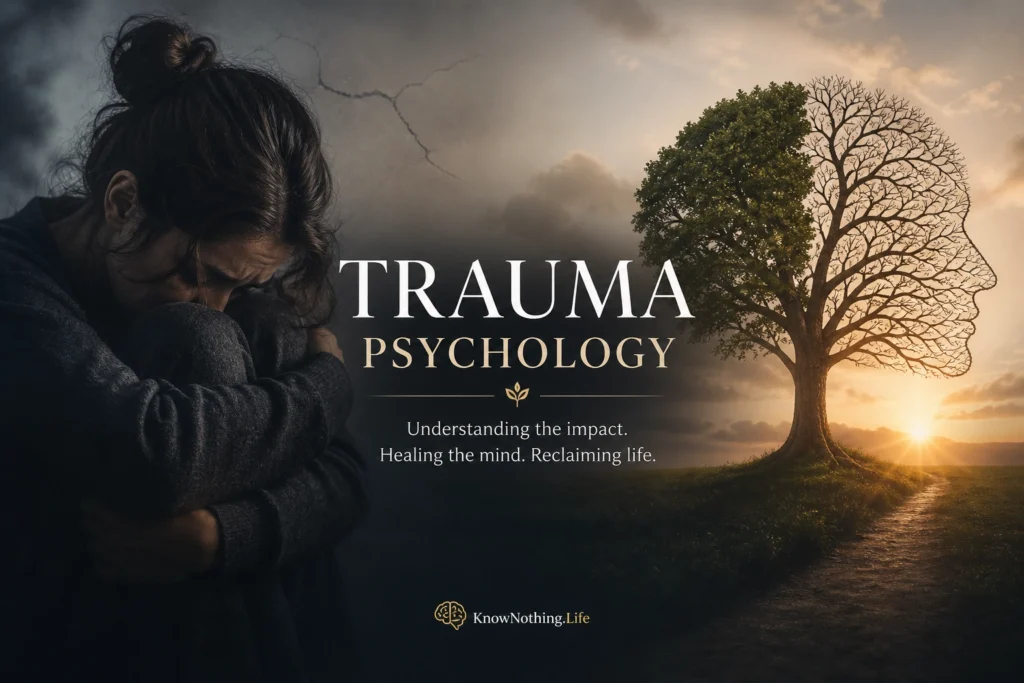
Trauma psychology studies how overwhelming experiences affect the mind, body, memory, identity, relationships, and nervous system. Trauma is not defined only by the event itself, but by the way the event is experienced and processed. Two people may live through similar events and respond differently depending on age, support, prior history, biological sensitivity, meaning, and available resources. A traumatic experience is typically one that exceeds a person’s capacity to cope, leaving the nervous system in a state of threat, helplessness, or fragmentation. Trauma may arise from war, abuse, neglect, assault, disaster, medical crisis, sudden loss, violence, racism, displacement, or prolonged exposure to danger and humiliation.
The field draws from clinical psychology, psychiatry, neuroscience, attachment theory, developmental psychology, and social theory. Thinkers such as Sigmund Freud, Pierre Janet, John Bowlby, Judith Herman, Bessel van der Kolk, Peter Levine, Francine Shapiro, and Bruce Perry have shaped modern understanding of trauma. Herman’s Trauma and Recovery remains one of the most influential works because it connects individual trauma to social power, captivity, and recovery through safety, remembrance, and reconnection. Van der Kolk’s The Body Keeps the Score popularized the idea that trauma is held not only in memory but in bodily states, threat responses, and patterns of emotional regulation. Trauma psychology therefore examines not only what happened, but what remains unresolved in the person’s body, mind, and world.
Defining Trauma
Trauma can be acute, chronic, complex, developmental, collective, or intergenerational. Acute trauma refers to a single overwhelming event, such as an assault, accident, natural disaster, or sudden violent loss. Chronic trauma involves repeated exposure to distressing events, such as domestic violence, ongoing bullying, war, or repeated medical procedures. Complex trauma usually refers to prolonged interpersonal trauma, especially when it occurs in conditions where escape is difficult and the victim depends on the person or system causing harm. Developmental trauma occurs when overwhelming stress affects a child during crucial stages of emotional and neurological growth.
Judith Herman emphasized that trauma is often connected to powerlessness. In Trauma and Recovery, she wrote, “The ordinary response to atrocities is to banish them from consciousness.” This line captures one of trauma’s central paradoxes: the experience is too important to forget, yet often too painful to fully remember. Trauma overwhelms ordinary meaning-making. It can leave the person stuck between intrusion and avoidance, between reliving and numbing, between desperate memory and protective forgetting. Trauma psychology studies this disrupted integration and asks how experience can be transformed from a living wound into a remembered past.
The Brain and Body Under Threat
When a person experiences danger, the body mobilizes for survival. The sympathetic nervous system activates fight or flight responses, increasing heart rate, muscle tension, alertness, and stress hormones. If escape or defense is impossible, the nervous system may shift into freeze, collapse, dissociation, or shutdown. These responses are not signs of weakness. They are survival strategies shaped by biology. The body does what it can to endure the unbearable, often before conscious thought has time to organize a response.
Neuroscience has helped explain why trauma can feel so immediate long after the danger has passed. The amygdala, involved in threat detection, may become highly reactive. The hippocampus, involved in contextual memory, may struggle to place traumatic memories firmly in the past. The prefrontal cortex, involved in reflection and regulation, may become less effective under intense stress. Bessel van der Kolk’s phrase “the body keeps the score” captures the idea that traumatic experience can persist through bodily sensations, startle responses, sleep problems, chronic tension, pain, and emotional reactivity. Trauma is not merely remembered; it is often re-experienced as if danger is still present.
Trauma, Memory, and Dissociation
Traumatic memory often differs from ordinary memory. Normal autobiographical memory tends to have sequence, context, and narrative form. Traumatic memory may be fragmented, sensory, emotional, and intrusive. A sound, smell, posture, location, or tone of voice can trigger a flashback or bodily reaction without the person immediately understanding why. This is because trauma can be encoded under extreme stress, when the brain’s usual systems for organizing memory are disrupted. The result may be memory that returns as image, sensation, panic, or numbness rather than as a coherent story.
Pierre Janet, one of the earliest theorists of dissociation, argued that trauma can divide experience when the mind cannot integrate overwhelming events into ordinary consciousness. Dissociation may involve feeling detached from the body, losing time, becoming emotionally numb, or experiencing the world as unreal. In the moment of trauma, dissociation can protect the person from unbearable pain. Later, however, it may interfere with intimacy, memory, emotional awareness, and self-continuity. Trauma psychology treats dissociation as a meaningful adaptation, not as random pathology. It asks what the mind had to separate in order to survive.
Attachment and Developmental Trauma
Trauma is especially powerful when it occurs in childhood because the developing brain and self are shaped through relationships. John Bowlby’s attachment theory showed that children rely on caregivers for safety, regulation, and a secure base from which to explore the world. When caregivers are protective and responsive, children learn that distress can be soothed and relationships can be trusted. When caregivers are frightening, neglectful, inconsistent, or abusive, the child faces a painful contradiction: the person needed for safety may also be a source of danger.
Developmental trauma can shape emotional regulation, self-worth, trust, boundaries, and identity. Children exposed to chronic fear may become hypervigilant, compliant, aggressive, dissociated, perfectionistic, or emotionally shut down. These patterns often continue into adulthood, not because the person chooses them, but because they were once adaptive. Bruce Perry’s work, including The Boy Who Was Raised as a Dog, emphasizes that trauma affects development according to timing, repetition, and relationship. A child’s brain develops in response to the environment it must survive. Healing therefore often requires safe, consistent relationships that provide new experiences of regulation and trust.
PTSD and Complex Trauma
Post-traumatic stress disorder (PTSD), is one of the best-known trauma-related diagnoses. It commonly involves intrusive memories, nightmares, flashbacks, avoidance, negative changes in mood and belief, emotional numbing, hypervigilance, irritability, sleep disturbance, and exaggerated startle responses. PTSD reflects a nervous system that continues to respond as if the danger has not fully ended. The person may know intellectually that they are safe, yet their body reacts otherwise. This mismatch between present reality and survival memory is one of the defining struggles of trauma.
Complex trauma often involves broader changes in personality, relationships, emotional regulation, and identity. Herman argued that prolonged captivity or domination can produce difficulties beyond classic PTSD, including shame, despair, relational instability, and a damaged sense of self. Complex trauma is common in survivors of childhood abuse, domestic violence, trafficking, torture, cultic abuse, and coercive control. Its effects are not limited to fear memories; they can shape how a person understands love, power, trust, responsibility, and their own worth. Treatment must therefore address not only symptoms, but the person’s whole system of meaning and relationship.
Trauma, Shame, and Identity
Trauma often leaves shame behind, especially when the harm involved humiliation, betrayal, abuse, or social judgment. Shame differs from guilt. Guilt says, “I did something wrong.” Shame says, “Something is wrong with me.” Survivors may blame themselves for freezing, not escaping, staying silent, returning to an abuser, or feeling confused afterward. Trauma psychology recognizes that these reactions must be understood through survival responses, dependency, fear, coercion, and nervous system overwhelm. What looks irrational from outside may have been the only available strategy at the time.
Trauma can also disrupt identity. A survivor may feel divided between who they were before and who they became afterward. They may feel contaminated, weak, permanently unsafe, or separate from ordinary life. Janoff-Bulman’s work on “shattered assumptions” helps explain this identity rupture. Trauma can break basic beliefs that the world is safe, people are trustworthy, and the self has control. Recovery often requires rebuilding these assumptions in a more mature form—not naive safety, but realistic trust; not total control, but agency; not innocence, but meaning after harm.
Social Context and Collective Trauma
Trauma is not only individual. Communities can be traumatized by war, genocide, slavery, colonization, forced migration, terrorism, natural disasters, poverty, political repression, and systemic violence. Collective trauma affects shared memory, cultural identity, trust in institutions, and intergenerational patterns of fear or silence. Individual symptoms may therefore reflect broader historical wounds. A person’s trauma may be personal, but the conditions that produced it can be social and political.
Herman insisted that trauma recovery has a social dimension because violence often depends on secrecy, denial, and power. Public acknowledgment matters. Survivors need not only private healing but also recognition that what happened was real and wrong. This is especially important in cases of abuse, war, racial violence, and institutional betrayal. Trauma psychology therefore intersects with justice, culture, and ethics. Healing is easier when the survivor is not forced to carry the truth alone.
Treatment and Trauma Recovery
Trauma treatment usually begins with safety and stabilization. Before deeply processing traumatic memory, many people need skills for grounding, emotional regulation, sleep, bodily awareness, and crisis management. Herman described recovery in three broad stages: safety, remembrance and mourning, and reconnection. This model remains influential because it respects the pacing of trauma work. Survivors should not be pushed into detailed memory processing before they have enough stability and support to tolerate it.
Several evidence-based and widely used approaches address trauma from different angles. Cognitive processing therapy helps survivors challenge trauma-related beliefs about guilt, danger, and self-blame. Prolonged exposure therapy helps reduce avoidance by safely revisiting traumatic memories and situations. EMDR, developed by Francine Shapiro, uses bilateral stimulation while processing distressing memories and has become a major trauma treatment. Somatic approaches, including Peter Levine’s Waking the Tiger, emphasize body awareness and the completion of survival responses. No single therapy fits everyone, but effective trauma treatment helps the person integrate what happened without being continually ruled by it.
Resilience, Post-Traumatic Growth, and Meaning
Trauma can cause deep suffering, but human beings are also capable of resilience. Resilience does not mean being unaffected. It means adapting, seeking support, rebuilding functioning, and finding ways to live after harm. Protective factors include safe relationships, emotional validation, stable housing, cultural belonging, therapy, spirituality, community, physical health, and meaningful activity. Recovery is not forgetting the trauma. It is changing the relationship to it so that it becomes part of one’s history rather than the center of one’s life.
Some people also experience post-traumatic growth, a term associated with Richard Tedeschi and Lawrence Calhoun. This does not mean trauma is good or necessary. It means that, after suffering, some people develop deeper relationships, changed priorities, spiritual insight, increased compassion, or a stronger sense of personal strength. Viktor Frankl’s Man’s Search for Meaning is often cited in this context because it emphasizes meaning as a human response to suffering. Growth should never be demanded from survivors, but it can be honored when it emerges. The goal of trauma recovery is not to justify what happened, but to reclaim life from its aftermath.
Conclusion
Trauma psychology reveals that overwhelming experiences can alter memory, emotion, identity, relationships, and the body’s sense of safety. Trauma is not simply a bad memory. It is a disruption in the systems that help people regulate fear, trust others, understand themselves, and place the past in the past. Its effects may appear as flashbacks, numbness, hypervigilance, shame, dissociation, avoidance, anger, depression, or relational difficulty. These responses are not signs of personal failure. They are often survival adaptations that outlived the danger that created them.
The study of trauma is also a study of recovery. Because trauma affects the brain, body, and relationships, healing must involve more than insight alone. It requires safety, regulation, memory integration, connection, meaning, and often social acknowledgment. Trauma changes people, but it does not have to define the whole of life. With support, treatment, and time, survivors can move from being organized around threat to being organized around agency, connection, and possibility. Trauma psychology matters because it explains suffering without reducing people to damage—and because it shows that even after profound harm, healing remains possible.