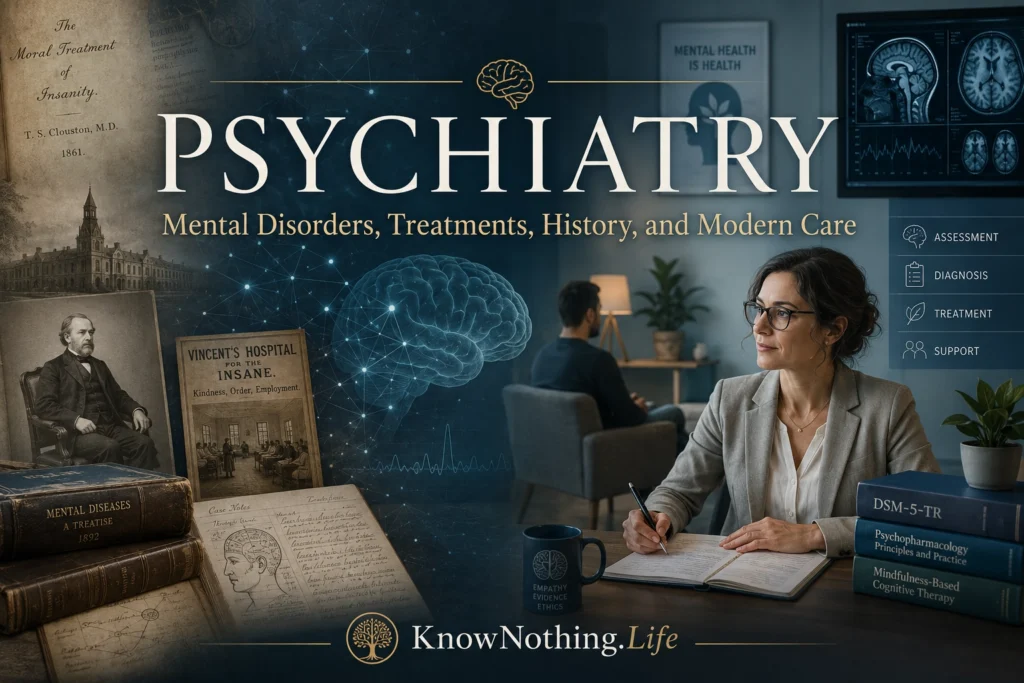
Psychiatry is the branch of medicine devoted to understanding, diagnosing, treating, and preventing mental disorders. It deals with disturbances of mood, thought, perception, behavior, memory, impulse control, identity, sleep, and relationships. Unlike many medical specialties, psychiatry stands directly at the intersection of biology and lived experience. A psychiatrist may treat depression, schizophrenia, bipolar disorder, anxiety disorders, trauma-related disorders, eating disorders, substance use disorders, personality disorders, and neurodevelopmental conditions, but these conditions cannot be understood through the brain alone. They also involve personal history, family life, social stress, culture, meaning, and the patient’s own account of suffering.
The field has always wrestled with a difficult question: what does it mean for the mind to be ill? Karl Jaspers, in General Psychopathology, argued that psychiatry must combine explanation and understanding. Explanation seeks causes, mechanisms, and patterns; understanding seeks the inner meaning of experience. This distinction remains central. Psychiatry is strongest when it does not reduce a person to symptoms, chemicals, childhood history, or social forces alone. It asks how brain, body, memory, environment, relationship, and meaning come together in the form of mental suffering.
The Historical Roots of Psychiatry
The history of psychiatry begins long before modern medicine. Ancient cultures often interpreted madness through spiritual, moral, or supernatural frameworks, but Greek medicine introduced a naturalistic view. The Hippocratic text On the Sacred Disease argued that epilepsy was not divine punishment but a natural condition, challenging supernatural explanations of abnormal behavior. Although ancient humoral theory is no longer scientifically valid, it marked an important shift: mental disturbance could be investigated as part of the human body and its conditions.
Modern psychiatry developed through reform, classification, and clinical observation. Philippe Pinel, associated with moral treatment, argued that people with mental illness should be treated with care rather than cruelty. His Treatise on Insanity helped establish observation and humane management as medical responsibilities. Emil Kraepelin later transformed psychiatric classification by organizing disorders according to symptom patterns, course, and outcome. His distinction between dementia praecox and manic-depressive illness shaped later ideas of schizophrenia and bipolar disorder. Kraepelin’s work gave psychiatry a diagnostic structure, though later thinkers would criticize the limits of rigid categories.
Psychiatry as Medicine of Mind and Brain
Psychiatry is medical because mental disorders are deeply connected to the brain and body. Depression can alter sleep, appetite, movement, pain, concentration, and energy. Anxiety can produce racing heart, dizziness, chest tightness, nausea, and trembling. Psychosis can disturb perception, belief, language, and reality testing. Bipolar disorder can transform sleep need, energy, confidence, judgment, and impulse control. These conditions show that mental illness is not imaginary or merely a weakness of attitude. It is embodied suffering.
At the same time, psychiatry cannot be reduced to brain chemistry. George Engel’s biopsychosocial model, presented in “The Need for a New Medical Model,” remains one of the most important frameworks in the field. Engel argued that medicine must consider biological, psychological, and social dimensions together. In psychiatry, this is essential. A panic disorder may involve genetic vulnerability, nervous-system arousal, catastrophic thinking, work stress, avoidance habits, and childhood insecurity. A good psychiatric formulation looks beyond the diagnosis and asks how the whole pattern developed.
Diagnosis and Classification
Psychiatric diagnosis helps clinicians organize symptoms, communicate clearly, guide treatment, and conduct research. Manuals such as the Diagnostic and Statistical Manual of Mental Disorders and the International Classification of Diseases provide shared language for conditions such as major depressive disorder, schizophrenia, generalized anxiety disorder, obsessive-compulsive disorder, and post-traumatic stress disorder. Diagnosis can be relieving for patients because it gives a name to suffering that may have felt confusing, shameful, or isolating.
Yet diagnosis is also controversial. Most psychiatric conditions do not have simple blood tests or brain scans that confirm them in ordinary clinical practice. Diagnosis often depends on reported experience, observed behavior, duration, distress, impairment, and clinical judgment. Thomas Szasz, in The Myth of Mental Illness, criticized psychiatry for medicalizing problems in living. Many psychiatrists reject his strongest claims because severe mental illness is real and often devastating, but his critique remains a warning. A diagnosis should be a tool for understanding and care, not a label that erases individuality.
Medication and Psychopharmacology
Psychiatric medication is one of the most visible parts of modern treatment. Antidepressants, mood stabilizers, antipsychotics, stimulants, anti-anxiety medications, and medications for substance use disorders can reduce suffering and restore functioning. Lithium remains one of the most important treatments for bipolar disorder. Antipsychotic medications can reduce hallucinations, delusions, and disorganized thinking. Antidepressants may help with depression, panic, obsessive-compulsive symptoms, and trauma-related anxiety. For many people, medication makes sleep, work, therapy, and relationships possible again.
Medication, however, is not the whole of psychiatry. Benefits vary, side effects matter, and symptoms often exist within complicated lives. The psychiatrist’s task is not simply to prescribe, but to listen, monitor, explain, adjust, and collaborate. Medication can reduce the intensity of suffering, but recovery may also require therapy, social support, grief work, trauma treatment, exercise, sleep repair, addiction care, purpose, and practical changes in the person’s environment.
Psychotherapy and the Talking Cure
Psychotherapy has always been central to psychiatry, even as biological treatments have expanded. Sigmund Freud and Josef Breuer’s Studies on Hysteria introduced the phrase “talking cure,” originally associated with their patient Anna O. Freud’s psychoanalysis emphasized unconscious conflict, childhood experience, dreams, repression, defense mechanisms, and the therapeutic relationship. Although many of Freud’s specific theories have been revised or rejected, his central insight remains influential: symptoms may carry meaning, and speaking in a therapeutic relationship can change the inner life.
Modern psychiatry includes many forms of psychotherapy. Aaron Beck’s cognitive therapy showed how depression and anxiety can be maintained by automatic thoughts, distorted interpretations, and negative core beliefs. Marsha Linehan’s dialectical behavior therapy combines acceptance, mindfulness, emotion regulation, distress tolerance, and behavioral change, especially for people with chronic emotional instability and self-harm. Psychodynamic therapy, interpersonal therapy, family therapy, trauma-focused therapy, and group therapy all continue to matter. Psychiatry is most complete when it understands that words, relationships, habits, and meanings can be as clinically important as medication.
Severe Mental Illness and Human Dignity
Psychiatry often treats conditions that can profoundly disrupt a person’s life. Schizophrenia, bipolar disorder, severe depression, catatonia, addiction, and life-threatening eating disorders can interfere with perception, judgment, safety, work, relationships, and self-care. A person in psychosis may hear voices or believe they are being persecuted. A person in mania may feel invincible, sleep very little, spend recklessly, or act with dangerous impulsivity. A person with severe depression may lose the ability to imagine a future.
The ethical demand of psychiatry is to treat serious illness without destroying dignity. Historically, people with mental illness have often been confined, mocked, hidden, overmedicated, or stripped of autonomy. Erving Goffman’s Asylums criticized psychiatric institutions as “total institutions” that could reshape identity through control and dependency. His critique remains relevant. Hospitalization and involuntary care may sometimes be necessary for safety, but they must be used carefully. The patient is not merely a risk, diagnosis, or chart. The patient is a person whose suffering requires skillful care and moral respect.
Psychiatry, Culture, and Society
Mental illness is always experienced within culture. Arthur Kleinman’s work in cultural psychiatry emphasized “explanatory models,” the beliefs patients and families hold about what caused illness, what it means, and how it should be treated. One person may understand depression as a medical illness, another as spiritual emptiness, another as family failure, another as trauma, and another as exhaustion from social pressure. If psychiatry ignores these meanings, treatment may fail even when technically correct.
Society also shapes mental health. Poverty, racism, isolation, unemployment, war, abuse, discrimination, housing instability, and community violence can all intensify psychiatric suffering. Frantz Fanon, a psychiatrist and political thinker, explored the psychological effects of racism and colonial domination in Black Skin, White Masks and The Wretched of the Earth. His work reminds psychiatry that suffering is not always located only inside the individual. Sometimes the world itself is injuring the mind.
Criticism and Reform
Psychiatry has a difficult history, and responsible psychiatry must acknowledge it. The field has been associated with coercive treatment, harmful institutionalization, diagnostic bias, overmedication, and pathologizing social difference. Homosexuality was once classified as a mental disorder in the DSM, a clear example of how prejudice can enter medical authority. Critics such as Michel Foucault, R. D. Laing, and Thomas Szasz challenged psychiatry’s power to define madness, normality, and deviance.
These critiques do not erase the reality of mental illness, but they do demand humility. Foucault’s Madness and Civilization argued that societies define and confine madness in ways shaped by power. Laing’s The Divided Self tried to understand psychosis as meaningful experience rather than mere defect. Their strongest claims remain debated, but their warning is valuable: psychiatry must never confuse authority with truth. Humane psychiatry requires science, compassion, consent, cultural awareness, and respect for patient voice.
Contemporary Psychiatry
Contemporary psychiatry is shaped by neuroscience, genetics, psychopharmacology, trauma research, sleep science, psychotherapy research, and social medicine. Researchers study neural circuits involved in mood, reward, fear, memory, salience, attention, and self-regulation. Neuroplasticity has helped dissolve the false divide between biological and psychological treatment, because experience itself changes the brain. Therapy, medication, relationships, stress, learning, and trauma all leave biological traces.
Still, neuroscience has not solved psychiatry. Brain scans are useful in research and in ruling out some medical conditions, but they usually cannot diagnose ordinary depression, anxiety, schizophrenia, or personality disorders by themselves. The future of psychiatry will likely become more personalized, combining biological data, symptom patterns, life history, culture, and patient goals. Digital tools, telepsychiatry, AI-assisted care, psychedelic-assisted therapy, ketamine treatment, and recovery-oriented models may expand possibilities, but the heart of psychiatry will remain the clinical encounter between a suffering person and a trained listener.
Final Thoughts on Psychiatry
Psychiatry matters because mental suffering can be as serious, disabling, and life-threatening as physical illness. It can distort reality, crush hope, damage relationships, impair judgment, and make ordinary life feel impossible. At its best, psychiatry offers more than diagnosis or medication. It offers a disciplined attempt to understand the whole person: brain, body, history, culture, relationships, symptoms, and meaning.
The major figures in psychiatry reveal both the field’s promise and its danger. Pinel represents humane reform; Kraepelin represents clinical classification; Freud represents the depth of inner life; Jaspers represents the need to understand subjective experience; Engel represents the biopsychosocial model; Beck and Linehan represent evidence-based psychotherapy; Goffman, Foucault, Szasz, Laing, Kleinman, and Fanon remind psychiatry to examine power, culture, institutions, and dignity. Psychiatry is not merely the medicine of mental disorders. It is the medical discipline that confronts human suffering where biology, consciousness, society, and personal meaning meet.