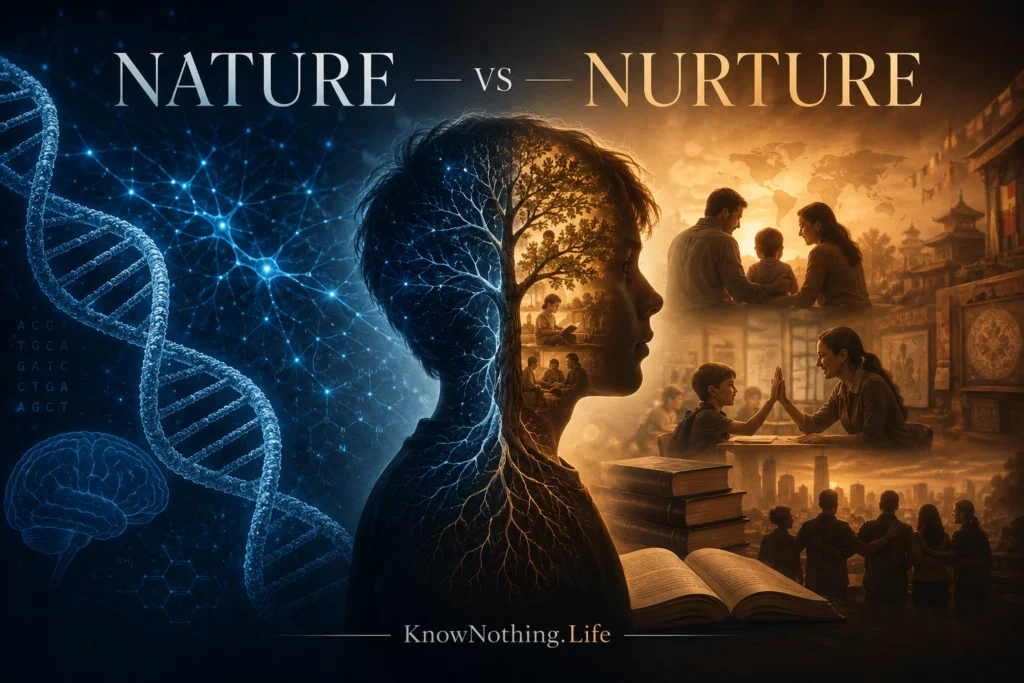
The debate over nature vs nurture asks one of the oldest and most important questions in psychology, philosophy, education, and human development: are people shaped more by their biological inheritance or by the environments in which they are raised? “Nature” refers to the genetic, biological, and evolutionary factors that influence human traits, while “nurture” refers to family life, culture, education, social experience, nutrition, trauma, opportunity, and the countless environmental forces that shape development. The phrase is often presented as a battle between two opposing explanations, but modern science has largely moved beyond that simple opposition. Human beings are not written entirely by DNA, nor are they blank pages written entirely by society. They are living organisms whose inherited potentials unfold through experience.
The most accurate answer is not nature or nurture, but nature through nurture. Genes influence temperament, intelligence, vulnerability to disease, personality, and behavior, but genes do not operate in isolation. They require environments to activate, suppress, strengthen, redirect, or limit their effects. Likewise, environments do not shape all people in the same way because individuals bring different biological sensitivities, temperaments, and predispositions into every situation. A strict nature-versus-nurture argument asks which side wins; a deeper understanding asks how inherited tendencies and lived experience continuously interact across a lifetime.
The Historical Roots of the Debate
The modern wording of the debate is closely associated with Francis Galton, a Victorian scientist and cousin of Charles Darwin. In English Men of Science: Their Nature and Nurture (1874), Galton used the phrase to separate inherited qualities from environmental influences. He described “nature and nurture” as a convenient way to divide the forces that compose personality, writing that nature is what a person brings into the world, while nurture is what affects him after birth. Galton’s work helped establish heredity as a serious subject of scientific investigation, but it also carried dangerous assumptions that later fed into eugenic thinking, making his legacy both historically important and ethically troubling.
On the opposite side of the early modern debate stood behaviorists such as John B. Watson, whose 1913 manifesto, “Psychology as the Behaviorist Views It,” argued that psychology should study observable behavior rather than inner mental life. Watson later made one of the most famous nurture-centered claims in psychology, saying that with “a dozen healthy infants” and control over their world, he could train any one of them to become almost any kind of specialist. He admitted he was “going beyond my facts,” but the statement captured the extreme environmental confidence of early behaviorism.
The Case for Nature
The case for nature rests on the observation that human beings are born with biological differences that matter. Infants differ in activity level, emotional reactivity, attention, sociability, and sensitivity long before parents, schools, or culture have had years to mold them. Some children are cautious, some bold; some are easily soothed, while others react intensely to stress. These early temperamental differences do not determine destiny, but they influence how children experience the world and how the world responds to them. A naturally anxious child may seek less novelty, receive more protection, and develop habits that reinforce caution. A highly outgoing child may receive more social feedback, take more risks, and build confidence through repeated interaction.
Behavioral genetics strengthened the nature side by showing that many psychological traits are partly heritable. The Minnesota Study of Twins Reared Apart, led by Thomas J. Bouchard Jr. and colleagues, became one of the most influential studies in this field. Published in Science in 1990, it examined twins separated early in life and raised in different homes. The researchers reported that about 70 percent of the variance in IQ among the studied twins was associated with genetic variation, and that identical twins reared apart were often strikingly similar in personality, interests, and attitudes.
This does not mean genes are destiny. Heritability describes variation within a population, not the fixed fate of an individual. A trait can be highly heritable and still be changed by environment. Height, for example, is strongly influenced by genes, but nutrition, illness, and living conditions also affect how tall a person becomes. The same logic applies to intelligence, personality, mental health, and behavior. Genes create probabilities, sensitivities, and ranges of possibility; they do not write a complete biography.
The Case for Nurture
The case for nurture begins with the obvious power of experience. Language, religion, manners, political beliefs, education, diet, skills, fears, ambitions, and moral values are all shaped heavily by the social world. A child born with the capacity for language will speak English, Spanish, Mandarin, Arabic, or another language depending on the environment into which that child is born. Human nature may provide the ability to learn language, but nurture supplies the words, meanings, grammar, accents, and cultural context. This is one of the clearest examples of how biology creates capacity while environment shapes content.
Developmental psychology has repeatedly shown that early environments matter. Secure attachment, emotional responsiveness, stimulation, nutrition, safety, and education influence later development. Thinkers such as John Locke, who famously compared the mind to a tabula rasa, or blank slate, emphasized the formative power of experience. Later, behaviorists such as Watson and B. F. Skinner argued that behavior could be shaped through conditioning, reinforcement, and punishment. Skinner’s Science and Human Behavior presented human action as deeply shaped by environmental consequences, especially rewards and punishments.
Nurture is especially visible in cases of deprivation. Children raised without adequate language exposure, emotional care, nutrition, or safety may suffer long-term developmental consequences. Poverty, chronic stress, violence, discrimination, poor schooling, and lack of medical care can all limit human potential. These environmental forces do not erase biology, but they can powerfully influence whether biological capacities flourish or remain underdeveloped. A child may inherit strong cognitive potential, but without literacy, encouragement, health, and opportunity, that potential may never fully appear.
Gene-Environment Interaction
Modern science no longer treats nature and nurture as separate forces stacked on opposite sides of a scale. Instead, it studies gene-environment interaction, meaning that genes and environments influence each other. A person’s genetic tendencies can affect the kinds of environments they seek, evoke, and respond to. A musically inclined child may practice more, attract encouragement from teachers, and choose friends with similar interests. An impulsive child may evoke stricter discipline, take greater risks, or enter situations that amplify the original tendency. In this way, nature can help shape nurture.
Psychologist Eric Turkheimer summarized behavioral genetics in his influential article “Three Laws of Behavior Genetics and What They Mean” (2000). His first law states that all human behavioral traits are heritable; the second says the effect of being raised in the same family is smaller than the effect of genes; the third says a substantial portion of behavioral variation is not explained by genes or shared family environment. These laws challenged both extreme environmentalism and simplistic genetic determinism.
The third law is especially important because it points to nonshared environment: experiences that make siblings different even when they grow up in the same household. Two children may have the same parents but different peer groups, teachers, illnesses, friendships, birth order experiences, private interpretations, and random life events. A single household is not one identical environment. Each child experiences family life through a different temperament, developmental stage, and social position. This helps explain why siblings can be surprisingly different even when they share both genes and home.
Nature, Nurture, and Personality
Personality is one of the clearest examples of nature and nurture working together. Traits such as extraversion, neuroticism, openness, conscientiousness, and agreeableness show meaningful genetic influence, but they are also shaped by culture, family expectations, peer relationships, education, and life experience. A naturally introverted child may become socially confident in a supportive environment, while an extraverted child may become guarded after repeated rejection or trauma. Biology may influence the starting point, but experience helps shape the final pattern.
The nature-nurture question also appears in mental health. Conditions such as depression, anxiety, schizophrenia, bipolar disorder, and addiction often involve genetic vulnerability, but vulnerability is not the same as inevitability. Stress, trauma, social support, sleep, substance use, poverty, therapy, and medication can all influence whether a predisposition becomes a disorder. A person may inherit a higher risk for anxiety, for example, but that risk can be intensified by chronic stress or reduced by secure relationships, coping skills, and treatment.
This interaction is why modern psychology prefers risk models over simple causes. Few complex human traits come from a single gene or a single experience. Most emerge from many genes, many environments, and many developmental moments. Robert Plomin, one of the leading figures in behavioral genetics and author of Blueprint: How DNA Makes Us Who We Are, has argued that DNA plays a major role in psychological individuality, but even strong genetic influence does not eliminate the importance of environment, chance, or personal development.
The Ethical Importance of the Debate
The nature vs nurture debate has serious ethical consequences. If society overemphasizes nature, it may excuse inequality as biologically inevitable or reduce people to inherited traits. This danger is visible in the history of eugenics, racial hierarchy, and deterministic interpretations of intelligence or behavior. Galton’s work helped develop statistical tools and heredity research, but it also contributed to ideas that were later used to justify coercive and discriminatory policies. Any serious discussion of heredity must therefore be careful, humble, and morally alert.
If society overemphasizes nurture, it may create a different kind of injustice. Parents may be blamed too heavily for every outcome, individuals may be treated as infinitely moldable, and biological differences may be ignored even when they matter. Children with learning disabilities, neurodevelopmental differences, mental health vulnerabilities, or unusual temperaments may be misunderstood if every difficulty is explained only as poor parenting, bad teaching, or lack of effort. A balanced view recognizes both responsibility and limitation.
The most humane position is neither fatalistic nor naïve. Biology matters, but it does not cancel freedom, education, therapy, culture, or moral responsibility. Environment matters, but it does not make all people interchangeable. A good society should use knowledge of both nature and nurture to expand opportunity, reduce preventable harm, and respect individual differences. The purpose of understanding heredity should not be to rank human worth, but to better support human development.
Final Thoughts
Nature and nurture are not rival authors competing to write the story of a human life. They are co-authors, editors, and translators working at the same time. Genes influence how people grow, but environments influence how genes are expressed. Families, schools, cultures, hardships, opportunities, and choices all shape the person who emerges. The old question asked whether heredity or environment mattered more; the modern answer is that neither can be understood without the other.
The deepest lesson of the nature vs nurture debate is that human beings are both rooted and unfinished. We are born with biological tendencies, but we develop through relationship, culture, learning, and experience. We inherit possibilities, not completed selves. Nature gives the organism; nurture gives the world in which that organism becomes a person.