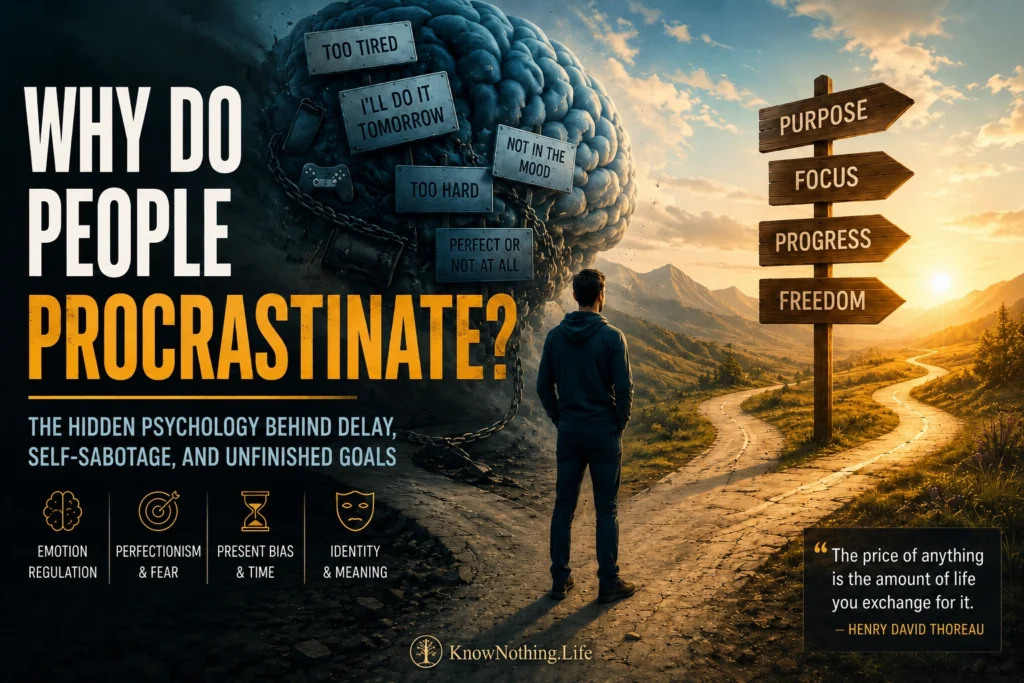
Procrastination is one of the most familiar forms of self-defeat. A person knows what needs to be done, understands that delay will probably make life harder, and still avoids the task. The student postpones the paper until panic becomes the only fuel. The worker delays an email because it feels uncomfortable. The artist avoids the blank page because beginning might expose inadequacy. The person who wants a healthier life says “tomorrow” until tomorrow becomes a way of living. Procrastination is not simply laziness. Laziness implies unwillingness to act. Procrastination is more conflicted: the person often wants to act, intends to act, and feels guilty for not acting.
Psychologist Piers Steel defines procrastination as voluntarily delaying an intended course of action despite expecting to be worse off for the delay. That definition captures the irrational core of the problem. Procrastination is not strategic waiting, rest, reflection, or choosing a better time. It is delay against one’s own judgment. This is why procrastination causes so much shame. The procrastinator is not ignorant of the task. They are painfully aware of it. The task follows them around mentally, draining attention, creating dread, and turning free time into a guilty half-rest.
The Ancient Problem of Akrasia
Long before modern psychology, philosophers recognized procrastination as part of a broader human weakness called akrasia: acting against one’s better judgment. Aristotle explored akrasia in the Nicomachean Ethics, asking how a person can know the good and still fail to do it. His answer involved conflict between reason, appetite, habit, and character. Human beings do not act from knowledge alone. They act from trained desire, emotional readiness, and the strength or weakness of practical judgment. In procrastination, reason says “begin,” but emotion says “not yet.”
Plato also understood the divided self. In Phaedrus, he compares the soul to a charioteer trying to guide two horses, one noble and one unruly. The metaphor applies perfectly to procrastination. One part of the mind sees the long-term good: finish the work, make the call, start the application, clean the room, confront the problem. Another part seeks immediate relief: check the phone, make a snack, reorganize the desk, wait until the mood improves. Procrastination is not the absence of will. It is a conflict of wills inside the same person.
Procrastination as Emotion Regulation
Modern psychology increasingly sees procrastination as an emotion-regulation problem, not merely a time-management problem. Timothy Pychyl, author of Solving the Procrastination Puzzle, argues that procrastination is a way of prioritizing short-term mood repair over long-term goals. The task may be boring, difficult, ambiguous, threatening, or emotionally loaded. Avoiding it produces immediate relief. That relief rewards the avoidance, making procrastination more likely next time.
This explains why planners, apps, and schedules often fail. The problem is not always that the person lacks a calendar. The problem is that the task produces aversive emotion: anxiety, boredom, resentment, confusion, fear of failure, fear of success, or shame. When the person avoids the task, they are not choosing happiness; they are choosing temporary emotional escape. Unfortunately, the task usually returns with interest. The relief fades, and the person now faces the original work plus guilt, time pressure, and damaged self-trust.
Fear of Failure and Perfectionism
Many people procrastinate because beginning threatens their self-image. If the project remains imaginary, it can remain perfect. Once started, it becomes measurable, flawed, and vulnerable to judgment. Perfectionism often disguises itself as high standards, but in procrastination it frequently becomes fear. The person says, “I work better under pressure,” when the deeper truth may be, “I am afraid to find out what I can do without an excuse.” Waiting until the last minute creates a built-in explanation for imperfect results.
This is connected to self-handicapping, a concept studied in social psychology. A person may create obstacles so that failure can be blamed on the obstacle rather than ability. If the paper is poor, the procrastinator can say, “I only had one night.” If the business idea fails, they can say, “I never really had time.” This protects self-esteem in the short term but blocks growth. Real improvement requires contact with reality. Procrastination protects the fantasy self while starving the actual self.
Time, Reward, and the Present Bias
Procrastination is also a problem of time perception. Human beings are biased toward immediate rewards and immediate relief. A distant deadline does not feel emotionally real until it approaches. Behavioral economists call this present bias or hyperbolic discounting: future costs and rewards are discounted compared with present feelings. This is why a person can sincerely intend to work later and still choose distraction now. The future self is treated almost like another person who will somehow be stronger, calmer, and more disciplined.
Piers Steel’s temporal motivation theory helps explain this pattern. Motivation rises when expectancy and value are high, and falls when delay and impulsiveness are high. In plain language, people are more likely to act when they believe they can succeed, care about the outcome, feel the deadline approaching, and are not surrounded by tempting alternatives. A vague, difficult task with a distant reward is a perfect breeding ground for procrastination. A clear, immediate, meaningful task is easier to begin.
The Role of Identity and Meaning
Not all procrastination comes from weakness. Sometimes it signals conflict about meaning. A person may delay because the task does not fit their values, because they resent being controlled, or because success would commit them to a life they do not actually want. Existential philosophers such as Søren Kierkegaard and Jean-Paul Sartre were deeply interested in avoidance, anxiety, and self-deception. Sartre’s idea of “bad faith” describes the human tendency to hide from freedom and responsibility by pretending we are more trapped than we are. Procrastination can become a form of bad faith when “I can’t” really means “I do not want to face the choice.”
But procrastination can also hide grief, burnout, or depression. A person who cannot begin may not be morally weak; they may be depleted. In those cases, harsh self-criticism can make the problem worse. The philosophical question is not only “Why am I not disciplined?” but “What truth is my delay protecting me from?” Sometimes the answer is fear. Sometimes it is exhaustion. Sometimes it is the recognition that the task belongs to someone else’s version of life.
What University Studies Show
Research has repeatedly shown that procrastination carries real costs. In a classic longitudinal study, Dianne Tice and Roy Baumeister found that procrastinators initially reported lower stress, but later experienced more stress, more illness, and poorer performance. This fits the lived experience of procrastination: delay may feel good early, but the bill arrives later. Procrastination borrows comfort from the future and charges interest.
Piers Steel’s major meta-analysis in Psychological Bulletin found that strong predictors of procrastination include task aversiveness, task delay, low self-efficacy, impulsiveness, distractibility, disorganization, and lower conscientiousness. Fuschia Sirois and Timothy Pychyl have emphasized procrastination as short-term mood repair, linking it to well-being and emotion regulation. These findings matter because they move procrastination away from moral insult and toward psychological mechanism. People procrastinate not because they are simply lazy, but because they are trying to manage feeling, uncertainty, reward, and self-image.
The Psychological Cost of Procrastination
Procrastination damages more than productivity. It damages self-trust. Each delay teaches the mind that intentions may not be reliable. Over time, the person begins to doubt their own promises: “I know I said I would, but I probably won’t.” That loss of self-confidence can become more painful than the task itself. Procrastination also keeps the nervous system in a state of unfinished threat. The avoided task remains mentally active, producing background stress even during leisure.
There is also a social cost. Procrastination can affect coworkers, partners, classmates, clients, and families. Missed deadlines and last-minute crises often become other people’s emergencies. This can create resentment and shame, especially when the procrastinator has good intentions but poor follow-through. The tragedy is that procrastination often hides sensitivity, fear, or high standards, yet it may look from the outside like carelessness.
Final Thoughts on Why People Procrastinate
People procrastinate because the present self seeks relief from discomfort while the future self is left to pay the price. They procrastinate because tasks feel boring, frightening, unclear, meaningless, or tied to judgment. They procrastinate because of emotion regulation, present bias, perfectionism, low confidence, impulsivity, resentment, burnout, or fear of becoming responsible for their own potential. Philosophy calls this akrasia, bad faith, or weakness of will. Psychology calls it self-regulation failure, mood repair, and temporal discounting. Both traditions point to the same truth: procrastination is a conflict between what we value and what we can tolerate feeling.
The way out begins with honesty. The question is not “Why am I so lazy?” but “What feeling am I avoiding?” Starting small works because it lowers emotional resistance. Clear deadlines help because they make time real. Self-compassion helps because shame often fuels more avoidance. Meaning helps because people endure difficulty more readily when the task matters. Procrastination survives in vagueness, fear, and fantasy. Action begins when the next step becomes small enough, concrete enough, and honest enough to face.