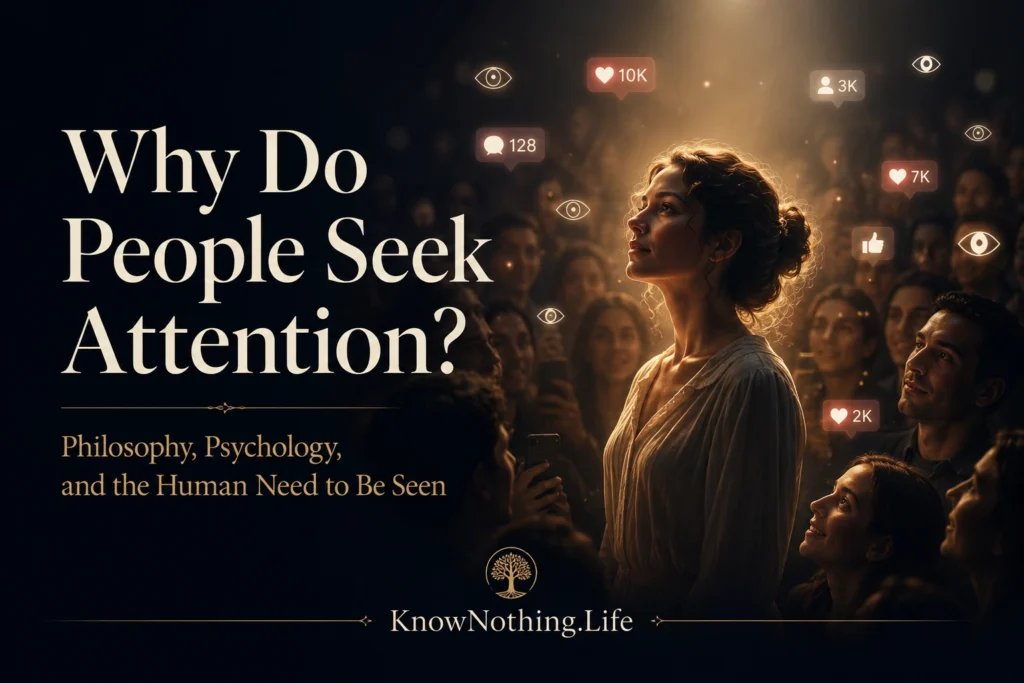
Attention-seeking is often used as an insult, as if the desire to be noticed were automatically shallow, childish, or manipulative. But the need for attention is not a strange defect in human nature. It is one of the basic conditions of social life. From infancy, human beings depend on the attention of others for survival, comfort, learning, and identity. A baby cries because attention brings food, warmth, protection, and connection. A child performs, asks questions, repeats jokes, interrupts, or shows drawings because being noticed confirms that they matter. Adults become more subtle, but the need does not disappear. People still want to be seen, heard, chosen, admired, understood, and remembered.
The problem is not attention itself. The problem is what kind of attention a person seeks, why they seek it, and what they are willing to do to get it. Healthy attention helps people feel connected and recognized. Unhealthy attention-seeking may involve exaggeration, disruption, seduction, victimhood, outrage, constant performance, or emotional crisis used to pull others back toward the self. At its deepest level, attention-seeking is not only about vanity. It is about existence. To be ignored too long can feel like social death. To be noticed can feel, for a moment, like proof that one is real.
The Philosophy of Recognition
Philosophically, the desire for attention is connected to the desire for recognition. Human beings do not only want to exist; they want their existence acknowledged by others. G. W. F. Hegel made recognition central to his account of self-consciousness in Phenomenology of Spirit. His famous struggle for recognition suggests that the self becomes fully aware of itself through relation to another self. We do not form identity in isolation. We come to know ourselves partly through being seen, named, mirrored, resisted, respected, or misrecognized by others.
This idea appears in modern social philosophy as well. Charles Taylor, in “The Politics of Recognition,” argues that recognition is not a courtesy but “a vital human need.” When people are ignored, stereotyped, humiliated, or treated as invisible, their identity can be wounded. Attention-seeking, in this light, is not always a demand for applause. Sometimes it is a demand for recognition after neglect. The person who seems dramatic may be asking, however awkwardly, “Do I matter to you?” The philosophical challenge is that everyone needs recognition, but no one can build a stable self entirely on the gaze of others.
Attention and the Self
William James, in The Principles of Psychology, famously wrote, “Every one knows what attention is.” He described attention as the mind taking possession, “in clear and vivid form,” of one object among many possible objects. Psychologically, attention is selection. To give attention is to say, consciously or not, “This matters right now.” That is why receiving attention feels powerful. It makes the self feel selected out of the background.
Attention also shapes identity. Children learn who they are partly through what adults notice. If a child receives attention only for achievement, they may become performance-driven. If they receive attention only when distressed, they may learn that suffering is the most reliable way to be seen. If they receive attention for beauty, humor, rebellion, helplessness, or anger, those traits may become part of the person’s social strategy. Attention is not neutral. It rewards certain versions of the self and neglects others.
The Need to Belong
One of the strongest psychological explanations for attention-seeking is the need to belong. Roy Baumeister and Mark Leary’s influential 1995 paper, “The Need to Belong,” argued that human beings have a fundamental motivation to form and maintain strong, stable interpersonal relationships. This need is not ornamental. It is tied to survival, emotion, health, and meaning. In ancestral environments, exclusion from the group could be dangerous. In modern life, social exclusion still produces pain, anxiety, shame, and anger.
Attention-seeking can therefore be understood as a bid for belonging. A joke, post, outfit, story, confession, performance, or dramatic gesture may all function as signals: “Look at me. Include me. Respond to me.” Some people seek attention because they are socially confident and expressive. Others seek it because they are insecure and afraid of disappearing. The same outward behavior can come from very different inner states. A person may be loud because they feel powerful, or because silence feels like abandonment.
Insecurity, Shame, and Validation
Many attention-seeking behaviors come from insecurity. When a person lacks stable self-worth, external attention can become emotional oxygen. Compliments, likes, flirtation, admiration, sympathy, or outrage provide temporary relief from emptiness or shame. The problem is that temporary validation fades quickly. The person must seek another dose: another reaction, another audience, another crisis, another proof of desirability or importance.
This creates a cycle. The more a person depends on external attention to feel real or worthy, the more frightening ordinary invisibility becomes. A quiet day feels like rejection. A delayed response feels like abandonment. A lack of praise feels like failure. Psychoanalytic theorists such as Heinz Kohut, founder of self psychology, emphasized the importance of mirroring in the development of the self. When early mirroring is inconsistent or inadequate, a person may later search intensely for affirmation from others. Attention-seeking can be a way of repairing a self that never learned to feel solid from within.
Social Media and the Attention Economy
Modern technology has transformed attention into a measurable public currency. Likes, views, shares, comments, followers, and notifications turn social recognition into numbers. This does not create the human need for attention, but it amplifies it. Social media platforms reward visibility, emotional intensity, beauty, outrage, novelty, confession, and conflict. The person who feels unseen now has a global stage, but also a global scoreboard.
Researchers have described social media as an attention economy, where visibility is unequally distributed and continuously pursued. Online attention can feel rewarding because it gives rapid feedback, but it can also make self-worth unstable. A post that performs well may lift mood; one that is ignored may produce embarrassment or self-doubt. For some people, the platform becomes not just a tool for expression but a mirror they keep checking to see whether they still matter.
Attention-Seeking and Personality
Attention-seeking also appears in personality psychology. Some people are naturally high in extraversion, expressiveness, sensation-seeking, or social dominance, which can make them more comfortable being visible. Others may show attention-seeking patterns linked to insecurity, narcissistic traits, histrionic traits, or anxious attachment. These patterns are different and should not be carelessly lumped together. A performer, teacher, leader, comedian, activist, or artist may seek attention as part of communication and vocation. That is not the same as using attention to manipulate, control, or destabilize others.
Narcissistic attention-seeking often centers on admiration and status. The person wants to be seen as exceptional, superior, beautiful, brilliant, or powerful. Histrionic attention-seeking may involve theatrical emotion, seductiveness, or dramatic expression. Anxious attention-seeking may involve reassurance-seeking, crisis, or fear of abandonment. In all cases, the central question is what the attention is doing psychologically. Is it sharing, connecting, expressing, and creating? Or is it compensating for a fragile self, avoiding shame, or forcing others into emotional labor?
The Social Uses of Attention
Attention-seeking is not always bad. Much human achievement requires the courage to ask for attention. Artists exhibit work. Writers publish. Scientists present discoveries. Leaders speak. Protesters march. Teachers hold a room. Children need adults to notice their growth. Lovers need to feel chosen. Grief needs witnesses. In these cases, attention is not vanity; it is communication. A society without attention would also be a society without recognition, celebration, accountability, or care.
The ethical difference lies in reciprocity. Healthy attention-seeking leaves room for others to exist. It can say, “See me,” without saying, “Only I matter.” Unhealthy attention-seeking consumes the room, punishes neglect, or turns every situation into a stage for the self. The mature person does not stop needing attention. They learn to seek it honestly, give it generously, and survive moments when they are not the center.
The Pain of Being Ignored
To understand attention-seeking, one must also understand the pain of being ignored. Social exclusion activates distress because humans are wired for connection. Being unseen can produce anger, despair, jealousy, or desperation. A neglected child may misbehave because negative attention feels better than no attention. An adult may provoke conflict because conflict at least proves that someone is engaged. In some relationships, attention-seeking is not the beginning of the problem but the symptom of a long absence of attunement.
This does not mean every bid for attention must be indulged. Boundaries matter. But contempt rarely helps. Calling someone “attention-seeking” can become a way to dismiss the need underneath the behavior. A more serious response asks: What kind of attention is being sought? What wound does it point to? What healthier form of recognition could replace it?
Final Thoughts on Why People Seek Attention
People seek attention because attention is one of the ways human beings receive recognition, belonging, safety, value, and identity. Philosophy shows that the self is not formed in isolation; it develops through recognition by others. Psychology shows that attention is tied to attachment, reward, self-esteem, belonging, personality, and emotional regulation. The desire to be seen is not shameful. It is part of being human.
The danger comes when attention becomes a substitute for self-worth, intimacy, responsibility, or truth. A person who depends entirely on attention may become trapped in performance, always needing the next reaction to feel real. But a person who denies the need for attention altogether may become emotionally starved, unseen, and disconnected. The healthier path is not to reject attention, but to humanize it. We need to be seen, and we need to see others. Recognition becomes mature when it is mutual: when the desire to matter does not erase the equal reality of everyone else.